Europe · Southern Europe

Greece

Recipes connected with Greece

Food and eating habits

How people eat in Greece

50 indicators exploring everyday meals, ingredients and food culture. Information is completed progressively from documented evidence.

48 of 50 indicators with documented information

Not all data are comparable: food supply, purchases and intake are different measures. Check the period, population and method for each finding. Qualitative descriptions do not establish percentages or amounts.

Timing and company

7/8
Timing and company — Greece
IndicatorFindings and context
Meal times
Quantitative findingSurvey

Modal clock times in HH.MM format: Before breakfast: 08.00; Breakfast: 08.00; During morning: 10.00; Before lunch: 12.00; Lunch: 14.00; After lunch: 15.00; During afternoon: 18.00; Before dinner: 20.00; Dinner: 21.00; After dinner: 22.00; During evening: 23.00.

Scope, method and limitations
Observation period
1995–2000
Unit
clock time HH.MM; modes, not decimal hours
Population or sample
Greek EPIC participants aged 35–74; historical cohort, not representative of today’s national population.
Geographic scope
Dietary recalls from 1995–2000; one day per participant.
Definition and method
Standardized EPIC-SOFT food and drink interview; water-only occasions excluded.
Comparison limitations
Partial historical coverage:not current habits or a prescribed timetable.One day does not describe individual habits.
Meals per day
Quantitative findingSurvey

Women in the Greek cohort:adjusted mean 5.0 intake occasions/day.Includes meals, snacks and drinks other than water alone.

Scope, method and limitations
Observation period
1995–2000
Unit
intake occasions/day; women adjusted mean
Population or sample
Greek EPIC participants aged 35–74; historical cohort, not representative of today’s national population.
Geographic scope
Dietary recalls from 1995–2000; one day per participant.
Definition and method
Mean adjusted for age and weighted by season and recall day.
Comparison limitations
Partial historical coverage:not current habits or a prescribed timetable.One day does not describe individual habits.
Meal duration Insufficient data in the sources consulted
Daily energy distribution
Quantitative findingObserved intake

Men in the Greek cohort:median later-to-earlier energy-intake ratio 0.71.This compares time windows, not a percentage.

Scope, method and limitations
Observation period
1995–2000
Unit
dimensionless later/earlier energy-intake ratio; men median
Population or sample
Greek EPIC participants aged 35–74; historical cohort, not representative of today’s national population.
Geographic scope
Dietary recalls from 1995–2000; one day per participant.
Definition and method
Energy 15.00–24.00 divided by 06.00–14.00.The authors replace zero denominators with 1 kcal to calculate the ratio.
Comparison limitations
Partial historical coverage:not current habits or a prescribed timetable.One day does not describe individual habits. Does not provide percentage shares for breakfast, lunch, dinner or snacks.
Weekdays and weekends
Quantitative findingSurvey

Daily eating time, hours:minutes; order total, women, men.Monday to Friday:2:04 / 1:58 / 2:10; Saturday and Sunday:2:36 / 2:26 / 2:47. Food management except dish washing, total:0:48 weekdays and 0:49 weekend.

Scope, method and limitations
Observation period
2013–2014
Unit
hours:minutes/day; Monday–Friday versus Saturday–Sunday means
Population or sample
People aged 20–74 living in private households in Greece.
Geographic scope
Fieldwork 2013–2014; 2010 identifies the HETUS wave, not the Greek observation year.
Definition and method
Interviews and diaries for one weekday and one weekend day, harmonised.Main activity only; hours: minutes without conversion.
Comparison limitations
Partial historical coverage of accumulated daily duration: not meal duration, timing or meal count.No division of daily totals or mixing with schoolchildren or the EPIC cohort.
Eating at home and away
Quantitative findingSurvey

24.1% report eating in fast-food restaurants at least once a week.

Scope, method and limitations
Observation period
2018
Unit
percent reporting fast-food restaurant meals weekly
Population or sample
Analytic sample of 3525 students aged 11, 13 and 15 living in Greece.
Geographic scope
Greek HBSC school survey 2018.
Definition and method
Anonymous classroom questionnaires; random cluster sampling, stratified by region and school type.
Comparison limitations
Partial schoolchild coverage:self-reports, not adults or all meals.Sampling logistically excluded the Ionian and North/South Aegean islands; not all regions represented. Not the percentage of meals outside home or a split between restaurants, school and home.
Cooking frequency
Quantitative findingSurvey

Food management excluding dish washing.Order:total, women, men.Mean daily population time:0:48 / 1:21 / 0:12; among participants:1:17 / 1:35 / 0:33. Daily participation:62.2% / 85.5% / 36.7%.

Scope, method and limitations
Observation period
2013–2014
Unit
hours:minutes/day and daily participation percent; separate population and participant means
Population or sample
People aged 20–74 living in private households in Greece.
Geographic scope
Fieldwork 2013–2014; 2010 identifies the HETUS wave, not the Greek observation year.
Definition and method
Interviews and diaries for one weekday and one weekend day, harmonised.Main activity only; hours: minutes without conversion.
Comparison limitations
Partial historical coverage.Food management excludes dish washing; not cooking days/week or dish duration.Population means include nonparticipants; participant means have a different denominator.Harmonised series may differ from national releases.
Eating together
Quantitative findingSurvey

20.2% report eating with family rarely and 79.8% almost every day, using the study’s grouped categories.

Scope, method and limitations
Observation period
2018
Unit
percent of analytic adolescent sample
Population or sample
Analytic sample of 3525 students aged 11, 13 and 15 living in Greece.
Geographic scope
Greek HBSC school survey 2018.
Definition and method
Anonymous classroom questionnaires; random cluster sampling, stratified by region and school type.
Comparison limitations
Partial schoolchild coverage:self-reports, not adults or all meals.Sampling logistically excluded the Ionian and North/South Aegean islands; not all regions represented.

Pantry and recipes

2/2
Pantry and recipes — Greece
IndicatorFindings and context
Most consumed ingredients
Quantitative findingObserved intake

Usual intake medians, men/women, g per person per day: Vegetables excluding potatoes: 203/158; Potatoes: 44/27; Legumes: 17/10; Fruit excluding juices: 75/90; Cereals and products: 223/151; Dairy and products: 181/180; Meat and products: 96/58; Fish, seafood and products: 16/14.

Scope, method and limitations
Observation period
2013–2014
Unit
g/person/day; usual intake medians
Population or sample
Greek residents aged 18 or older. HYDRIA recruited 4011 people; 60 without a dietary recall were excluded from analysis.
Geographic scope
Collection from June 2013 to December 2014; results weighted to the adult population.
Definition and method
Two nonconsecutive 24-hour recalls; usual intake distribution estimated with NCI and weighted for survey design and census. Adult food-group medians selected by sex.
Comparison limitations
Partial coverage: selected food groups, without a complete national ranking. Intake medians, not purchases or supply; neither annualized nor added together. Do not confuse with energy-adjusted means in the same table. Includes under-reporters.
Ingredient prevalence in recipes
Qualitative descriptionRecipe sample

The salad combines tomato, cucumber, onion, feta, olives, oregano, oil and vinegar, with optional capers. Tzatziki combines yogurt, cucumber, garlic, oil, vinegar and salt; instructions add dill. Mousaka combines eggplant, potato, beef, onion, tomato and cinnamon with butter, flour, milk and egg béchamel seasoned with nutmeg.

Scope, method and limitations
Observation period
2026-11-03
Population or sample
Purposive sample of 3 official recipes: Greek salad, Tzatziki and Mousaka.
Geographic scope
Official pages consulted on 2026-11-03; describes only the selected versions.
Definition and method
Denominator: 3 canonical English pages selected for contrasting preparations. Deduplicated by canonical URL, excluding language copies. Ingredients and instructions read separately; dill appears in the tzatziki instructions.
Comparison limitations
Partial qualitative coverage of composition, without prevalence percentages. Does not represent the entire official recipe collection or country; does not measure intake, household frequency or regional uniformity. Not an exhaustive ingredient list for each recipe.

Cereals and plant foods

6/6
Cereals and plant foods — Greece
IndicatorFindings and context
Cereals and cereal products
Quantitative findingPurchases

Rice: 1116.06 g per household per month; Pasta: 2292.35 g per household per month.

Scope, method and limitations
Observation period
2025
Unit
g/household/month
Population or sample
Private households in Greece covered by HBS.
Geographic scope
Mean monthly household purchases; 2025, whole country.
Definition and method
Household budget survey; original seven-digit categories, acquisition code 1, all-households column.
Comparison limitations
Partial indicator coverage: selected products. Purchases, not individual intake; excludes other acquisition modes. Not quantities eaten; categories with different units cannot be added.
Bread
Quantitative findingPurchases

White, corn or semolina bread: 4872.8 g per household per month; Brown, wholegrain, multigrain or rye bread: 1331.91 g per household per month.

Scope, method and limitations
Observation period
2025
Unit
g/household/month
Population or sample
Private households in Greece covered by HBS.
Geographic scope
Mean monthly household purchases; 2025, whole country.
Definition and method
Household budget survey; original seven-digit categories, acquisition code 1, all-households column.
Comparison limitations
Partial indicator coverage: selected products. Purchases, not individual intake; excludes other acquisition modes. Not quantities eaten; categories with different units cannot be added.
Pulses
Quantitative findingPurchases

Lentils: 599.92 g per household per month; Beans: 388.96 g per household per month.

Scope, method and limitations
Observation period
2025
Unit
g/household/month
Population or sample
Private households in Greece covered by HBS.
Geographic scope
Mean monthly household purchases; 2025, whole country.
Definition and method
Household budget survey; original seven-digit categories, acquisition code 1, all-households column.
Comparison limitations
Partial indicator coverage: selected products. Purchases, not individual intake; excludes other acquisition modes. Not quantities eaten; categories with different units cannot be added.
Vegetables
Quantitative findingPurchases

Tomatoes: 2982.72 g per household per month; Cucumbers: 1034.91 g per household per month.

Scope, method and limitations
Observation period
2025
Unit
g/household/month
Population or sample
Private households in Greece covered by HBS.
Geographic scope
Mean monthly household purchases; 2025, whole country.
Definition and method
Household budget survey; original seven-digit categories, acquisition code 1, all-households column.
Comparison limitations
Partial indicator coverage: selected products. Purchases, not individual intake; excludes other acquisition modes. Not quantities eaten; categories with different units cannot be added.
Fruit
Quantitative findingPurchases

Apples: 2119.97 g per household per month; Oranges: 2772.48 g per household per month.

Scope, method and limitations
Observation period
2025
Unit
g/household/month
Population or sample
Private households in Greece covered by HBS.
Geographic scope
Mean monthly household purchases; 2025, whole country.
Definition and method
Household budget survey; original seven-digit categories, acquisition code 1, all-households column.
Comparison limitations
Partial indicator coverage: selected products. Purchases, not individual intake; excludes other acquisition modes. Not quantities eaten; categories with different units cannot be added.
Potatoes, roots and tubers
Quantitative findingPurchases

Fresh potatoes: 5672.69 g per household per month; Sweet potatoes and other starchy roots: 109.37 g per household per month.

Scope, method and limitations
Observation period
2025
Unit
g/household/month
Population or sample
Private households in Greece covered by HBS.
Geographic scope
Mean monthly household purchases; 2025, whole country.
Definition and method
Household budget survey; original seven-digit categories, acquisition code 1, all-households column.
Comparison limitations
Partial indicator coverage: selected products. Purchases, not individual intake; excludes other acquisition modes. Not quantities eaten; categories with different units cannot be added.

Protein foods

5/5
Protein foods — Greece
IndicatorFindings and context
Meat
Quantitative findingPurchases

Fresh or chilled beef and veal: 2333.75 g per household per month; Fresh, chilled or frozen pork: 1875.12 g per household per month; Fresh or chilled poultry: 3260.84 g per household per month.

Scope, method and limitations
Observation period
2025
Unit
g/household/month
Population or sample
Private households in Greece covered by HBS.
Geographic scope
Mean monthly household purchases; 2025, whole country.
Definition and method
Household budget survey; original seven-digit categories, acquisition code 1, all-households column.
Comparison limitations
Partial indicator coverage: selected products. Purchases, not individual intake; excludes other acquisition modes. Not quantities eaten; categories with different units cannot be added.
Fish and seafood
Quantitative findingPurchases

Frozen fish: 239.06 g per household per month; Fresh or chilled shellfish and cephalopods: 80.01 g per household per month; Frozen shellfish and cephalopods: 188.81 g per household per month.

Scope, method and limitations
Observation period
2025
Unit
g/household/month
Population or sample
Private households in Greece covered by HBS.
Geographic scope
Mean monthly household purchases; 2025, whole country.
Definition and method
Household budget survey; original seven-digit categories, acquisition code 1, all-households column.
Comparison limitations
Partial indicator coverage: selected products. Purchases, not individual intake; excludes other acquisition modes. Not quantities eaten; categories with different units cannot be added.
Eggs
Quantitative findingPurchases

Eggs: 19.23 units per household per month.

Scope, method and limitations
Observation period
2025
Unit
units/household/month
Population or sample
Private households in Greece covered by HBS.
Geographic scope
Mean monthly household purchases; 2025, whole country.
Definition and method
Household budget survey; original seven-digit categories, acquisition code 1, all-households column.
Comparison limitations
Partial indicator coverage: selected products. Purchases, not individual intake; excludes other acquisition modes. Not quantities eaten; categories with different units cannot be added.
Milk and dairy products
Quantitative findingPurchases

Fresh whole milk, including long-life: 3735.06 ml per household per month; Fresh reduced-fat or fat-free milk, including sour and long-life: 2771.99 ml per household per month; Soft cheeses, combined category: 1431.13 g per household per month; Hard cheeses, combined category: 955.98 g per household per month; Full-fat or reduced-fat yogurt: 1670.36 g per household per month.

Scope, method and limitations
Observation period
2025
Unit
ml or g/household/month; product-specific
Population or sample
Private households in Greece covered by HBS.
Geographic scope
Mean monthly household purchases; 2025, whole country.
Definition and method
Household budget survey; original seven-digit categories, acquisition code 1, all-households column.
Comparison limitations
Partial indicator coverage: selected products. Purchases, not individual intake; excludes other acquisition modes. Not quantities eaten; categories with different units cannot be added.
Protein sources
Quantitative findingObserved intake

Total protein by origin: men, animal 59 %, plant 39 %, unknown 2 %; women, animal 59 %, plant 39 %, unknown 3 %.

Scope, method and limitations
Observation period
1995–2000
Unit
percent of total dietary protein
Population or sample
Greek EPIC sample: 1311 men and 1373 women aged 35–74.
Geographic scope
EPIC calibration study conducted between 1995 and 2000; Greek row, not a current national estimate.
Definition and method
EPIC-SOFT 24-hour dietary recall and ENDB database; means age-adjusted and weighted by season and recall day. Original percentages of total protein.
Comparison limitations
Partial coverage: broad origin, without a complete food-specific breakdown. Historical cohort, not current national consumption. Published female percentages do not sum exactly to the total because of rounding; preserved without renormalizing. Not directly comparable with household purchases.

Fats, flavours and condiments

3/3
Fats, flavours and condiments — Greece
IndicatorFindings and context
Cooking fats
Quantitative findingPurchases

Olive oil: 1766.27 g per household per month; Margarine and diet margarine: 192.15 g per household per month.

Scope, method and limitations
Observation period
2025
Unit
g/household/month
Population or sample
Private households in Greece covered by HBS.
Geographic scope
Mean monthly household purchases; 2025, whole country.
Definition and method
Household budget survey; original seven-digit categories, acquisition code 1, all-households column.
Comparison limitations
Partial indicator coverage: selected products. Purchases, not individual intake; excludes other acquisition modes. Not quantities eaten; categories with different units cannot be added. Official sources disagree on the olive-oil unit:the detailed table says g and the release says ml for the same figure;mass and volume are not equated.
Herbs and spices
Quantitative findingPurchases

Spices and dried herbs, combined category: 44.53 g per household per month.

Scope, method and limitations
Observation period
2025
Unit
g/household/month
Population or sample
Private households in Greece covered by HBS.
Geographic scope
Mean monthly household purchases; 2025, whole country.
Definition and method
Household budget survey; original seven-digit categories, acquisition code 1, all-households column.
Comparison limitations
Partial indicator coverage: selected products. Purchases, not individual intake; excludes other acquisition modes. Not quantities eaten; categories with different units cannot be added.
Sauces and condiments
Quantitative findingPurchases

Mustard: 134.57 g per household per month; Ready-made sauces: 171.99 g per household per month.

Scope, method and limitations
Observation period
2025
Unit
g/household/month
Population or sample
Private households in Greece covered by HBS.
Geographic scope
Mean monthly household purchases; 2025, whole country.
Definition and method
Household budget survey; original seven-digit categories, acquisition code 1, all-households column.
Comparison limitations
Partial indicator coverage: selected products. Purchases, not individual intake; excludes other acquisition modes. Not quantities eaten; categories with different units cannot be added.

Meal composition

6/6
Meal composition — Greece
IndicatorFindings and context
Breakfast composition
Quantitative findingSurvey

Breakfast: 92.8 % of women and 92.4 % of men reported this meal on the recalled day.

Scope, method and limitations
Observation period
1995–2000
Unit
percent reporting meal on recalled day
Population or sample
Greek EPIC participants aged 35–74: 1368 women and 1324 men.
Geographic scope
Historical data collected in 1995–2000; one recalled day per participant.
Definition and method
Face-to-face dietary recall with EPIC-SOFT. Percentage reporting at least one occasion in each category; water-only occasions excluded.
Comparison limitations
Partial frequency coverage without dish composition. Historical cohort, not representative of the current national population. One day does not measure individual habits; categories may overlap and percentages must not be summed.
Main meal composition
Quantitative findingSurvey

Lunch: 98.6 % of women and 98.6 % of men reported this meal on the recalled day.

Scope, method and limitations
Observation period
1995–2000
Unit
percent reporting meal on recalled day
Population or sample
Greek EPIC participants aged 35–74: 1368 women and 1324 men.
Geographic scope
Historical data collected in 1995–2000; one recalled day per participant.
Definition and method
Face-to-face dietary recall with EPIC-SOFT. Percentage reporting at least one occasion in each category; water-only occasions excluded.
Comparison limitations
Partial frequency coverage without dish composition. Historical cohort, not representative of the current national population. One day does not measure individual habits; categories may overlap and percentages must not be summed.
Dinner composition
Quantitative findingSurvey

Dinner: 93.5 % of women and 95.5 % of men reported this meal on the recalled day.

Scope, method and limitations
Observation period
1995–2000
Unit
percent reporting meal on recalled day
Population or sample
Greek EPIC participants aged 35–74: 1368 women and 1324 men.
Geographic scope
Historical data collected in 1995–2000; one recalled day per participant.
Definition and method
Face-to-face dietary recall with EPIC-SOFT. Percentage reporting at least one occasion in each category; water-only occasions excluded.
Comparison limitations
Partial frequency coverage without dish composition. Historical cohort, not representative of the current national population. One day does not measure individual habits; categories may overlap and percentages must not be summed.
Appetisers and snacks
Quantitative findingSurvey

Occasions outside main meals; women / men: During morning: 53.9 % / 55.7 %; After lunch: 21.4 % / 20.4 %; During afternoon: 75.2 % / 72.2 %; Before dinner: 14.0 % / 15.4 %; After dinner: 21.3 % / 23.7 %; During evening: 1.6 % / 2.1 %.

Scope, method and limitations
Observation period
1995–2000
Unit
percent reporting each occasion on recalled day
Population or sample
Greek EPIC participants aged 35–74: 1368 women and 1324 men.
Geographic scope
Historical data collected in 1995–2000; one recalled day per participant.
Definition and method
Face-to-face dietary recall with EPIC-SOFT. Percentage reporting at least one occasion in each category; water-only occasions excluded.
Comparison limitations
Partial frequency coverage without dish composition. Historical cohort, not representative of the current national population. One day does not measure individual habits; categories may overlap and percentages must not be summed.
Desserts and sweets
Quantitative findingObserved intake

Median intake of the broad sweet category: 42 g/day. Includes sweet drinks, desserts, sugars, sweeteners, sweet baked products, puff pastry and compote.

Scope, method and limitations
Observation period
2013–2015
Unit
g/day; median broad sweet category
Population or sample
Adult HNNHS validation subsample: 3796 participants.
Geographic scope
Collection between September 2013 and May 2015.
Definition and method
Dietary-recall column of the original table; non-consecutive interviews, one face-to-face and one by telephone. Published median preserved.
Comparison limitations
Partial coverage: aggregated category, not desserts alone, grams of sugar, portion amount or dessert frequency. Not replaced by the propensity-questionnaire calculation.
Portion sizes
Quantitative findingSurvey

The questionnaire’s worked methodological example uses 68.75 g as a bread portion, taking portion sizes from Greek adult dietary guidelines. It is a calculation reference, not an observed mean serving.

Scope, method and limitations
Observation period
2013–2015
Unit
g/bread portion; worked methodological reference
Population or sample
Example in the validation method; not a population of observed servings.
Geographic scope
Collection between September 2013 and May 2015.
Definition and method
Reading the original example, distinguishing the reference used from amounts reported in recalls.
Comparison limitations
Partial coverage of a methodological bread reference. Does not establish real servings, dish sizes or individual advice; original guidelines were not independently checked.

Techniques and equipment

5/5
Techniques and equipment — Greece
IndicatorFindings and context
Cooking techniques
Qualitative descriptionCultural context

The documented mousaka combines sautéed onion, simmered meat sauce, pan-browned potatoes and grilled aubergines; it is then layered and baked until the béchamel is golden.

Scope, method and limitations
Observation period
Descriptions consulted 2026-11-03
Population or sample
Specific mousaka, Greek salad and tzatziki recipes; purposive selection, not a household sample.
Geographic scope
Official versions consulted on 2026-11-03; no observation period for household practices.
Definition and method
Reading each recipe’s instructions; examples of procedures without calculating prevalence.
Comparison limitations
Partial qualitative coverage: no national technique frequency or household or food percentages. The documented recipe does not represent all dish variants.
Vegetable preparation
Qualitative descriptionCultural context

The documented Greek salad uses tomato, cucumber and onion cut without cooking. For tzatziki, cucumber is peeled, deseeded, grated and squeezed to remove excess water. In mousaka, aubergines are grilled before the dish is layered and baked.

Scope, method and limitations
Observation period
Descriptions consulted 2026-11-03
Population or sample
Specific mousaka, Greek salad and tzatziki recipes; purposive selection, not a household sample.
Geographic scope
Official versions consulted on 2026-11-03; no observation period for household practices.
Definition and method
Reading each recipe’s instructions; examples of procedures without calculating prevalence.
Comparison limitations
Partial qualitative coverage: no national technique frequency or household or food percentages. The documented recipe does not represent all dish variants.
Food preservation
Qualitative descriptionCultural context

Regional examples: Kalloni sardines on Lesvos preserved with salt; Mesolongi mullet roe cured with salt; Limnos anchovies marinated in wine vinegar, garlic and herbs; Evia herring smoked over beechwood.

Scope, method and limitations
Observation period
Descriptions consulted 2026-11-03
Population or sample
Products of the named localities; not a household preservation survey.
Geographic scope
Official versions consulted on 2026-11-03; no observation period for household practices.
Definition and method
Reading regional examples in an official description of preserved seafood.
Comparison limitations
Partial qualitative coverage, without usage percentages, home-freezing data or shelf lives. Describes regional products without generalizing their production to all households or prescribing home-preservation protocols.
Fermented foods
Qualitative descriptionCultural context

In Feta PDO production, sheep and goat milk is coagulated and drained in moulds without pressure. Coarse salt is applied to the cut curd, and surface microorganisms contribute to flavour. Ripening begins with brine and continues under refrigeration.

Scope, method and limitations
Observation period
Descriptions consulted 2026-11-03
Population or sample
Specific process for Feta cheese with protected designation of origin.
Geographic scope
Official versions consulted on 2026-11-03; no observation period for household practices.
Definition and method
Reading the official description of coagulation, draining, salting and ripening.
Comparison limitations
Partial qualitative coverage of one ripened cheese: no consumption frequency, household production or specific microorganisms or starters. Does not describe all Greek fermented foods.
Kitchen equipment
Quantitative findingSurvey

Household percentages, 2025 / 2024. Cooking means: Electric cooking stove: 95.2 % / 94.6 %; Gas cooking stove, distinct from natural gas: 3.0 % / 3.2 %; Natural-gas cooking stove: 0.5 % / 0.8 %; Firewood cooking: 0.2 % / 0.2 %; Other means: 0.1 % / 0.3 %; Not cooking: 0.8 % / 0.8 %. Equipment: Dishwasher: 42.5 % / 42.1 %; Freezer: 34.8 % / 34.7 %.

Scope, method and limitations
Observation period
2024–2025
Unit
percent of private households; cooking means and ownership separately
Population or sample
Private households in Greece. The final 2025 sample comprised 5540 households; that size is not attributed to 2024.
Geographic scope
Annual 2025 results and the 2024 comparison published in the same report; publication in September 2026.
Definition and method
Continuous national survey with two-stage stratified random sampling and weighting. Cooking means and appliance ownership read separately.
Comparison limitations
Partial coverage: reported cooking means and dishwasher or freezer ownership; not technique frequency or actual appliance use. No oven, microwave or pressure-cooker ownership data. Do not add categories across tables or correct their rounding.

Drinks

3/3
Drinks — Greece
IndicatorFindings and context
Everyday drinks
Quantitative findingPurchases

Mean purchases per household per month: Fruit juices, concentrates and syrups: 1893.02 ml; Vegetable juices: 11.14 ml; Coffee, extracts and substitutes: 344.87 g; Tea and tea products: 5.72 g; Mountain tea, chamomile and other herbs: 16 g; Cocoa and drink preparations: 31.7 g; Water sold in containers: 6923.14 ml; Soft drinks: 2892.04 ml; Ouzo: 54.47 ml; Whisky: 178.63 ml; Other spirits and liqueurs: 317.15 ml; Grape wine: 1310.86 ml; Sparkling wine: 21.45 ml; Fortified wine: 21.39 ml; Beer: 1907.6 ml; Low-alcohol or alcohol-free beer: 71.62 ml.

Scope, method and limitations
Observation period
2025
Unit
ml or g/household/month; product-specific
Population or sample
Private households in Greece covered by HBS.
Geographic scope
Mean monthly household purchases; 2025, whole country.
Definition and method
Household budget survey; original seven-digit categories, acquisition code 1, all-households column.
Comparison limitations
Partial purchase coverage: not intake or per-person amounts. Categories group products; grams of coffee, tea and cocoa are not brewed volumes. Do not add grams to millilitres or interpret purchases as drinking with meals.
Coffee and tea preparation
Qualitative descriptionCultural context

Greek coffee is prepared in a briki and served hot in a thick-walled cup, with cold water alongside. Frappé is shaken with cold water; sugar and milk are optional. Freddo espresso blends espresso and ice; freddo cappuccino adds cold milk froth. Mountain tea is a Sideritis infusion.

Scope, method and limitations
Observation period
2022 description; consulted 2026-11-03
Population or sample
Coffee and infusion practices described for Greece; not a population sample.
Geographic scope
Coffee description published in 2022; official cultural pages consulted on 2026-11-03.
Definition and method
Reading preparation and service descriptions, and the botanical identity of mountain infusion.
Comparison limitations
Partial qualitative coverage: no usage percentages, standardized cup size, sugar dose or milk amount. Does not prescribe temperatures or times or attribute health benefits to the infusion.
Drinks with meals
Quantitative findingSurvey

Alcohol with meals at least once a week: Greece is in the 21–30 % band among people who consumed alcohol in the past year. This is the original map’s interval, not a point estimate.

Scope, method and limitations
Observation period
2015
Unit
percent of past-year alcohol consumers; map category
Population or sample
Alcohol consumers aged 18–64 in the Greek RARHA SEAS sample. The original survey included 1519 adults; the result’s denominator is the subset who drank alcohol.
Geographic scope
Greek survey from 2015; reported frequency for the twelve months before interview.
Definition and method
Computer-assisted telephone interviews, multistage sampling and within-household quotas. Category read from the map and checked against Greece’s bar; band preserved without calculating a midpoint.
Comparison limitations
Partial coverage: alcohol combined, without separate wine, beer or spirits shares or water, coffee or tea data. The band is not a confidence interval. Does not represent all adults or each meal; not a purchased or consumed volume.

Nutrition and dietary patterns

3/3
Nutrition and dietary patterns — Greece
IndicatorFindings and context
Energy and nutrients
Quantitative findingObserved intake

Mean energy: men 2192 and women 1530 kcal/day. Daily medians, men/women: protein 80/57 g; total fat 99/70 g; glycaemic carbohydrates 183/140 g; fibre 18/14 g.

Scope, method and limitations
Observation period
2013–2014
Unit
kcal/day; g/day
Population or sample
Greek residents aged 18 or older. HYDRIA recruited 4011 people; 60 without a dietary recall were excluded from analysis.
Geographic scope
Collection from June 2013 to December 2014; results weighted to the adult population.
Definition and method
Two nonconsecutive 24-hour recalls; energy expressed as a mean, nutrients as NCI-estimated medians of usual intake.
Comparison limitations
Partial historical coverage. Includes under-reporters; these are not recommendations. Mean and median are not interchangeable; energy is not reconstructed from these nutrients.
Salt and sugars
Quantitative findingObserved intake

Mean estimated salt: whole sample 10.7 g/day; men 11.9 g/day; women 9.7 g/day.

Scope, method and limitations
Observation period
2015–2016
Unit
g salt/day
Population or sample
SING: 252 healthy adults aged 18–75; 114 men and 138 women, mainly in greater Thessaloniki.
Geographic scope
Recruitment and urine collection from February 2015 to March 2016; regional opportunistic sample.
Definition and method
One 24-hour urine collection per person, with completeness checks. Authors adjusted urinary sodium by 1.05 and expressed it as salt using factor 2.542.
Comparison limitations
Partial coverage: salt, without quantifying sugars. Not representative of all Greece or individual usual intake. Excludes pregnancy, breastfeeding and several diseases, including hypertension and diabetes. Reproduces the authors’ estimate, not a new conversion.
Dietary patterns
Quantitative findingSurvey

Calculated Mediterranean adherence: low 32.6 %, intermediate 39.1 %, high 28.3 %. High adherence: men 31.3 %, women 25.7 %; under 65 years 25.5 %, aged 65 or older 39.7 %.

Scope, method and limitations
Observation period
2013–2014
Unit
percent of adults; defined score categories
Population or sample
Greek residents aged 18 or older. HYDRIA recruited 4011 people; 60 without a dietary recall were excluded from analysis.
Geographic scope
Collection from June 2013 to December 2014; results weighted to the adult population.
Definition and method
Nine-component Mediterranean dietary score, modelled with NCI and census weights: low 0–3 points, intermediate 4–5, high 6–9.
Comparison limitations
Partial coverage: classification derived from reported intake, not self-declared dietary identity. Does not quantify vegetarianism, veganism or flexitarianism. Includes under-reporters; sex and age groups overlap and must not be added.

Shopping, prices and waste

6/7
Shopping, prices and waste — Greece
IndicatorFindings and context
Food expenditure
Quantitative findingPurchases

Food and non-alcoholic drinks: 371.20 EUR/household/month in 2025, 20.4% of expenditure; in 2024, 356.68 EUR and 20.7%.

Scope, method and limitations
Observation period
2024–2025
Unit
EUR/household/month and percent expenditure
Population or sample
Private Greek households; final 2025 sample: 5540 households.
Geographic scope
Purchases at current 2025 and 2024 prices from the same report.
Definition and method
Continuous national survey, two-stage stratified random sampling and weighting; purchases table read.
Comparison limitations
Partial: household spending, not per person; includes non-alcoholic drinks, excludes catering. Not a fixed-basket cost or constant-price comparison.
Cost of a common basket Insufficient data in the sources consulted
Cost of specific meals
Quantitative findingPurchases

MEZEdaki 2026 menu, Miraggio, Halkidiki: tzatziki 10 EUR; Greek salad 14 EUR; pork souvlaki with pita, tomato, tzatziki and onion 14 EUR.Taxes included.

Scope, method and limitations
Observation period
2026
Unit
EUR/listed restaurant dish; taxes included
Population or sample
Dishes offered by one Miraggio resort restaurant; not a national sample.
Geographic scope
2026 menu edition identified by the PDF title; consulted 2026-11-03.
Definition and method
Original menu and tax note read; prices per listed dish, without inferring weight or home-cooking cost.
Comparison limitations
Partial local coverage: not Greece’s average or a comparison across venues. Menu does not establish current opening or availability; restaurant listed closed for the season.
Grocery shopping locations
Quantitative findingSurvey

29% report buying ready-cooked food from supermarkets.

Scope, method and limitations
Observation period
2026
Unit
percent reporting purchase channel
Population or sample
IELKA consumer survey: national sample of 800 people.
Geographic scope
Survey June 2026; published July 2026.
Definition and method
Self-reports in the original survey; recruitment and weighting not detailed on the page.
Comparison limitations
Partial: channel choice for prepared food only. Not supermarket monetary share or allocation of total food spending.
Shopping frequency
Quantitative findingSurvey

Supermarkets: 3.2 visits/week and 13/month; 2.2 different chains on average. Monthly visits: bakery 10, café 6, minimarket or kiosk 5.5, specialist stores approximately 4.

Scope, method and limitations
Observation period
2025
Unit
visits/week or visits/month; average chains separately
Population or sample
IELKA national sample of 1500 consumers.
Geographic scope
Survey February 2025; published May 2025.
Definition and method
Self-reports in the original survey; recruitment and weighting not detailed on the page.
Comparison limitations
Partial: self-reported visits, not verified transactions or basket size. Weekly and monthly figures were separately published; not converted or added.
Prepared food and delivery
Quantitative findingPurchases

Mean reported prepared-food spending: 14.79 EUR/household/week. 39% report never buying it.

Scope, method and limitations
Observation period
2026
Unit
EUR/household/week; percent never buying
Population or sample
IELKA consumer survey: national sample of 800 people.
Geographic scope
Survey June 2026; published July 2026.
Definition and method
Self-reports in the original survey; recruitment and weighting not detailed on the page.
Comparison limitations
Partial: no delivery orders or meal count. Published weekly mean retained without annualization.
Household food waste
Quantitative findingSurvey

Estimated national mean household food waste: 86.5 kg/person/year, including once-edible and inedible parts.

Scope, method and limitations
Observation period
2021
Unit
kg/person/year; household edible and inedible waste
Population or sample
Final representative sample of 1133 Greek households according to the study.
Geographic scope
Diaries collected in spring 2021; scientific publication 2024.
Definition and method
Semi-structured online diaries lasting one day to one week; national annualization by the researchers.
Comparison limitations
Partial coverage based on the original abstract: not the whole food chain, retail or food service. Short diaries do not observe a full year; figure not recalculated and no time trend inferred.

Seasons and celebrations

2/2
Seasons and celebrations — Greece
IndicatorFindings and context
Seasonal produce
Qualitative descriptionCultural context

Spring is associated with peas, spinach, artichokes, asparagus, lettuce, dill and wild greens. Boiled greens with oil and lemon and artichokes with broad beans are described. Fresh-fig harvest begins in August; named producing areas include Messinia, Laconia, Arcadia and Evia.

Scope, method and limitations
Observation period
Descriptions consulted2026-11-03
Population or sample
Cultural description of Greece; not a population sample.
Geographic scope
Official pages read on 2026-11-03; no annual observation series.
Definition and method
Reading explicitly described products, preparations and occasions; each example’s scope retained.
Comparison limitations
Partial qualitative coverage: no precise months by vegetable or variation by region, weather or year. Harvest onset determines neither duration nor year-round retail availability.
Celebration food
Qualitative descriptionCultural context

Maundy Thursday brings tsoureki, lamprokouloura and red-dyed eggs. Mageiritsa with offal and herbs follows the Easter midnight service. Easter Sunday features charcoal-roasted lamb or oven-roasted lamb or kid depending on region. Christmas features honey-walnut melomakarona, almond kourabiedes and christopsomo.

Scope, method and limitations
Observation period
Descriptions consulted2026-11-03
Population or sample
Cultural description of Greece; not a population sample.
Geographic scope
Official pages read on 2026-11-03; no annual observation series.
Definition and method
Reading explicitly described products, preparations and occasions; each example’s scope retained.
Comparison limitations
Partial cultural coverage: no prevalence or compulsory menu for every household. Regional differences retained; Easter and its associated calendar dates vary each year.

Coverage in progress

The editorial guide for this country is in preparation. You can already explore its recipes; regional attributions are added when documented.

Guide available in other languages: Español

Places and communities

One country, many cuisines

An initial selection of regions to explore. Culinary boundaries may differ from administrative divisions.

Greece

Creta

Greece

Cícladas

Greece

Citera

Cook

Recipes connected with Greece

Each recipe documents one version. Geographic associations do not imply an exclusive origin.
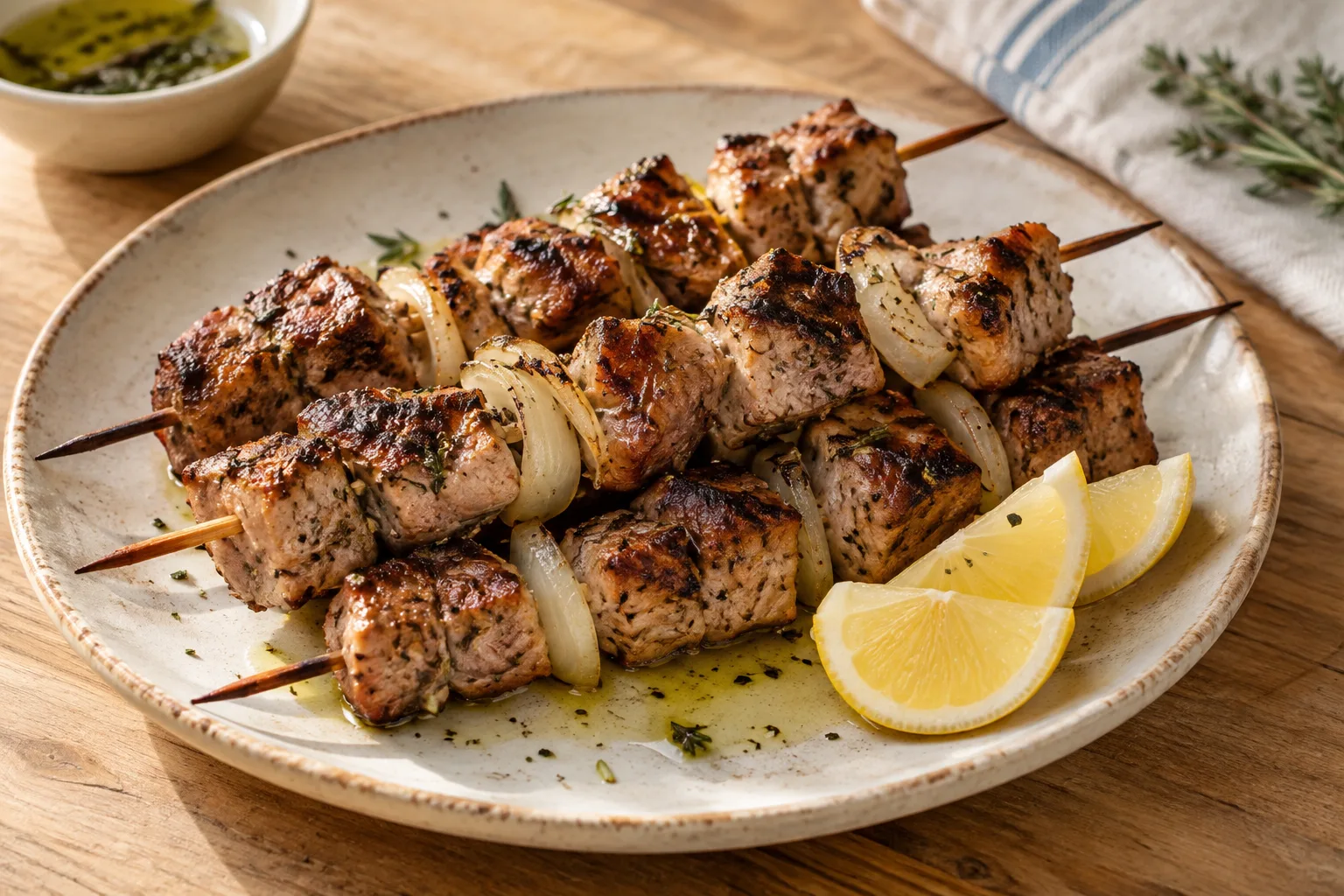
Greek pork souvlaki
Image generated by the Kitchenpause team
60 minEasy

Greek pork souvlaki

Greek skewers of pork tenderloin marinated with garlic, vinegar, olive oil, and herbs. Makes 4 servings; times are approximate.

View recipe
Greek Orange Portokalopita
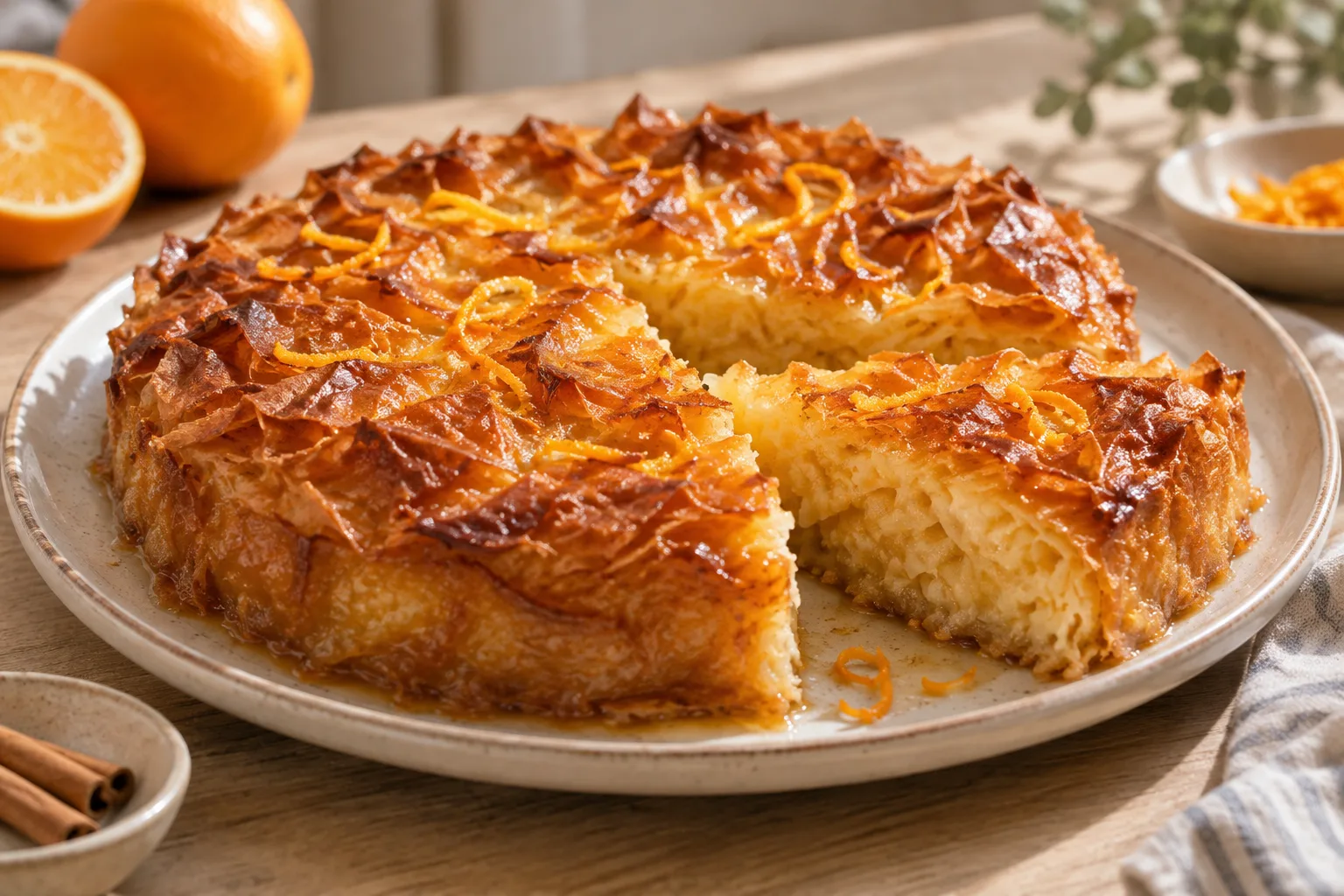
Image generated by the Kitchenpause team
90 minIntermediate

Greek Orange Portokalopita

A Greek cake made with phyllo, yogurt, and orange, soaked in citrus syrup. Makes approximately 12–16 portions.

View recipe
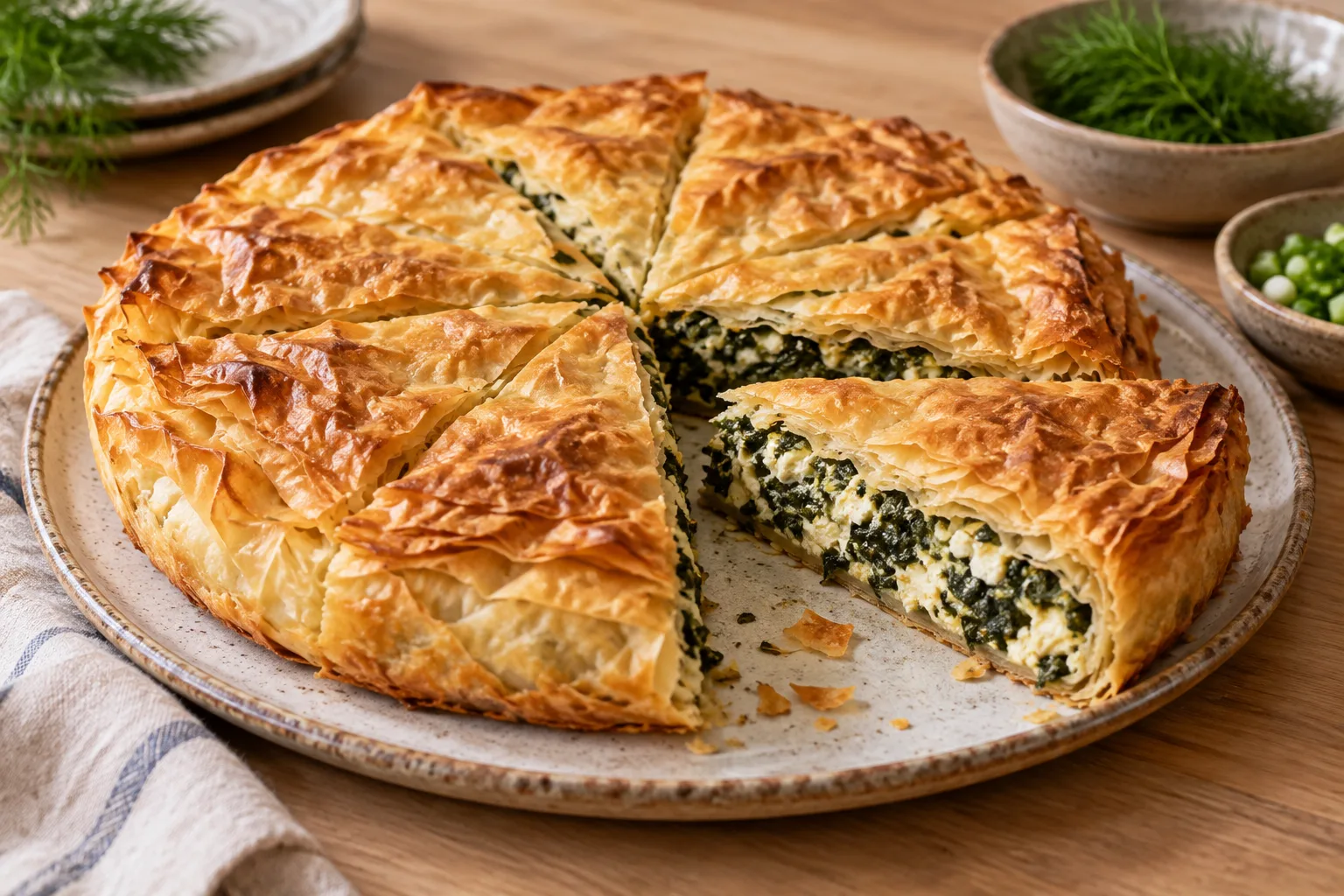
Greek Spinach and Feta Spanakopita
Image generated by the Kitchenpause team
90 minIntermediate

Greek Spinach and Feta Spanakopita

A Greek savory pie of spinach, feta, dill, and spring onions wrapped in crisp layers of phyllo pastry. Makes 8 servings; preparation and resting times are approximate.

View recipe
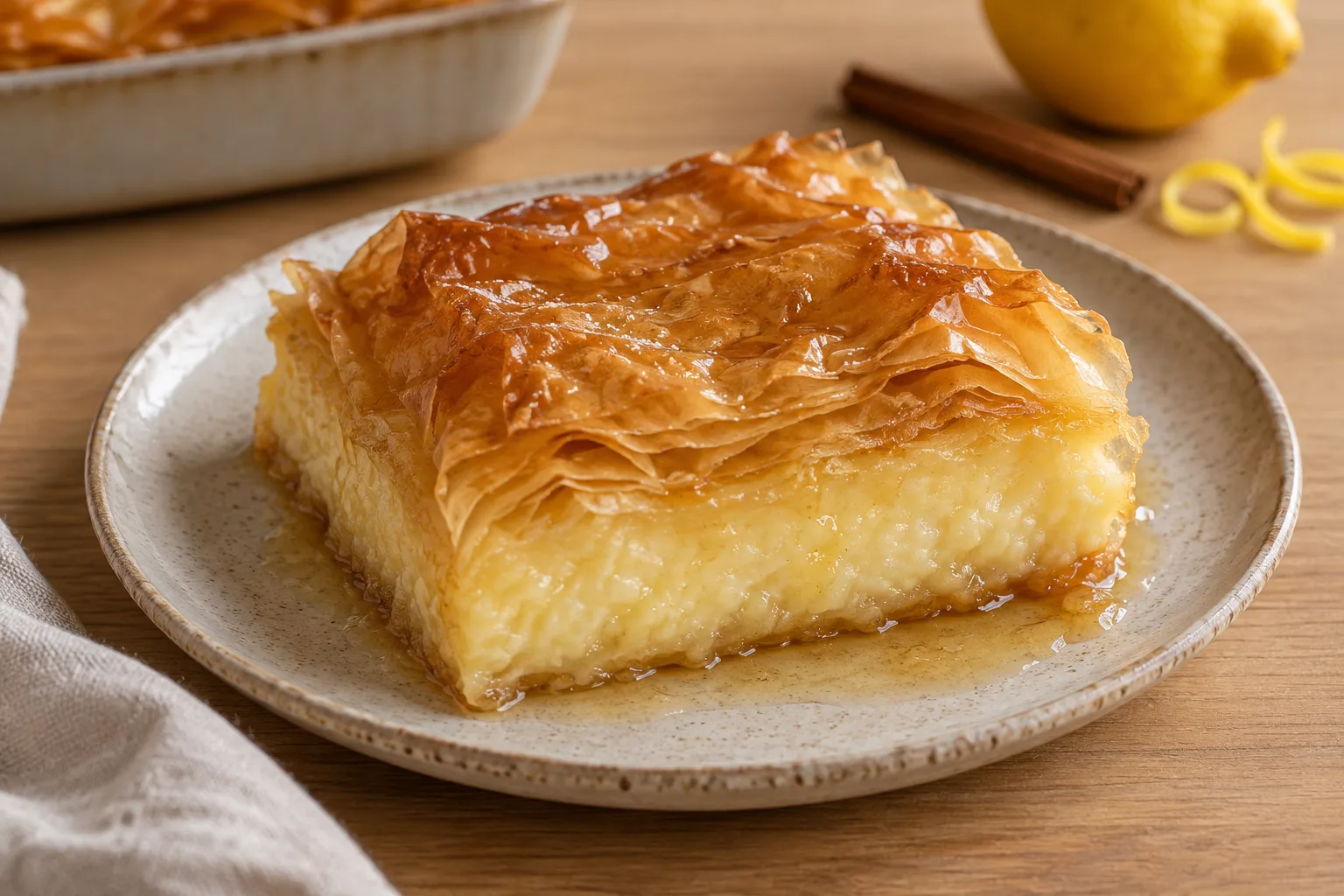
Greek Galaktoboureko
Image generated by the Kitchenpause team
135 minIntermediate

Greek Galaktoboureko

A Greek pie of semolina-and-milk custard wrapped in crisp filo pastry and soaked with lemon syrup.

View recipe
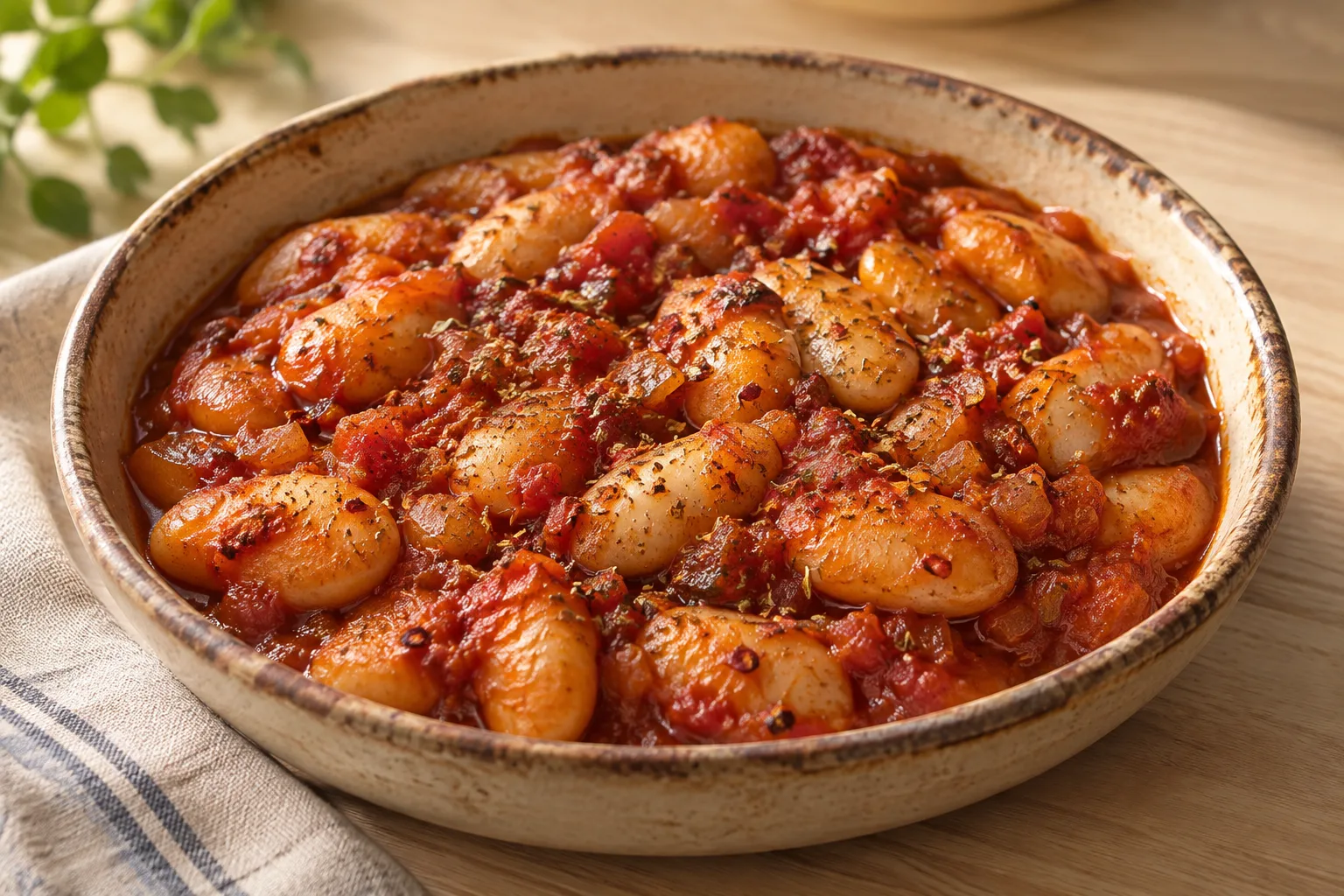
Greek Gigantes Plaki
Image generated by the Kitchenpause team
90 minEasy

Greek Gigantes Plaki

Giant beans in a tomato, garlic, and olive oil sauce, baked until the sauce thickens.

View recipe
Greek Loukoumades
Image generated by the Kitchenpause team
110 minIntermediate

Greek Loukoumades

Greek fermented-dough fritters, fried until golden and served with honey, cinnamon, and walnuts.

View recipe

Sources consulted

Read the sources and each document’s scope. A heritage inscription concerns a particular practice, not all of a country’s cuisine.

  1. Timing of eating across ten European countries: EPIC calibration study www.cambridge.org/core/services/aop-cambridge-core/content/view/8F479DFE2716C7D67CB6EA83E102… Huseinovic et al.; Public Health Nutrition; Cambridge University Press Consulted: November 3, 2026
  2. Meal patterns across ten European countries: EPIC calibration study, original Tables 1 and 2 www.cambridge.org/core/journals/public-health-nutrition/article/meal-patterns-across-ten-eur… Huseinovic et al.; Public Health Nutrition; Cambridge University Press Consulted: November 3, 2026
  3. tus_00week: official Greek2013–2014 time-use observations ec.europa.eu/eurostat/api/dissemination/statistics/1.0/data/tus_00week?lang=en&geo=EL&time=2… Eurostat; national Time Use Survey supplied by ELSTAT Consulted: November 3, 2026
  4. HETUS2000/2010 statistical metadata: Greek2013–2014 collection ec.europa.eu/eurostat/cache/metadata/en/tus_00_esms.htm Eurostat; national Time Use Survey supplied by ELSTAT Consulted: November 3, 2026
  5. Diet-Related Behaviors and Diet Quality among School-Aged Adolescents Living in Greece pmc.ncbi.nlm.nih.gov/articles/PMC7763124/ Original Greek HBSC2018 investigators; Nutrients2020 Consulted: November 3, 2026
  6. tus_00age: official Greek2013–2014 time-use observations ec.europa.eu/eurostat/api/dissemination/statistics/1.0/data/tus_00age?lang=en&geo=EL&time=20… Eurostat; national Time Use Survey supplied by ELSTAT Consulted: November 3, 2026
  7. Household Budget Survey 2025 Table 2.00 monthly average quantities www.statistics.gr/en/statistics?_documents_WAR_publicationsportlet_INSTANCE_VBZOni0vs5VJ_doc… Hellenic Statistical Authority Consulted: November 3, 2026
  8. HBS2025: expenditure Table1 and quantity Table10 www.statistics.gr/en/statistics?_documents_WAR_publicationsportlet_INSTANCE_qDQ8fBKKo4lN_doc… Hellenic Statistical Authority (ELSTAT) Consulted: November 3, 2026
  9. Intake of total, animal and plant proteins, and their food sources in 10 countries in EPIC www.researchgate.net/publication/51439377_Intake_of_total_animal_and_plant_proteins_and_thei… Halkjaer and colleagues; European Journal of Clinical Nutrition; author copy uploaded by coauthor Ailsa A Welch Consulted: November 3, 2026
  10. Today’s Mediterranean Diet in Greece: Findings from the National Health and Nutrition Survey—HYDRIA (2013–2014) pmc.ncbi.nlm.nih.gov/articles/PMC8949101/ Magriplis and colleagues; Nutrients2022 Consulted: November 3, 2026
  11. Sodium and Potassium Intake in Healthy Adults in Thessaloniki Greater Metropolitan Area—The SING Study pmc.ncbi.nlm.nih.gov/articles/PMC5409756/ Vasara and colleagues; Nutrients2017 Consulted: November 3, 2026
  12. Greek salad www.visitgreece.gr/en/experiences/gastronomy/recipes/greek-salad Greek National Tourism Organisation (GNTO), VisitGreece Consulted: November 3, 2026
  13. Tzatziki www.visitgreece.gr/en/experiences/gastronomy/recipes/tzatziki Greek National Tourism Organisation (GNTO), VisitGreece Consulted: November 3, 2026
  14. Mousaka www.visitgreece.gr/en/experiences/gastronomy/recipes/mousaka Greek National Tourism Organisation (GNTO), VisitGreece Consulted: November 3, 2026
  15. Coffee pleasure, the Greek way www.visitgreece.gr/en/blog/visit-greece/coffee-pleasure-the-greek-way Greek National Tourism Organisation Consulted: November 3, 2026
  16. Nutritional Value of Mountain Tea portal.greekfarms.gov.gr/en/diatrofiki-axia-tsai-tou-vounou/ Greek Ministry of Rural Development and Food, GreekFarms portal Consulted: November 3, 2026
  17. Comparative monitoring of alcohol epidemiology across the EU: RARHA synthesis report www.epicentro.iss.it/alcol/pdf/Comparative%20monitoring%20%20of%20alcohol%20epidemiology%20%… Moskalewicz, Room and Thom, editors; RARHA SEAS research consortium; Istituto Superiore di Sanita repository Consulted: November 3, 2026
  18. Why Is Per Capita Consumption Underestimated in Alcohol Surveys? Original Table 1 survey characteristics academic.oup.com/view-large/206625945 Original survey analysts; Alcohol and Alcoholism, Oxford University Press2020 Consulted: November 3, 2026
  19. Validation of a Food Propensity Questionnaire for HNNHS and adherence to food-group guidelines pmc.ncbi.nlm.nih.gov/articles/PMC7353208/ Nutrients2020; original HNNHS investigators Consulted: November 3, 2026
  20. Salted and cured seafood: regional examples portal.greekfarms.gov.gr/en/salted-and-cured-seafood/ GreekFarms, Greek government agricultural portal Consulted: November 3, 2026
  21. Feta PDO: production process agriculture.ec.europa.eu/farming/geographical-indications-and-quality-schemes/geographical-i… European Commission, Directorate-General for Agriculture and Rural Development Consulted: November 3, 2026
  22. Consumer survey June2026: prepared food spending and channels ielka.gr/anakoinosi-09-07-2026/ IELKA original research institute Consulted: November 3, 2026
  23. Consumer survey February2025: shopping frequency ielka.gr/anakoinosi-13-5-2025/ IELKA original research institute Consulted: November 3, 2026
  24. MEZEDaki Menu2026, Miraggio Resort, Halkidiki www.miraggio.gr/media/zwwj3rbn/mezedaki-menu-2026-18-35-cm.pdf Miraggio Thermal Spa Resort; restaurant original menu Consulted: November 3, 2026
  25. Quantification of household food waste in Greece to establish the2021nationalbaseline doi.org/10.1016/j.wasman.2024.09.012 Sigala et al.; Waste Management2024 Consulted: November 3, 2026
  26. Flavours of Spring www.visitgreece.gr/en/experiences/gastronomy/traditional-cuisine/flavours-of-spring Greek National Tourism Organisation (GNTO), VisitGreece Consulted: November 3, 2026
  27. Sun-dried products of Greece www.visitgreece.gr/en/experiences/gastronomy/traditional-products/sun-drying-products Greek National Tourism Organisation (GNTO), VisitGreece Consulted: November 3, 2026
  28. Easter in Greece www.visitgreece.gr/inspirations/easter-in-greece Greek National Tourism Organisation (GNTO), VisitGreece Consulted: November 3, 2026
  29. Christmas treats from Greece www.visitgreece.gr/en/blog/visit-greece/christmas-treats-from-greece Greek National Tourism Organisation (GNTO), VisitGreece Consulted: November 3, 2026
  30. Gastronomía de Heraclión www.visitgreece.gr/en/experiences/architecture/traditional-settlements/gastronomy-in-herakli… Greek National Tourism Organisation
  31. Cocina de las Cícladas www.visitgreece.gr/fr/experiences/gastronomy/traditional-cuisine/cycladic-cuisine Greek National Tourism Organisation
  32. Gastronomía de Citera www.visitgreece.gr/en/experiences/gastronomy/beverages/gastronomy-of-kythira Greek National Tourism Organisation

We use session and security technologies to provide our features. Only with your permission do we load Google Analytics to measure visits and Google Maps on Contact. Choose separately, reject or accept both.

Withdraw either permission here. Withdrawing analytics reloads the page to unload the running tag.

Cookie policy