Asia · Southern Asia
India
Three entry points into a country of many repertoires: lamb stews, meals on a leaf, and fish and sweets, linked to the current recipe collection.
Food and eating habits
How people eat in India
50 indicators exploring everyday meals, ingredients and food culture. Information is completed progressively from documented evidence.
48 of 50 indicators with documented information
Not all data are comparable: food supply, purchases and intake are different measures. Check the period, population and method for each finding. Qualitative descriptions do not establish percentages or amounts.
Timing and company
7/8
| Indicator | Findings and context |
|---|---|
| Meal times |
In the Delhi-NCR cohort, recorded intakes did not show a clear breakfast–lunch–dinner timing pattern. Scope, method and limitations
|
| Meals per day |
Mean of 2.5 meals per day; median 2.0. Scope, method and limitations
|
| Meal duration | Insufficient data in the sources consulted |
| Daily energy distribution |
The cohort spread energy intake across the day, including evening and late-night consumption. Scope, method and limitations
|
| Weekdays and weekends |
In the Delhi sample, mean 5.83 eating occasions on a weekday and 5.66 on a weekend day. Scope, method and limitations
|
| Eating at home and away |
95.5% of meals were reported at home and 4.5% away from home. Scope, method and limitations
|
| Cooking frequency |
Food and meal preparation and management: daily participation 41.0%; 200 minutes per participant per day. Scope, method and limitations
|
| Eating together |
Self-reported mean of 4 meals shared with known people per week, counting lunches and dinners. Scope, method and limitations
|
Pantry and recipes
2/2
| Indicator | Findings and context |
|---|---|
| Most consumed ingredients |
Two staple cereals, kg per person per month, rural / urban: rice 5.065 / 4.193; wheat 3.920 / 3.622. Scope, method and limitations
|
| Ingredient prevalence in recipes |
In the sample of 1013 Punjabi recipes: cayenne in 496; garam masala in 251; coriander in 243. These are occurrence counts. Scope, method and limitations
|
Cereals and plant foods
6/6
| Indicator | Findings and context |
|---|---|
| Cereals and cereal products |
Cereals: 9.35 kg per person per month in rural areas; 8.02 kg in urban areas. Scope, method and limitations
|
| Bread |
Uttarakhand: chapatis accompanying palak ka kaapa spinach curry. Scope, method and limitations
|
| Pulses |
Pulses: 0.623 kg per person per month in rural areas; 0.665 kg in urban areas. Scope, method and limitations
|
| Vegetables |
Vegetables: monthly valued consumption of INR 248 per person in rural areas and INR 288 in urban areas. Scope, method and limitations
|
| Fruit |
Fruit: monthly valued consumption of INR 158 per person in rural areas and INR 271 in urban areas. Scope, method and limitations
|
| Potatoes, roots and tubers |
West Bengal: potatoes with poppy-seed paste in aloo posto. Scope, method and limitations
|
Protein foods
5/5
| Indicator | Findings and context |
|---|---|
| Meat |
Chicken and other meat, weekly category: 34.5% of women and 44.5% of men. Scope, method and limitations
|
| Fish and seafood |
Fish, weekly category: 30.6% of women and 39.0% of men. Scope, method and limitations
|
| Eggs |
Eggs, weekly category: 39.9% of women and 50.7% of men. Scope, method and limitations
|
| Milk and dairy products |
Milk or curd, daily category: 48.8% of women and 48.8% of men. Scope, method and limitations
|
| Protein sources |
Sources of estimated protein, rural / urban: cereals 45.9 / 38.7%; pulses 8.7 / 9.1%; dairy 11.0 / 12.9%; eggs, fish and meat combined 12.4 / 14.1%; other foods 22.0 / 25.3%. Scope, method and limitations
|
Fats, flavours and condiments
3/3
| Indicator | Findings and context |
|---|---|
| Cooking fats |
Edible oils: monthly valued consumption of INR 114 per person in rural areas and INR 127 in urban areas. Scope, method and limitations
|
| Herbs and spices |
West Bengal: turmeric, chili, cumin and coriander in macher jhol, with ginger and fresh coriander leaves. Scope, method and limitations
|
| Sauces and condiments |
Southern India: coconut or tomato chutney served with hot paniyaram. Scope, method and limitations
|
Meal composition
6/6
| Indicator | Findings and context |
|---|---|
| Breakfast composition |
Delhi local sample: plain paratha at breakfast, accompanied by tea or a vegetable preparation. Scope, method and limitations
|
| Main meal composition |
Lunches in the Delhi sample: chapati or boiled rice with pulse or vegetable preparations; salad or curd as accompaniments. Scope, method and limitations
|
| Dinner composition |
Dinners in the Delhi sample: cereal with vegetables or pulses, with accompaniments such as curd, salad or pickle. Scope, method and limitations
|
| Appetisers and snacks |
Between meals in the Delhi sample: biscuits or savoury namkeen snacks with tea, green tea or coffee; fruit or soup were also reported. Scope, method and limitations
|
| Desserts and sweets |
Bengal: mishti doi, a sweet yogurt dessert with sugar and a caramelized flavour, associated with special occasions and festivals. Scope, method and limitations
|
| Portion sizes |
Delhi, observed medians per eating occasion: boiled rice 140 g; chickpea curry (chole) 188 g; cooked mixed pulses 255 g. Scope, method and limitations
|
Techniques and equipment
5/5
| Indicator | Findings and context |
|---|---|
| Cooking techniques |
Uttarakhand: bhat ki chudkani illustrates pressure-cooker use and onions sautéed in ghee. Scope, method and limitations
|
| Vegetable preparation |
Delhi sample: raw carrot and radish salad; raw cucumber, onion and tomato were also reported. Scope, method and limitations
|
| Food preservation |
Bengal: the documented mishti doi preparation includes refrigeration after setting, before serving. Scope, method and limitations
|
| Fermented foods |
Bengal: mishti doi is a sweet yogurt made with fermentation, combining a dairy base and sugar. Scope, method and limitations
|
| Kitchen equipment |
Documented pressure-cooker use in Uttarakhand’s bhat ki chudkani; no household ownership rate is established here. Scope, method and limitations
|
Drinks
3/3
| Indicator | Findings and context |
|---|---|
| Everyday drinks |
Aerated drinks, daily category: 2.7% of women and 4.2% of men. Scope, method and limitations
|
| Coffee and tea preparation |
Delhi sample: median serving per occasion of 170 ml for tea, green tea and coffee, each separately. Scope, method and limitations
|
| Drinks with meals |
Breakfast in the Delhi sample: milk as a drink and tea accompanying plain paratha; no percentages by drink. Scope, method and limitations
|
Nutrition and dietary patterns
3/3
| Indicator | Findings and context |
|---|---|
| Energy and nutrients |
Estimated intake per person per day, rural / urban: energy 2212 / 2240 kcal; protein 61.8 / 63.4 g; fat 60.4 / 69.8 g. Unadjusted values. Scope, method and limitations
|
| Salt and sugars |
Estimated daily salt, adjusted for non-urinary losses: Delhi and Haryana 9.45 g per person; Andhra Pradesh 10.41 g per person. Scope, method and limitations
|
| Dietary patterns |
39% of adults identify as vegetarian; the definition was left to each respondent. Scope, method and limitations
|
Shopping, prices and waste
6/7
| Indicator | Findings and context |
|---|---|
| Food expenditure |
Food per person per month: rural 1939 INR, 47.04% of total consumption; urban 2776 INR, 39.68%. Scope, method and limitations
|
| Cost of a common basket | Insufficient data in the sources consulted |
| Cost of specific meals |
Estimated home-cooked thali cost: vegetarian 30.8 INR; with chicken 59.5 INR. Scope, method and limitations
|
| Grocery shopping locations |
Odisha and West Bengal sample: traditional market for vegetables 97% and fruit 94%; general shop for rice 72% of households. Scope, method and limitations
|
| Shopping frequency |
In the Punjab mothers’ sample, need-based visits to food stores predominated, without a fixed schedule. Scope, method and limitations
|
| Prepared food and delivery |
Meals sourced outside the home in the Delhi sample: once a week 20%; once a month 28.3%. Scope, method and limitations
|
| Household food waste |
Estimated household food waste: 55 kg per person per year, including inedible parts; medium confidence. Scope, method and limitations
|
Seasons and celebrations
2/2
| Indicator | Findings and context |
|---|---|
| Seasonal produce |
Indian geographical-indication mangoes: combined availability window from March to August, depending on variety and region. Scope, method and limitations
|
| Celebration food |
Tamil Nadu: Pongal, in January, celebrates the harvest with newly harvested rice cooked with jaggery. Scope, method and limitations
|
Explore its cuisinesRead as an article ↗
India: Kashmir, Kerala and Bengal as starting routes
Documentary synthesis prepared with AI assistance. It does not replace specialist review or certify kitchen testing. · Updated 2 November 2026
A route that begins with differences
India brings together cuisines that change with territory, community, products and occasion. As a starting point, this guide offers three documented routes: the Kashmir Valley, Kerala and West Bengal. They are entry points into a much larger map. The current recipe selection includes rogan josh, dosa, kheer, gulab jamun and jalebi, offering ways to explore stews, doughs and sweets without assuming a single national menu.
The word curry is insufficient to describe these differences. A lamb preparation, a fermented batter and a milk sweet involve different operations and structures. Each dish's name and published version help explain them more precisely than a broad label of flavour or heat.
Three regional routes
Kashmir: versions of a stew
Rogan josh belongs to the Kashmiri repertoire. KitchenPause retains several versions, including recipes identifying the region and another declaring the use of tomato. That difference should remain visible: a family of dishes can accommodate different community practices and formulations. Recipes whose titles and documentation identify Kashmir are linked to this region; more generic variants do not receive the same precision automatically.
Kerala: a meal as a sequence
The sadya brings together rice, vegetable preparations, accompaniments, pickles and sweets on a banana leaf. Arrangement and serving order are part of the experience. This example offers a way to study a complete meal: not everything reaches the table with the same role or is prepared at the same moment. It is a particular tradition of Kerala, not the only way to eat throughout southern India.
West Bengal: fish and sweets
The regional repertoire includes fish, seafood and sweets such as rasgulla and sandesh. This combination broadens the map from a savoury dish to the work of dairy and sweet textures. Bengali traditions maintain connections with Bangladesh and other territories. A regional guide can explain those relationships without claiming exclusivity over an entire shared culinary family.
Batters and fermentation
The catalogue's masala dosa provides an entry point different from stews. Before starting, check whether the recipe includes making the batter or uses a prepared base, and separate that work from the filling. Composition, resting and cooking a thin layer influence texture. The recipe remains in the catalogue's Indian repertoire without being assigned to Kerala simply because the guide includes a southern route.
Sweets and occasions
Kheer, gulab jamun and jalebi offer a comparison of cereals, dairy and dough. Choosing one requires looking at whether consistency is built through cooking, shaping pieces or finishing in syrup. Cultural context broadens the reading, while quantities and times belong to the chosen version. Attention to differences allows further exploration of regions without treating their preparations as uniform.
Vocabulary for choosing a technique
- Rogan josh: a family of stews linked to Kashmir, with versions worth identifying.
- Dosa: a batter preparation spread into a thin layer; the catalogue's masala dosa adds a filling.
- Kheer: a sweet that explores the relationship between cereal, dairy and consistency.
- Sadya: a festive Kerala meal arranging several preparations on a banana leaf.
The table as a sequence
The sadya brings together rice, vegetable preparations, pickles, accompaniments and sweets served in sequence. The example distinguishes each component's role and the order of service. An elaborate meal is not explained solely by its largest dish: contrasts, portions and the moment components are brought together also matter. It is a documented Kerala practice, not a uniform model for all India.
From stew to sweet: changing structure
Rogan josh, dosa and the catalogue's sweets show three different kinds of work. A stew transforms pieces and sauce; a dosa requires handling a mixture and spreading it; a sweet in syrup organises dough and finishing differently. Spice intensity alone does not explain these differences. Texture and process provide a more precise reading of the repertoire than a single category of curry.
A route that preserves versions
You might devote one session to a Kashmiri stew and another to masala dosa, leaving a sweet for later exploration. Prepare batter and filling, or base and sauce, separately according to the exercise. Regional documentation from Bengal then offers a route into fish and dairy techniques. When comparing, preserve each recipe's particularities, including the version declaring tomato: they help explain how a family of preparations changes.
From territory to today's recipe collection
Start with Kashmiri rogan josh to work on a lamb stew, or masala dosa to explore batter and filling. Regional links are added to recipes that explicitly document them. The others retain their national category and visible version, including the adaptation declaring tomato.
Shopping, prices and waste
Food expenditure. Food per person per month: rural 1939 INR, 47.04% of total consumption; urban 2776 INR, 39.68%.
Observation period: 2023-24. Rural and urban Indian households; HCES per-person estimates. August 2023–July 2024 survey; separate rural and urban means. Household consumption and expenditure survey with product-specific recall periods; published monthly results, without our own conversions. Reported or valued household consumption, not cash outlay alone. Nominal period prices; denominator is total consumption, not income or savings.
Cost of specific meals. Estimated home-cooked thali cost: vegetarian 30.8 INR; with chicken 59.5 INR.
Home-cooking model using input prices from India’s four broad regions. September 2026; estimated cost per model thali plate, not a restaurant price. Vegetarian plate with roti, vegetables, rice, dal, curd and salad; non-vegetarian version replaces dal with chicken. Fixed weights and cooking gas included. Model estimate, not an observed bill or universal home recipe. Some ingredient prices estimated; no serving gram weights or other dish costs inferred.
Grocery shopping locations. Odisha and West Bengal sample: traditional market for vegetables 97% and fruit 94%; general shop for rice 72% of households.
Low- and middle-income households in Odisha and West Bengal; regional rural and urban sample. 2017 survey; reported usual outlet for each food group. Original survey-data analysis; one usual-outlet response per group. Percentages refer to households, not expenditure. Partial coverage of the stated scope and period; no national extrapolation or equivalence with spending, volume or online purchases.
Shopping frequency. In the Punjab mothers’ sample, need-based visits to food stores predominated, without a fixed schedule.
Fieldwork dates not stated in the verified passages; qualitative sample result. Partial coverage of the stated scope and period; no national extrapolation or equivalence with spending, volume or online purchases.
Prepared food and delivery. Meals sourced outside the home in the Delhi sample: once a week 20%; once a month 28.3%.
Purposive sample of urban Delhi adults; not nationally representative. January–March 2018; reported frequency of meals sourced outside the home. Profile and habits questionnaire; original categories retained without adding them. Delivery not separated from restaurant consumption. Partial coverage of the stated scope and period; no national extrapolation or equivalence with spending, volume or online purchases.
Household food waste. Estimated household food waste: 55 kg per person per year, including inedible parts; medium confidence.
Indian households; national estimate modelled from subnational studies. 2022 estimation reference; underlying studies cover different years, not one national survey in that year. Synthesis and modelling using UN population data; medium confidence assigned by the report. Includes edible and inedible parts. Household waste only, not agricultural losses, food service or retail. Avoidable share, reasons and discarded products not measured here; limited original geographical coverage.
Cereals and plant foods
Cereals and cereal products. Cereals: 9.35 kg per person per month in rural areas; 8.02 kg in urban areas.
Pulses. Pulses: 0.623 kg per person per month in rural areas; 0.665 kg in urban areas.
Observation period: 2023-24. Rural and urban Indian households; HCES per-person estimates. August 2023–July 2024 survey; separate rural and urban means. Household consumption and expenditure survey with product-specific recall periods; published monthly results, without our own conversions. Partial coverage: reported or valued household consumption, not measured individual intake. Neither national production availability nor annual intake; no variety breakdown.
Bread. Uttarakhand: chapatis accompanying palak ka kaapa spinach curry.
Potatoes, roots and tubers. West Bengal: potatoes with poppy-seed paste in aloo posto.
Culinary example from the named region; no survey period. Partial coverage of types and preparations; no consumption quantities or frequencies, and not all regions.
Vegetables. Vegetables: monthly valued consumption of INR 248 per person in rural areas and INR 288 in urban areas.
Fruit. Fruit: monthly valued consumption of INR 158 per person in rural areas and INR 271 in urban areas.
Observation period: 2023-24. Rural and urban Indian households; HCES per-person estimates. August 2023–July 2024 survey; separate rural and urban means. Household consumption and expenditure survey with product-specific recall periods; published monthly results, without our own conversions. Monetary consumption value, not grams or exclusively cash spending. Survey definition retained; quantities eaten cannot be calculated.
Fats, flavours and condiments
Cooking fats. Edible oils: monthly valued consumption of INR 114 per person in rural areas and INR 127 in urban areas.
Observation period: 2023-24. Rural and urban Indian households; HCES per-person estimates. August 2023–July 2024 survey; separate rural and urban means. Household consumption and expenditure survey with product-specific recall periods; published monthly results, without our own conversions. Monetary consumption value, not grams or exclusively cash spending. Survey definition retained; quantities eaten cannot be calculated.
Herbs and spices. West Bengal: turmeric, chili, cumin and coriander in macher jhol, with ginger and fresh coriander leaves.
Sauces and condiments. Southern India: coconut or tomato chutney served with hot paniyaram.
Examples from the named regions in an institutional cookbook; no survey period. Partial coverage of ingredients and culinary uses; no consumption quantities or occurrence frequencies in a representative recipe sample.
Timing and company
Meal times. In the Delhi-NCR cohort, recorded intakes did not show a clear breakfast–lunch–dinner timing pattern.
Daily energy distribution. The cohort spread energy intake across the day, including evening and late-night consumption.
Partial coverage of the stated population and period. Exploratory cohort, not nationally representative; possible underreporting. Field dates unspecified: only the qualitative finding is retained, without national percentages or meal times.
Meals per day. Mean of 2.5 meals per day; median 2.0.
Eating at home and away. 95.5% of meals were reported at home and 4.5% away from home.
Members of Indian households included in NSS 2011–2012. Partial coverage of the stated population and period. Original analysis of a weighted national survey; recall of meals in the preceding month. Historical self-reported data; meals follow the survey definition, not every snack or measured intake.
Weekdays and weekends. In the Delhi sample, mean 5.83 eating occasions on a weekday and 5.66 on a weekend day.
Observation period: 2018. Purposively selected adults in Delhi; small sample. Partial coverage of the stated population and period. Dietary recalls on two non-consecutive days, working and non-working. Not representative of India; includes meals and snacks with self-reported recall. No comparison of timing or duration.
Cooking frequency. Food and meal preparation and management: daily participation 41.0%; 200 minutes per participant per day.
Observation period: 2024. Indian residents aged six and over, rural and urban households. Partial coverage of the stated population and period. Previous-day recall diary; half-hour slots considering all activities. Includes meal management. Time among participants, not an all-population mean; no cooking days per week. Excludes hard-to-reach Andaman and Nicobar villages.
Eating together. Self-reported mean of 4 meals shared with known people per week, counting lunches and dinners.
Observation period: 2022. People surveyed in India by Gallup. Partial coverage of the stated population and period. Recall of shared lunches and dinners during the preceding week; published rounded result. Excludes breakfast and does not separate family from friends. Interpretation of known people may vary culturally; no causality demonstrated.
Protein foods
Meat. Chicken and other meat, weekly category: 34.5% of women and 44.5% of men.
Fish and seafood. Fish, weekly category: 30.6% of women and 39.0% of men.
Eggs. Eggs, weekly category: 39.9% of women and 50.7% of men.
Milk and dairy products. Milk or curd, daily category: 48.8% of women and 48.8% of men.
Observation period: 2019-21. Women and men aged 15–49 in India; results reported separately by sex. National survey in 2019–21; reported frequencies for the foods defined in the table. Frequency interview with daily, weekly, occasionally and never categories. Each category is retained without adding or recalculating percentages. Partial coverage: self-reported frequency, not amounts eaten or annual kilograms. Excludes ages below 15 and above 49. The weekly category excludes daily respondents; it does not mean at least weekly.
Protein sources. Sources of estimated protein, rural / urban: cereals 45.9 / 38.7%; pulses 8.7 / 9.1%; dairy 11.0 / 12.9%; eggs, fish and meat combined 12.4 / 14.1%; other foods 22.0 / 25.3%.
Observation period: 2023-24. Rural and urban Indian households; national per-person estimates. August 2023–July 2024; distribution across five food groups, rural and urban separately. Reported household consumption converted into protein using nutrient tables; published shares without adjustment for meals received or served to non-household members. Partial coverage: survey-derived intake estimate, not an individual measurement. Eggs, fish and meat form a single group and cannot be separated. Areas are not averaged and rounding is not corrected.
Meal composition
Breakfast composition. Delhi local sample: plain paratha at breakfast, accompanied by tea or a vegetable preparation.
Main meal composition. Lunches in the Delhi sample: chapati or boiled rice with pulse or vegetable preparations; salad or curd as accompaniments.
Appetisers and snacks. Between meals in the Delhi sample: biscuits or savoury namkeen snacks with tea, green tea or coffee; fruit or soup were also reported.
January–March 2018; working and non-working days, excluding fasting and festival days. Partial coverage of a local, socioeconomically selected sample. Does not describe all India or estimate national percentages, daily amounts or a mandatory sequence of courses.
Dinner composition. Dinners in the Delhi sample: cereal with vegetables or pulses, with accompaniments such as curd, salad or pickle.
Purposive sample of urban Delhi adults, eligible ages 25–60; not nationally representative. January–March 2018; working and non-working days, excluding fasting and festival days. Two non-consecutive twenty-four-hour dietary recalls per person; recipe interviews and preparation standardization. Partial coverage of a local, socioeconomically selected sample. Does not describe all India or estimate national percentages, daily amounts or a mandatory sequence of courses.
Desserts and sweets. Bengal: mishti doi, a sweet yogurt dessert with sugar and a caramelized flavour, associated with special occasions and festivals.
Institutional culinary description; no observation period. Partial coverage of types and ingredients; no consumption quantities or frequency and not representative of all Indian regions.
Portion sizes. Delhi, observed medians per eating occasion: boiled rice 140 g; chickpea curry (chole) 188 g; cooked mixed pulses 255 g.
Purposive sample of urban Delhi adults, eligible ages 25–60; not nationally representative. January–March 2018; working and non-working days, excluding fasting and festival days. Dietary recalls and standardized recipes; median of eating occasions among consumers. Cooked dish weight, without conversion from dry food. Small local sample; observed portions, not recommended servings or daily means. Non-consumers excluded. Not dry pulse weight; curry consistency matters.
Techniques and equipment
Cooking techniques. Uttarakhand: bhat ki chudkani illustrates pressure-cooker use and onions sautéed in ghee.
Food preservation. Bengal: the documented mishti doi preparation includes refrigeration after setting, before serving.
Fermented foods. Bengal: mishti doi is a sweet yogurt made with fermentation, combining a dairy base and sugar.
Kitchen equipment. Documented pressure-cooker use in Uttarakhand’s bhat ki chudkani; no household ownership rate is established here.
Institutional culinary description; no observation period. Regional documented example; no use frequency or household percentage measured. Not representative of all regions, and not a preservation instruction or validated shelf life.
Vegetable preparation. Delhi sample: raw carrot and radish salad; raw cucumber, onion and tomato were also reported.
Purposive sample of urban Delhi adults, eligible ages 25–60; not nationally representative. January–March 2018; working and non-working days, excluding fasting and festival days. Two non-consecutive twenty-four-hour dietary recalls per person; recipe interviews and preparation standardization. Partial coverage of a local, socioeconomically selected sample. Does not describe all India or estimate national percentages, daily amounts or a mandatory sequence of courses.
Drinks
Everyday drinks. Aerated drinks, daily category: 2.7% of women and 4.2% of men.
Observation period: 2019-21. Women and men aged 15–49 in India; results reported separately by sex. National survey in 2019–21; reported frequencies for the foods defined in the table. Frequency interview with daily, weekly, occasionally and never categories. Each category is retained without adding or recalculating percentages. Partial coverage: reported frequency of aerated drinks; no daily volume, water, juice or hot beverage measurements. Only the stated ages are included.
Coffee and tea preparation. Delhi sample: median serving per occasion of 170 ml for tea, green tea and coffee, each separately.
Purposive sample of urban Delhi adults, eligible ages 25–60; not nationally representative. January–March 2018; working and non-working days, excluding fasting and festival days. Two non-consecutive twenty-four-hour dietary recalls per person; recipe interviews and preparation standardization. Small local sample; median among consumers per occasion, not daily intake or a recommendation. No brewing method or milk/sugar amounts established.
Drinks with meals. Breakfast in the Delhi sample: milk as a drink and tea accompanying plain paratha; no percentages by drink.
January–March 2018; working and non-working days, excluding fasting and festival days. Partial coverage of a local, socioeconomically selected sample. Does not describe all India or estimate national percentages, daily amounts or a mandatory sequence of courses.
Nutrition and dietary patterns
Energy and nutrients. Estimated intake per person per day, rural / urban: energy 2212 / 2240 kcal; protein 61.8 / 63.4 g; fat 60.4 / 69.8 g. Unadjusted values.
Observation period: 2023-24. Rural and urban Indian households; national per-person estimates. August 2023–July 2024; national rural and urban means, without mixing per-person and per-consumer-unit values. Reported household consumption converted to energy, protein and fat using nutrient tables; published estimates unadjusted for meals received from other households or served to non-household members. Partial coverage: reported consumption converted using tables, not measured individual intake or a recommendation. No carbohydrate or fibre figures verified here. Areas kept separate; no own averaging.
Salt and sugars. Estimated daily salt, adjusted for non-urinary losses: Delhi and Haryana 9.45 g per person; Andhra Pradesh 10.41 g per person.
Adults aged at least twenty in urban, rural and slum communities of Delhi/Haryana and Andhra Pradesh. February–June 2014; two regions separately, without national extrapolation. Twenty-four-hour urinary sodium converted to salt by the authors and survey-weighted; published estimates inflated by ten percent for non-urinary losses. Historical regional coverage; estimated salt, not grams of sodium or an all-India mean. Possible losses and incomplete collections. No total, added or free sugar data.
Dietary patterns. 39% of adults identify as vegetarian; the definition was left to each respondent.
Observation period: 2019-2020. Non-institutionalized adults in India aged eighteen or older, in areas covered by the survey. November 17, 2019–March 23, 2020; self-identification as vegetarian. Face-to-face interviews in a stratified probability sample with demographic weighting; respondents define what vegetarian means. Partial coverage of dietary patterns: self-report, without a uniform definition or vegan/flexitarian figures. Methodology details territorial exclusions and sampling limitations.
Pantry and recipes
Most consumed ingredients. Two staple cereals, kg per person per month, rural / urban: rice 5.065 / 4.193; wheat 3.920 / 3.622.
Observation period: 2023-24. Rural and urban Indian households; HCES per-person estimates. August 2023–July 2024 survey; separate rural and urban means. Household consumption and expenditure survey with product-specific recall periods; published monthly results, without our own conversions. Partial staple-food coverage: rice and wheat only, not a ranking of all foods. Reported household consumption, not measured intake or cooked weight. Published monthly values; no annual conversion.
Ingredient prevalence in recipes. In the sample of 1013 Punjabi recipes: cayenne in 496; garam masala in 251; coriander in 243. These are occurrence counts.
Documentary sample of recipes classified as Punjabi; not people or population consumption. Recipes collected in December 2014; regional subset retained without adding labels from other cuisines. Ingredient names normalized and single-ingredient recipes excluded by the authors. Published occurrence counts from the supplementary table; regional denominator from the main table. Partial coverage of one website and regional cuisine. The source describes name cleaning, not a complete recipe-deduplication protocol. Counts retained without invented percentages, national rankings or human consumption.
Seasons and celebrations
Seasonal produce. Indian geographical-indication mangoes: combined availability window from March to August, depending on variety and region.
Recurring calendar described in institutional documentation; not observation of a particular year. Partial coverage: combined window for geographical-indication varieties, not an identical season for all varieties or regions or imported availability. Other products not covered.
Celebration food. Tamil Nadu: Pongal, in January, celebrates the harvest with newly harvested rice cooked with jaggery.
Recurring calendar described in institutional documentation; not observation of a particular year. Regional example of a celebration and associated food; not a complete festival catalogue or quantified consumption. The Tamil calendar determines the annual date.
Places and communities
One country, many cuisines
An initial selection of regions to explore. Culinary boundaries may differ from administrative divisions.
Kerala
Bengala Occidental
Cook
Recipes connected with India
Each recipe documents one version. Geographic associations do not imply an exclusive origin.
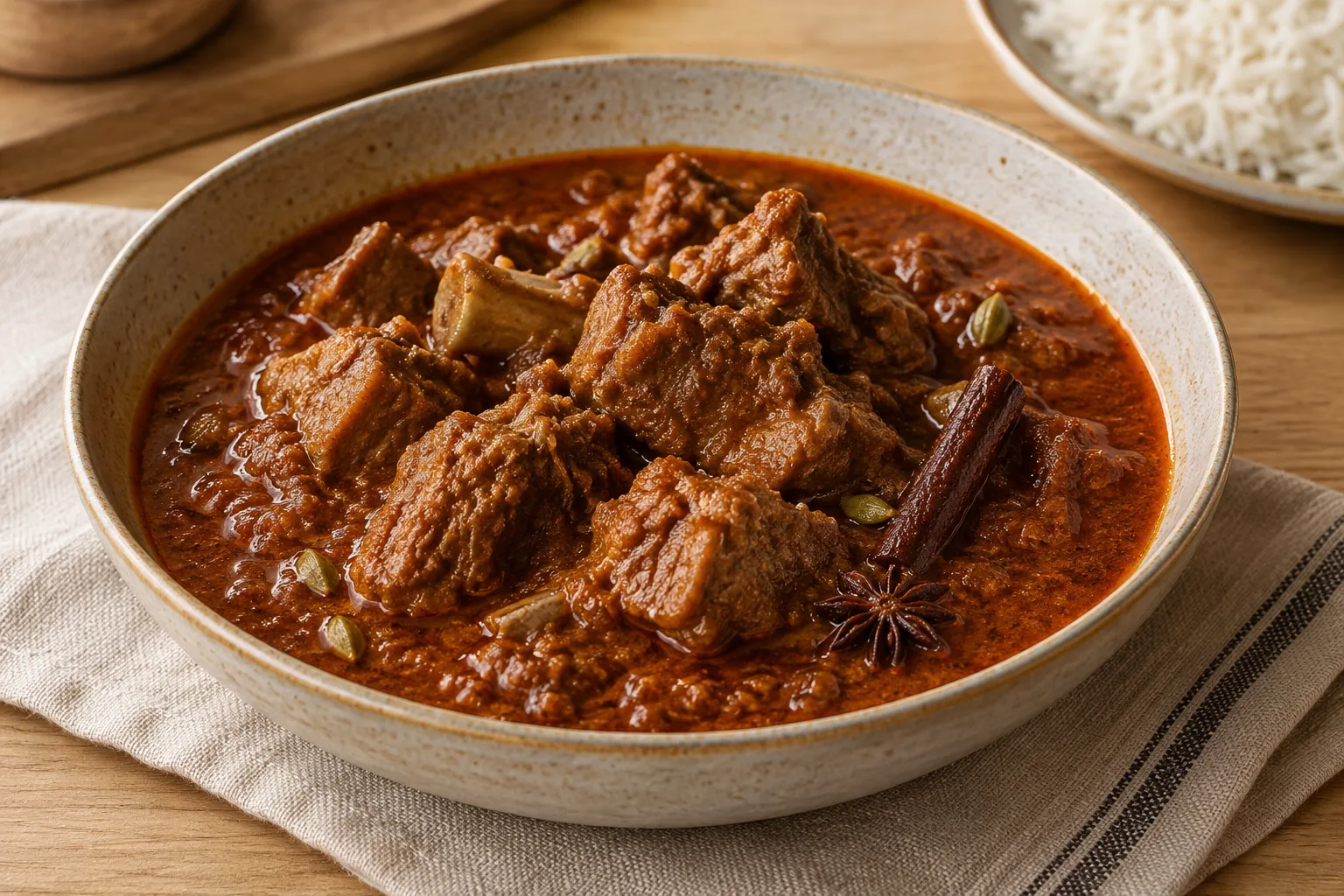
Lamb rogan josh with yogurt and spices
A Kashmiri lamb stew with ghee, yogurt, garlic, ginger, and aromatic spices. This version follows the variation that includes onion and garlic; serve when the meat is tender and the sauce is cohesive.
View recipe
Sources consulted
Read the sources and each document’s scope. A heritage inscription concerns a particular practice, not all of a country’s cuisine.
- Household Consumption Expenditure Survey 2023-24: Fact Sheet www.mospi.gov.in/sites/default/files/publication_reports/HCES%20FactSheet%202023-24.pdf National Statistical Office, MoSPI, Government of India Consulted: October 31, 2026
- Roti Rice Rate, October 2026 — September 2026 plate costs intelligence.crisil.com/content/dam/crisil-intelligence/what-we-think/reports/2026/10/roti-r… Crisil Intelligence Consulted: October 31, 2026
- How important are traditional retail outlets for sourcing healthy foods in Kenya and India? Table 6 www.gainhealth.org/sites/default/files/publications/documents/GAIN-Working-Paper-series-32-h… Fongar and Aberman / Global Alliance for Improved Nutrition Consulted: October 31, 2026
- Role of Children in Retail Food Purchases srcc.edu/system/files/Article-No9-Role-of-Children-in-Retail-Food-Purchases-Jain.pdf Vohra and Soni / Business Analyst, SRCC Consulted: October 31, 2026
- Assessment of Portion Sizes of Food Items Commonly Consumed by Urban Indian Adults: A Preliminary Study www.foodandnutritionjournal.org/volume8number1/assessment-of-portion-sizes-of-food-items-com… Sharma and Chadha / Current Research in Nutrition and Food Science Consulted: October 31, 2026
- Informe sobre el Índice de Desperdicio de Alimentos 2024: metodología y estimación de hogares de India wedocs.unep.org/bitstreams/98b3a30b-92d7-4ad1-86e8-fb923a1e1992/download United Nations Environment Programme Consulted: October 31, 2026
- Flavors of the Indian Food: a culinary journey dfe.gov.in/uploads/documents/flavours_of_the_indian_food_coimbatore.pdf Central Academy for State Forest Service, Directorate of Forest Education Consulted: October 31, 2026
- Production and consumption of pulses: Rajya Sabha answer 3226 sansad.in/getFile/annex/267/AU3226_v0jj7m.pdf?source=pqars Ministry of Agriculture and Farmers Welfare, Government of India Consulted: October 31, 2026
- A camera-phone based study reveals erratic eating pattern and disrupted daily eating-fasting cycle among adults in India journals.plos.org/plosone/article/file?id=10.1371%2Fjournal.pone.0172852&type=printable Gupta, Kumar and Panda / PLOS ONE Consulted: October 31, 2026
- How can we better capture food away from Home? Lessons from India’s linking person-level meal and household-level food data pmc.ncbi.nlm.nih.gov/articles/PMC5656091/ Fiedler and Yadav / Food Policy Consulted: October 31, 2026
- Time Use in India 2024: methods and Statements 16–17 www.mospi.gov.in/sites/default/files/publication_reports/TUS_Report_2024_28.03.2025F.pdf National Statistics Office, MoSPI, Government of India Consulted: October 31, 2026
- World Happiness Report 2025, Chapter 3: Sharing meals with others www.worldhappiness.report/ed/2025/sharing-meals-with-others-how-sharing-meals-supports-happi… De Neve, Dugan, Kaats and Prati / World Happiness Report Consulted: October 31, 2026
- National Family Health Survey NFHS-5, India 2019–21: table 10.25 dhsprogram.com/pubs/pdf/FR375/FR375.pdf International Institute for Population Sciences and Ministry of Health and Family Welfare, India Consulted: October 31, 2026
- NSS Report 594: Nutritional Intake in India, HCES 2022–23 and 2023–24 www.mospi.gov.in/sites/default/files/publication_reports/Nutritional_Intake_in_India_L.pdf National Statistical Office, MoSPI, Government of India Consulted: October 31, 2026
- Mean Dietary Salt Intake in Urban and Rural Areas in India: A Population Survey of 1395 Persons researchonline.lshtm.ac.uk/4651043/1/mean-dietary-salt-intake.pdf Johnson et al. / Journal of the American Heart Association; original article in LSHTM repository Consulted: October 31, 2026
- Religion in India: Tolerance and Segregation — food and methodology www.pewresearch.org/religion/wp-content/uploads/sites/7/2021/06/PF_06.29.21_India.full_.repo… Pew Research Center Consulted: October 31, 2026
- NSS Report 592: Household Consumption Expenditure Survey 2023-24, Statements 5R and 5U mospi.gov.in/sites/default/files/publication_reports/Final_Report_HCES_2023-24L.pdf National Statistical Office, MoSPI, Government of India Consulted: October 31, 2026
- Analysis of Food Pairing in Regional Cuisines of India journals.plos.org/plosone/article/file?id=10.1371/journal.pone.0139539&type=printable Jain, N K and Bagler / PLOS ONE Consulted: October 31, 2026
- Analysis of Food Pairing in Regional Cuisines of India: S4 Table journals.plos.org/plosone/article/file?id=10.1371/journal.pone.0139539.s004&type=supplementa… Jain, N K and Bagler / PLOS ONE Consulted: October 31, 2026
- Indian GI Mangoes: foreword dated 21 April 2022 apeda.gov.in/sites/default/files/files_universal_page/2024-05/Mango_brochure.pdf Agricultural and Processed Food Products Export Development Authority, Government of India Consulted: October 31, 2026
- India: Unity in Cultural Diversity — Tamil Nadu, fairs and festivals cdnbbsr.s3waas.gov.in/s32d2ca7eedf739ef4c3800713ec482e1a/uploads/2023/09/2023092156.pdf National Council of Educational Research and Training, 2018 Consulted: October 31, 2026
- Jammu y Kashmir: gastronomía www.incredibleindia.gov.in/en/jammu-and-kashmir Ministry of Tourism, Government of India Consulted: October 20, 2026
- Sadya de Kerala www.keralatourism.org/kerala-food/sadya/ Kerala Tourism Consulted: October 20, 2026
- Rutas y sabores de Bengala www.wbtourism.gov.in/assets/pdf/brochure/PackageTourBooklet.pdf Department of Tourism, Government of West Bengal Consulted: October 20, 2026