Documentary synthesis prepared with AI assistance. It does not replace specialist review or certify kitchen testing. · Updated 31 October 2026
A culinary map across peninsula and Borneo
Malaysia’s culinary landscape crosses two main land areas: the Malay Peninsula and the states of East Malaysia on Borneo. That geography matters at the table. A national dish or widely shared ingredient can connect people without making every local menu, household practice or recipe the same. Malay, Chinese and Indian traditions meet alongside Indigenous Bornean foodways, and regional dishes reflect both community histories and local interpretation. The country’s breakfast culture is one visible setting for this variety: nasi lemak is a familiar meal, but it is only one way of beginning the day.
A useful way to approach Malaysian food is to move between shared structures and local versions. Rice may anchor a meal, while sauces, herbs, fish, eggs or other accompaniments change its character. Noodles, curries, soups and street-food preparations offer other routes through the map. Penang, Kelantan and Sarawak provide three documented points of comparison: an urban food culture associated with Penang, rice preparations linked with Kelantan, and Sarawak’s Indigenous and coastal culinary traditions. These are entry points, not a complete inventory of Malaysia’s food or its communities.
Exchange, migration and the changing table
Malaysian food has developed through long histories of movement and exchange. Malay foodways sit alongside Chinese and Indian traditions, with migration and contact helping shape the country’s varied food culture. These encounters are not best understood as a single process that produced one uniform cuisine: communities retain distinctive practices, and dishes can take different forms across places and cooks. Peranakan food, for example, is described as a tradition combining Chinese techniques with Malay ingredients. It illustrates one particular history of cultural interaction rather than standing for every Malaysian kitchen.
Nasi lemak also shows why culinary history needs care. A familiar story associates the dish with a girl named Seri and an accidental addition of coconut milk to rice, but the story is a legend, not a documented account of a definitive origin. The dish itself is recorded in written sources by the late nineteenth and early twentieth centuries. Today it is widely associated with Malaysia and Malay food culture, and its presence extends beyond the country. Malaysia’s 2024 nomination of nasi lemak for UNESCO recognition as part of breakfast culture reflects its significance as a living food tradition; it does not mean that one dish represents all Malaysian cuisines or that every breakfast follows the same pattern.
Rice, coconut, aromatics and prepared pastes
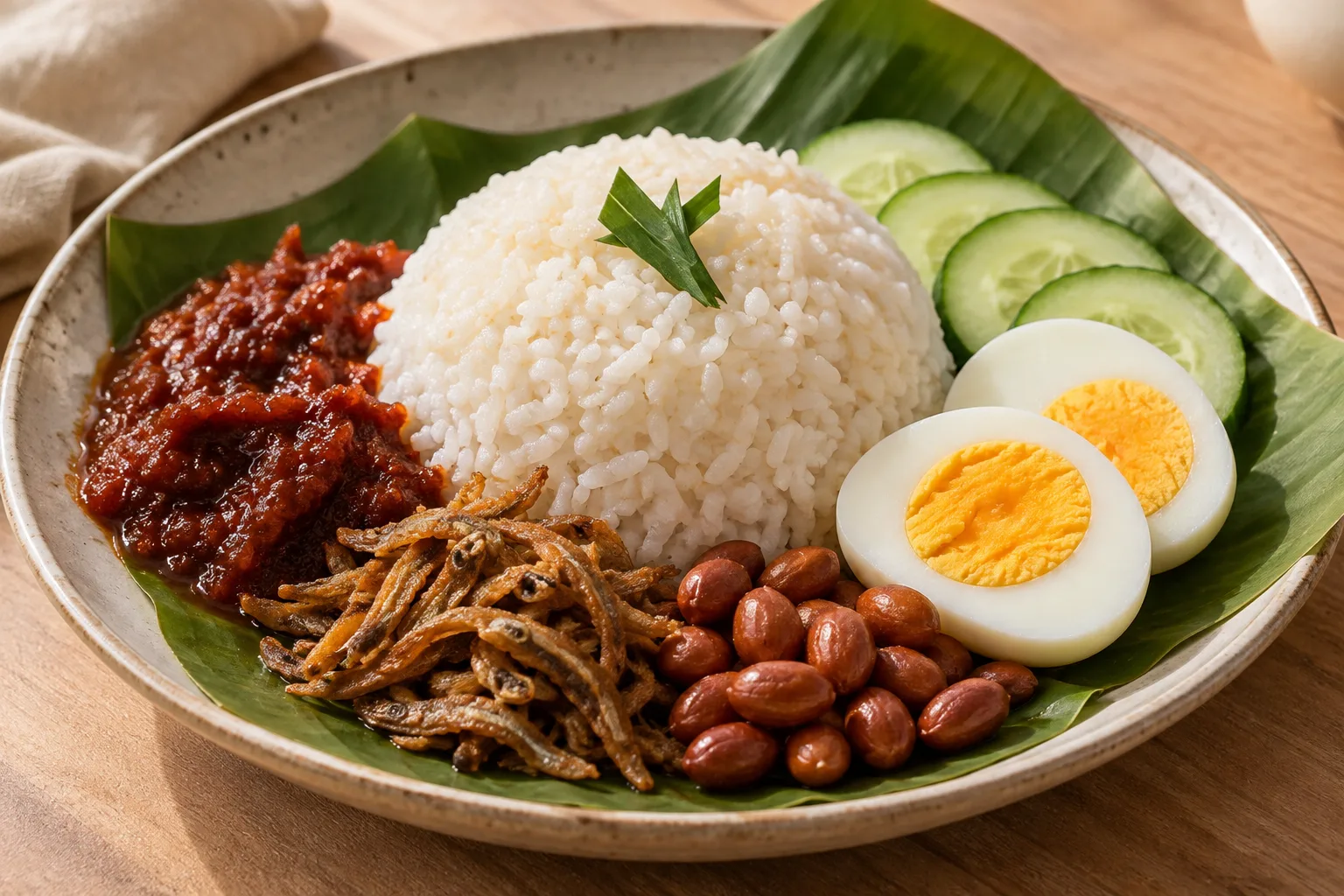
Rice is central to several of the preparations discussed here, but its role varies: it can be a fragrant base, a colourful regional dish or the centre of a meal with multiple accompaniments. In nasi lemak, rice is cooked with coconut milk and pandan. The resulting grains carry a gentle coconut richness and a distinct leafy aroma. A common serving includes sambal, dried anchovies, peanuts, egg and cucumber, though additional dishes and local versions vary. Coconut milk therefore belongs not only to the pantry but also to a particular transformation: it changes the rice’s aroma and mouthfeel while pandan perfumes the cooking liquid.
A Malaysian pantry is not reducible to one list, but several ingredients help explain these examples. Chiles and aromatics form pastes for sambal and curries; tamarind contributes acidity in some sambal preparations; and dried anchovies, peanuts, egg and cucumber provide contrasting accompaniments for nasi lemak. In Malay and Peranakan cooking, coconut, lemongrass, galangal, turmeric and belacan appear in documented combinations. These ingredients take different roles from dish to dish: some are ground into pastes, others season a sauce or perfume rice, and some are served as distinct components. Not every recipe uses them all, and a regional dish should be understood through its own ingredients rather than inferred from a general pantry.
A balance of fragrant, sharp, spicy and crisp
A Malaysian meal can bring several kinds of flavour and texture into one serving, but there is no single national formula for balance. Nasi lemak offers a clear example: coconut-scented rice is paired with sambal, crisp dried anchovies, peanuts, egg and cool cucumber. The rice is soft and aromatic; the anchovies and peanuts add crunch; cucumber supplies a fresh contrast; and sambal can be mild or markedly hot. Sourness may enter through tamarind in a sambal, while sugar can temper its sharpness. The exact effect depends on the cook and the version being served.
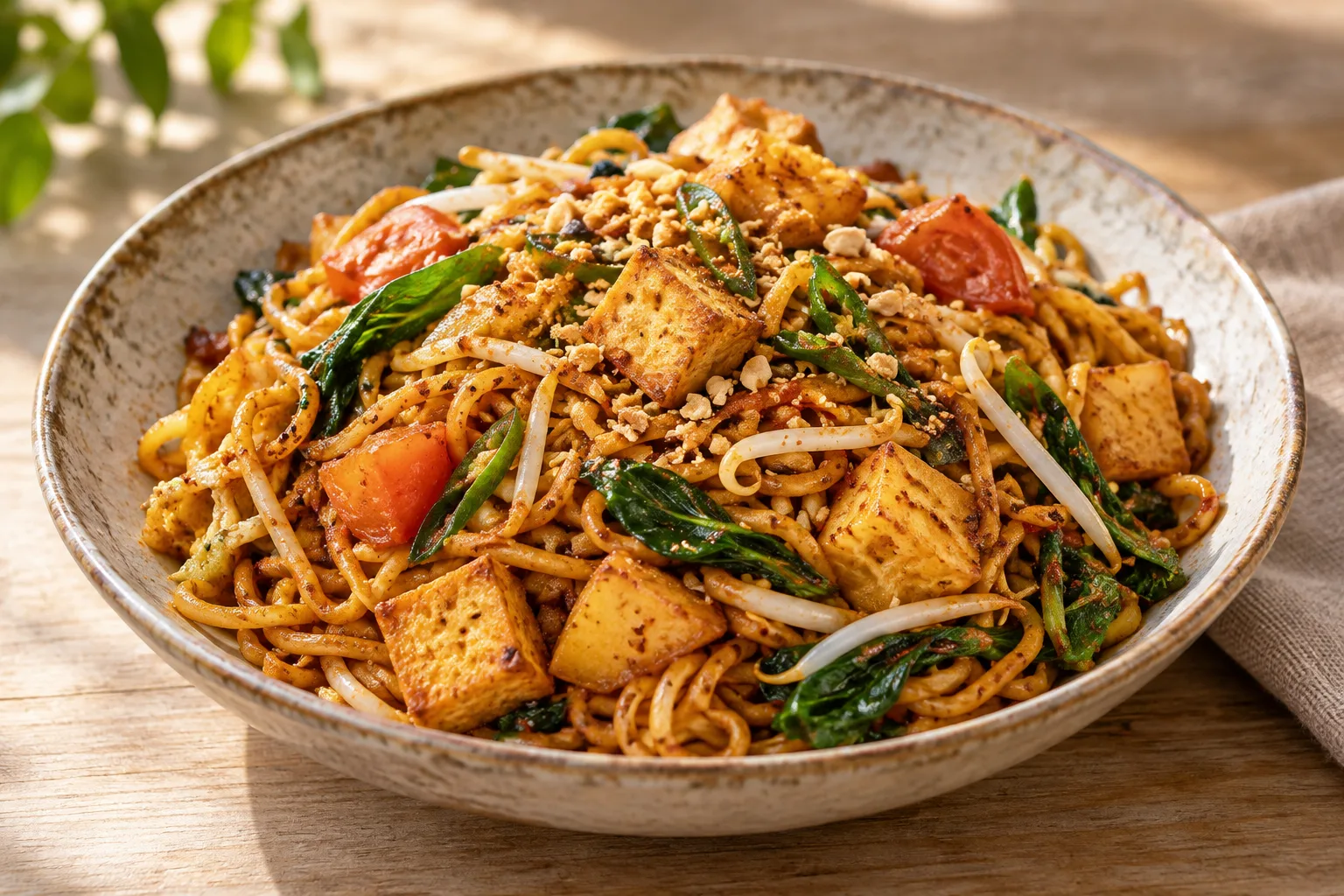
Other preparations produce a different experience. A soup such as Penang asam laksa brings noodles and broth together, while char kway teow is a noodle preparation associated with a different cooking style. Kelantan’s nasi kerabu is identified by blue rice and a set of accompaniments that may include herbs, vegetables, fish or salted egg and sambal. These dishes should not be collapsed into a generic “spicy” profile: rice, broth and noodles carry seasoning differently, and fresh herbs or vegetables can change the overall impression. Compare the structure of the dish—what is mixed, served alongside, or placed in a broth—as well as its seasoning, and regional distinctions become easier to appreciate.
Breakfast, everyday meals and culinary inheritance
Breakfast is an important setting for Malaysian food culture, and nasi lemak is widely associated with a Malay-style breakfast. It is also eaten beyond the morning, so the dish is not limited to one mealtime. A modest serving can pair coconut rice with sambal and a few familiar accompaniments; a more substantial version may add a protein dish such as fried chicken, spicy cuttlefish or rendang. Wrapped servings and plated meals offer different ways to present the same broad combination. These forms are part of everyday food life as well as a visible expression of cultural inheritance.
The idea of breakfast as a cultural practice is broader than a single plate. Malaysia’s breakfast traditions include foods and influences from Malay, Chinese and Indian communities, alongside regional and Indigenous foodways. Such traditions are shared in public food settings and passed on through families and cooks, but the evidence does not support treating every meal as a ritual or assigning the same habits to every household. A respectful account keeps both points in view: nasi lemak has wide recognition, and Malaysian breakfast culture remains diverse. The national conversation around breakfast heritage highlights that diversity without making one dish a stand-in for every community or region.
Steaming, frying, grinding and assembling
Different Malaysian preparations call for different work. Nasi lemak begins with rice cooked in coconut milk and pandan, commonly by steaming or by cooking the rice in a covered pot or rice cooker. Its accompaniments are prepared separately: dried anchovies may be fried until crisp, eggs cooked, cucumber sliced and sambal cooked from a ground or blended paste. This separation matters because the final meal is assembled from components with distinct textures and temperatures. A method for the rice does not automatically describe the preparation of the sambal or the finishing of the garnishes.
Other techniques come into focus in other dishes. Grinding aromatics combines chiles, shallots, garlic and other ingredients into pastes for sauces or curries. Slow cooking is associated in the documented Malay repertoire with rendang, while lighter curry preparations use a more liquid sauce. Noodles call for another set of decisions: a broth-based dish such as asam laksa is not technically equivalent to a stir-fried noodle dish such as char kway teow. These methods are part of living practice, not a checklist for all Malaysian cooking. The appropriate technique follows the particular dish and regional version, and the names alone do not guarantee identical ingredients or procedure.
How dishes are served and shared
A Malaysian table may be organised around a central rice dish, a bowl of noodles or a collection of separate accompaniments. Nasi lemak makes the assembled approach especially visible: rice sits with sambal, anchovies, peanuts, egg and cucumber, and optional additional dishes can make the portion more substantial. Banana leaves are used to wrap and serve nasi lemak in some traditional presentations. A wrapped portion is convenient and compact; a plated version can make the components more visible. Neither presentation alone defines the whole food culture, and the accompaniments vary by vendor and region.
Food stalls and urban eating places also form part of the setting in which Malaysian dishes are encountered. Penang is associated with street-food favourites, while breakfast culture more broadly brings together dishes and culinary influences from across communities. At a meal, notice whether noodles are served in broth or stir-fried, and whether rice accompaniments are mixed in or kept distinct. Those details describe the food more accurately than broad labels such as “street food” or “national dish.” When ingredients matter, ask what is included in the particular serving: sambal recipes can differ, and extra proteins or other toppings are not guaranteed by a dish name alone.
Terms for rice, sauces and regional dishes
These terms identify particular ingredients or preparations. Their definitions describe documented examples, not an unchanging recipe shared by every cook.
- Nasi lemak: Coconut-milk rice, commonly perfumed with pandan and served with sambal, dried anchovies, peanuts, egg and cucumber. Additional dishes and exact accompaniments vary.
- Sambal: A chile-based sauce or paste. A nasi lemak sambal may include aromatics and tamarind, and its heat and flavour vary by preparation.
- Ikan bilis: Small dried anchovies, commonly fried and served as a crisp, savoury accompaniment to nasi lemak.
- Nasi kerabu: A Kelantan-associated rice dish known for blue rice, served with accompaniments such as herbs, vegetables, fish or salted egg and sambal.
- Asam laksa: A Penang-associated noodle soup, a broth-based preparation distinct from stir-fried noodles.
- Char kway teow: A Penang-associated noodle dish prepared as a stir-fry, rather than served as a soup.
- Nasi tumpang: A named nasi lemak variation associated with Kelantan in the documented list of Malaysian versions.
The catalogue includes a Malaysian nasi lemak with sambal, anchovies and peanuts. These terms also point to cultural references beyond that recipe: nasi kerabu, asam laksa, char kway teow and nasi tumpang are part of the country’s documented food vocabulary whether or not they have an individual catalogue recipe.
One country, many cuisines
Kelantan
Kelantan’s documented rice repertoire includes nasi kerabu, identified by its blue rice and accompaniments such as herbs, vegetables, fish or salted egg and sambal. Nasi tumpang is also named as a Kelantan-associated nasi lemak variation. These dishes offer a specific view of regional foodways, while their ingredients and presentation should not be treated as fixed across every household or vendor.
Penang
Penang is documented as a place to explore urban street-food favourites, including asam laksa and char kway teow. The first is a noodle soup; the second is a stir-fried noodle dish, so their shared association with Penang does not make their composition or technique interchangeable. Together they offer a concise route into the island’s varied food repertoire without suggesting that these dishes exhaust it.
Sarawak
Sarawak’s foodways are represented in the available documentation through Indigenous and coastal flavours and traditional heritage dishes. This makes Sarawak an important part of a culinary map that extends beyond the Malay Peninsula. The evidence here supports that broad regional character but does not name specific Sarawak dishes, so this description stays with the documented community and coastal context rather than assigning unverified examples.
Cook