Europe · Eastern Europe

Poland

Recipes connected with Poland

Food and eating habits

How people eat in Poland

50 indicators exploring everyday meals, ingredients and food culture. Information is completed progressively from documented evidence.

50 of 50 indicators with documented information

Not all data are comparable: food supply, purchases and intake are different measures. Check the period, population and method for each finding. Qualitative descriptions do not establish percentages or amounts.

Timing and company

8/8
Timing and company — Poland
IndicatorFindings and context
Meal times
Quantitative findingSurvey

Lunch (obiad) is described as the main meal; this is a cultural characterization, not a measure of meal times or prevalence. All meals at fixed times were reported by 7.2% of men and 10.1% of women aged 18–64.

Scope, method and limitations
Observation period
July 2019–February 2020
Unit
% of respondents
Population or sample
No population sample is specified. Adults aged 18–64 in the Polish national study; group of 1227 people, with percentages by sex.
Geographic scope
Poland; no regional breakdown. Poland; reported regularity, Table 5.3.2b;2019–2020.
Definition and method
Cultural description; no survey method or denominator is specified. CAPI eating-habits questionnaire; stratified random sample from the PESEL register by sex, age and region. Collection from July 2019 to February 2020.
Comparison limitations
Partial coverage: it does not establish usual breakfast, lunch or dinner times or modal intervals, and does not establish frequency. Partial coverage: regularity, without clock times for breakfast, lunch or dinner or modal intervals.
Meals per day
Quantitative findingSurvey

Three meals daily were reported by 53.5% of men and 49.2% of women aged 18–64.

Scope, method and limitations
Observation period
July 2019–February 2020
Unit
% of respondents
Population or sample
Adults aged 18–64 in the Polish national study; group of 1227 people, with percentages by sex.
Geographic scope
Poland; reported usual daily meal count, Table 5.3.1b; observation 2019–2020.
Definition and method
CAPI eating-habits questionnaire; stratified random sample from the PESEL register by sex, age and region. Collection from July 2019 to February 2020.
Comparison limitations
Partial adult coverage and one response category. Not a national mean meal count or the percentage taking each meal; snacks are not added, sexes are not averaged and results are not extrapolated to younger or older people.
Meal duration
Quantitative findingSurvey

Mean duration of 26 minutes per episode of primary eating or drinking, in the historical 2003–2004 analysis.

Scope, method and limitations
Observation period
2003–2004
Unit
minutes per primary eating/drinking episode
Population or sample
People aged 15 and over in Poland; analytical sample of 19905 diary days, one day per person.
Geographic scope
Poland; 2003–2004 time-use survey. Episodes in which eating or drinking was the primary activity.
Definition and method
Secondary analysis of a nationally representative survey; each person’s first diary day, recorded in 10-minute slots. National holidays were excluded.
Comparison limitations
Historical finding; includes primary drinking. Not total daily time, preparation time or a separate duration for every meal type; does not describe the current population.
Daily energy distribution
Quantitative findingObserved intake

In the Warsaw cohort, breakfast supplied 22±6% of daily energy and supper 19±6%: means±standard deviations, not national averages.

Scope, method and limitations
Observation period
2005–2012
Unit
% of daily energy; mean±SD
Population or sample
126 children in the Polish CHOP component recruited in Warsaw; dietary follow-up at ages 3,4,5,6 and 8.
Geographic scope
CHOP dietary follow-up during 2005–2012 at ages 3,4,5,6 and 8; Warsaw component. Dates documented in the methods article from the same cohort.
Definition and method
Weighed or estimated records for three consecutive days, two weekdays and one weekend day, completed by carers; country-specific predefined eating occasions.
Comparison limitations
Partial coverage of a local child cohort. Pooled five-country values are not attributed to Poland. Other meals are not estimated from bars; energy per occasion differs from macronutrient percentages within a meal.
Weekdays and weekends
Qualitative descriptionSurvey

In the exploratory December 2020 sample, more daily time was devoted to eating and drinking at weekends than on weekdays.

Scope, method and limitations
Observation period
December 2020
Population or sample
71 residents of nine large Polish cities; convenience sample without national representativeness.
Geographic scope
December 2020 during the COVID-19 pandemic; comparison within one week.
Definition and method
Self-recording over seven consecutive days: five weekdays and two weekend days; daily activity totals.
Comparison limitations
Qualitative coverage of the direction of a daily-time difference, not duration per meal, clock times or meal count. The article’s time notation is not converted and findings are not generalized beyond this sample and period.
Eating at home and away
Quantitative findingSurvey

In the October 2010 survey, 90% of surveyed adults reported usually eating their main hot meal at home on weekdays; 97% did so on Saturdays, Sundays and other days off. These are reports about one particular meal, not shares of all meals or current figures.

Scope, method and limitations
Observation period
7–13 October 2010
Unit
% of respondents
Population or sample
Adult residents of Poland; representative random sample of 1035 people.
Geographic scope
Poland; usual location of the main hot meal on weekdays and days off.
Definition and method
Survey conducted on 7–13 October 2010; self-reported response, Table 2.
Comparison limitations
Historical finding about one specific meal; not a share of all meals or a measure of weekend timing, duration or meal count. Wording changed from 2000.
Cooking frequency
Quantitative findingSurvey

Among people doing food management that day, mean participation time was 1:52 for women and 1:08 for men; participation rates were 89.4% and 63.6%, respectively.

Scope, method and limitations
Observation period
2023
Unit
h:mm among participants; % participating
Population or sample
People aged 15 years and over in private households in Poland; results by sex.
Geographic scope
Poland,2023; food management, Tables 2.1 and 2.2, corrected time-use survey publication.
Definition and method
Representative household sample; diaries for one weekday and one weekend day during 2023. Durations refer to people doing the activity; rates refer to each sex group. Durations in h:mm.
Comparison limitations
Partial coverage: food management includes preparation, storage, preservation and washing up. Neither cooking-only time nor weekly cooking days. The survey excludes collective homes and homeless people and requires sufficient Polish proficiency.
Eating together
Qualitative descriptionSurvey

In the historical analysis, eating with others was more common than eating alone; companions were usually household members. This is qualitative evidence about recorded episodes, without an updated national percentage.

Scope, method and limitations
Observation period
2003–2004
Population or sample
People aged 15 and over in Poland; analytical sample of 19905 diary days, one day per person.
Geographic scope
Poland; 2003–2004 time-use survey. Episodes in which eating or drinking was the primary activity.
Definition and method
Secondary analysis of a nationally representative survey; each person’s first diary day, recorded in 10-minute slots. National holidays were excluded.
Comparison limitations
Historical finding; includes primary drinking. Not total daily time, preparation time or a separate duration for every meal type; does not describe the current population.

Pantry and recipes

2/2
Pantry and recipes — Poland
IndicatorFindings and context
Most consumed ingredients
Quantitative findingSurvey

Monthly quantities recorded by households in 2025: vegetables 7.15 kg, bread and cereals 5.00 kg and fruit 3.96 kg per person.

Scope, method and limitations
Observation period
2025
Unit
kg/person/month
Population or sample
People in households covered by the household budget survey.
Geographic scope
Poland; selected groups, per person per month, 2025.
Definition and method
Records food purchased, received free or obtained from own production; acquisition defines the time of recording.
Comparison limitations
Partial coverage: neither individual intake nor purchases alone; catering is excluded. No conversion to kg/year or complete ranking. Weighting introduced in 2023 limits comparison with earlier series.
Ingredient prevalence in recipes
Quantitative findingRecipe sample

In the KitchenPause sample of 6 recipes associated with Poland, onion, garlic and salt each occur in 3 of 6 recipes.

Scope, method and limitations
Observation period
2026-11-02
Unit
recipes in a defined sample
Population or sample
The 6 canonical published KitchenPause recipes associated with Poland.
Geographic scope
Catalogue snapshot 2026-11-02; not representative of the population.
Definition and method
All published recipes returned by the Poland association; one recipe per ID and each ingredient ID once per recipe. Public lists cross-checked.
Comparison limitations
Partial coverage: small editorial sample; no inference about intake, national prevalence or complete ingredient ranking. No synonym pooling or quantity weighting.

Cereals and plant foods

6/6
Cereals and plant foods — Poland
IndicatorFindings and context
Cereals and cereal products
Quantitative findingSurvey

Per person per month: rice 0.13 kg, pasta and pasta products 0.42 kg and flour 0.59 kg.

Scope, method and limitations
Observation period
2025
Unit
kg/person/month
Population or sample
People in households covered by the household budget survey.
Geographic scope
Poland; mean quantities per person per month in 2025.
Definition and method
Acquisitions through purchases, free receipts and own production; catering excluded. Mean across households, not the median or the mean conditional on recording the food.
Comparison limitations
Partial coverage: acquired quantities, not individual intake. No annual conversion or addition of overlapping categories. Weight recorded on acquisition; does not establish cooked portion weights or a uniform dry-weight basis. These categories are not compared directly.
Bread
Quantitative findingSurvey

Bread: 2.51 kg per person per month.

Scope, method and limitations
Observation period
2025
Unit
kg/person/month
Population or sample
People in households covered by the household budget survey.
Geographic scope
Poland; mean quantities per person per month in 2025.
Definition and method
Acquisitions through purchases, free receipts and own production; catering excluded. Mean across households, not the median or the mean conditional on recording the food.
Comparison limitations
Partial coverage: acquired quantities, not individual intake. No annual conversion or addition of overlapping categories. Total bread; no breakdown by bread type or its share.
Pulses
Quantitative findingSurvey

Among people aged 18–64, 13.9% of men and 11.8% of women reported never consuming dried pulses.

Scope, method and limitations
Observation period
2019–2020
Unit
% of valid respondents, never consuming dried pulses
Population or sample
Valid responses from 599 men and 587 women aged 18–64.
Geographic scope
Poland; national survey conducted from July 2019 to February 2020.
Definition and method
Frequency questionnaire; the “never” category in sex-specific dried-pulse tables.
Comparison limitations
Partial coverage: historical reported frequency, not grams, measured intake or dry-to-cooked weight equivalence. Food-specific denominators; not combined with household acquisitions in 2025.
Vegetables
Quantitative findingSurvey

Fresh or chilled vegetables: 3.6 kg per person per month; tomatoes 0.77 kg, cucumbers 0.44 kg and carrots 0.38 kg.

Scope, method and limitations
Observation period
2025
Unit
kg/person/month
Population or sample
People in households covered by the household budget survey.
Geographic scope
Poland; mean quantities per person per month in 2025.
Definition and method
Acquisitions through purchases, free receipts and own production; catering excluded. Mean across households, not the median or the mean conditional on recording the food.
Comparison limitations
Partial coverage: acquired quantities, not individual intake. No annual conversion or addition of overlapping categories. Named foods are subcategories and are not added to the total. The survey’s broad vegetable category includes potatoes and processed products.
Fruit
Quantitative findingSurvey

Fresh or chilled fruit: 3.68 kg per person per month; citrus fruit and bananas combined 1.45 kg and apples 0.87 kg.

Scope, method and limitations
Observation period
2025
Unit
kg/person/month
Population or sample
People in households covered by the household budget survey.
Geographic scope
Poland; mean quantities per person per month in 2025.
Definition and method
Acquisitions through purchases, free receipts and own production; catering excluded. Mean across households, not the median or the mean conditional on recording the food.
Comparison limitations
Partial coverage: acquired quantities, not individual intake. No annual conversion or addition of overlapping categories. Citrus fruit and bananas form a combined category; neither split it nor sum nested categories.
Potatoes, roots and tubers
Quantitative findingSurvey

Potatoes: 2.36 kg per person per month.

Scope, method and limitations
Observation period
2025
Unit
kg/person/month
Population or sample
People in households covered by the household budget survey.
Geographic scope
Poland; mean quantities per person per month in 2025.
Definition and method
Acquisitions through purchases, free receipts and own production; catering excluded. Mean across households, not the median or the mean conditional on recording the food.
Comparison limitations
Partial coverage: acquired quantities, not individual intake. No annual conversion or addition of overlapping categories. Potatoes only; also included in the broad vegetable category. Does not cover all tubers or adjust for peeling or cooking.

Protein foods

5/5
Protein foods — Poland
IndicatorFindings and context
Meat
Quantitative findingSurvey

Per person per month: total meat 5 kg; raw meat 2.95 kg, of which poultry 1.47 kg; processed meat and other meat preparations 1.83 kg.

Scope, method and limitations
Observation period
2025
Unit
kg/person/month
Population or sample
People in households covered by the household budget survey.
Geographic scope
Poland; mean quantities per person per month in 2025.
Definition and method
Acquisitions through purchases, free receipts and own production; catering excluded. Mean across households, not the median or the mean conditional on recording the food.
Comparison limitations
Partial coverage: acquired quantities, not individual intake. No annual conversion or addition of overlapping categories. Poultry is included in raw meat; nested categories are not added. No conversion between carcass, edible-portion or cooked weights.
Fish and seafood
Quantitative findingSurvey

The defined fish and seafood category records 0.25 kg per person per month.

Scope, method and limitations
Observation period
2025
Unit
kg/person/month
Population or sample
People in households covered by the household budget survey.
Geographic scope
Poland; mean quantities per person per month in 2025.
Definition and method
Acquisitions through purchases, free receipts and own production; catering excluded. Mean across households, not the median or the mean conditional on recording the food.
Comparison limitations
Partial coverage: acquired quantities, not individual intake. No annual conversion or addition of overlapping categories. Not all fish and seafood: excludes pickles, processed sea and fresh-water food and fish, ready-to-serve food including coated food products, and canned fish.
Eggs
Quantitative findingSurvey

Eggs: 11.54 units per person per month.

Scope, method and limitations
Observation period
2025
Unit
units/person/month
Population or sample
People in households covered by the household budget survey.
Geographic scope
Poland; mean quantities per person per month in 2025.
Definition and method
Acquisitions through purchases, free receipts and own production; catering excluded. Mean across households, not the median or the mean conditional on recording the food.
Comparison limitations
Partial coverage: acquired quantities, not individual intake. No annual conversion or addition of overlapping categories. Recorded units, without conversion to kilograms or annual extrapolation.
Milk and dairy products
Quantitative findingSurvey

Per person per month: milk 2.69 l; yogurt 0.72 kg; cheese and curd 1.1 kg.

Scope, method and limitations
Observation period
2025
Unit
l and kg/person/month, kept separate
Population or sample
People in households covered by the household budget survey.
Geographic scope
Poland; mean quantities per person per month in 2025.
Definition and method
Acquisitions through purchases, free receipts and own production; catering excluded. Mean across households, not the median or the mean conditional on recording the food.
Comparison limitations
Partial coverage: acquired quantities, not individual intake. No annual conversion or addition of overlapping categories. Milk excludes condensed and powdered milk. Litres and kilograms are distinct units and are not added. Does not measure protein intake.
Protein sources
Qualitative descriptionObserved intake

In this rural sample, dairy and red meat stood out as animal-protein sources, and cereals as a plant-protein source.

Scope, method and limitations
Observation period
Summer2014,2015,2017
Population or sample
80 healthy, nonsmoking, premenopausal rural women; a local, not national, sample.
Geographic scope
Mogielica, Beskid Wyspowy, southern Poland; summer harvest seasons of 2014,2015 and 2017.
Definition and method
Three to six 24-hour recalls per woman across one menstrual cycle; nutrient calculations using Dieta 6.0.
Comparison limitations
Partial qualitative coverage: no national percentages or complete set of protein sources. Trace amounts were excluded when separating animal and plant protein. No extrapolation to other groups or inference about health effects.

Fats, flavours and condiments

3/3
Fats, flavours and condiments — Poland
IndicatorFindings and context
Cooking fats
Quantitative findingSurvey

Oils and fats: 1 kg per person per month; butter 0.34 kg and vegetable fats 0.59 kg.

Scope, method and limitations
Observation period
2025
Unit
kg/person/month
Population or sample
People in households covered by the household budget survey.
Geographic scope
Poland; mean quantities per person per month in 2025.
Definition and method
Acquisitions through purchases, free receipts and own production; catering excluded. Mean across households, not the median or the mean conditional on recording the food.
Comparison limitations
Partial coverage: acquired quantities, not individual intake. No annual conversion or addition of overlapping categories. Butter and vegetable fats are subcategories of the total and are not added again. No amount used for cooking or breakdown by specific oils is inferred.
Herbs and spices
Quantitative findingRecipe sample

In the sample of 6 KitchenPause recipes associated with Poland, dried marjoram and sweet paprika each occur in 1 of 6 recipes.

Scope, method and limitations
Observation period
2026-11-02
Unit
recipes containing ingredient / defined sample
Population or sample
Six canonical published KitchenPause recipes associated with Poland.
Geographic scope
Catalogue snapshot collected 2026-11-02; defined editorial sample.
Definition and method
Each ingredient ID counted once per recipe, without synonym pooling. The ambiguous “parsley or dill” ingredient is assigned to neither herb.
Comparison limitations
Partial coverage: not national prevalence or seasoning intensity. Sample denominator, without quantity weighting or percentage conversion.
Sauces and condiments
Qualitative descriptionCultural context

Ćwikła from Werbkowice in Lubelskie combines beetroot and horseradish and is served cold alongside meat products.

Scope, method and limitations
Observation period
Traditional product record, registered2016
Population or sample
Record of a local culinary tradition, not a consumer survey.
Geographic scope
Werbkowice, Lubelskie region, Poland; traditional-product registration in 2016.
Definition and method
Official description of ingredients and uses, including interviews with local residents.
Comparison limitations
Partial qualitative coverage of one regional condiment; no national frequency or coverage of all sauces and condiments.

Meal composition

6/6
Meal composition — Poland
IndicatorFindings and context
Breakfast composition
Quantitative findingSurvey

79% reported eating breakfast every morning.

Scope, method and limitations
Observation period
2010
Unit
% of respondents
Population or sample
Adult residents of Poland; representative random sample of 1035 participants.
Geographic scope
Poland, October 2010.
Definition and method
Survey of self-reported habits conducted from 7 to 13 October 2010.
Comparison limitations
Self-reported frequency, not weighed food records or a current measurement. Breakfast foods and drinks are not described.
Main meal composition
Qualitative descriptionCultural context

The cultural description of obiad includes soup, a main course and a home-made dessert; side dishes include boiled or mashed potatoes.

Scope, method and limitations
Population or sample
Culinary description without a consumer sample.
Geographic scope
Poland; traditional repertoire examples, with no stated observation period.
Definition and method
Manual reading of a cultural account, not a consumption survey.
Comparison limitations
Partial qualitative coverage: it does not establish frequency, grams per serving or current national prevalence.
Dinner composition
Qualitative descriptionCultural context

For the evening meal, kolacja, open sandwiches or leftovers are mentioned as examples of simple preparations.

Scope, method and limitations
Population or sample
Culinary description without a consumer sample.
Geographic scope
Poland; traditional repertoire examples, with no stated observation period.
Definition and method
Manual reading of a cultural account, not a consumption survey.
Comparison limitations
Partial qualitative coverage: it does not establish frequency, grams per serving or current national prevalence.
Appetisers and snacks
Quantitative findingSurvey

24% reported eating sweets or pastries between meals daily, including those doing so several times a day.

Scope, method and limitations
Observation period
2010
Unit
% of respondents
Population or sample
Adult residents of Poland; representative random sample of 1035 participants.
Geographic scope
Poland, October 2010.
Definition and method
Survey of self-reported habits conducted from 7 to 13 October 2010.
Comparison limitations
Self-reported frequency, not weighed food records or a current measurement.
Desserts and sweets
Qualitative descriptionCultural context

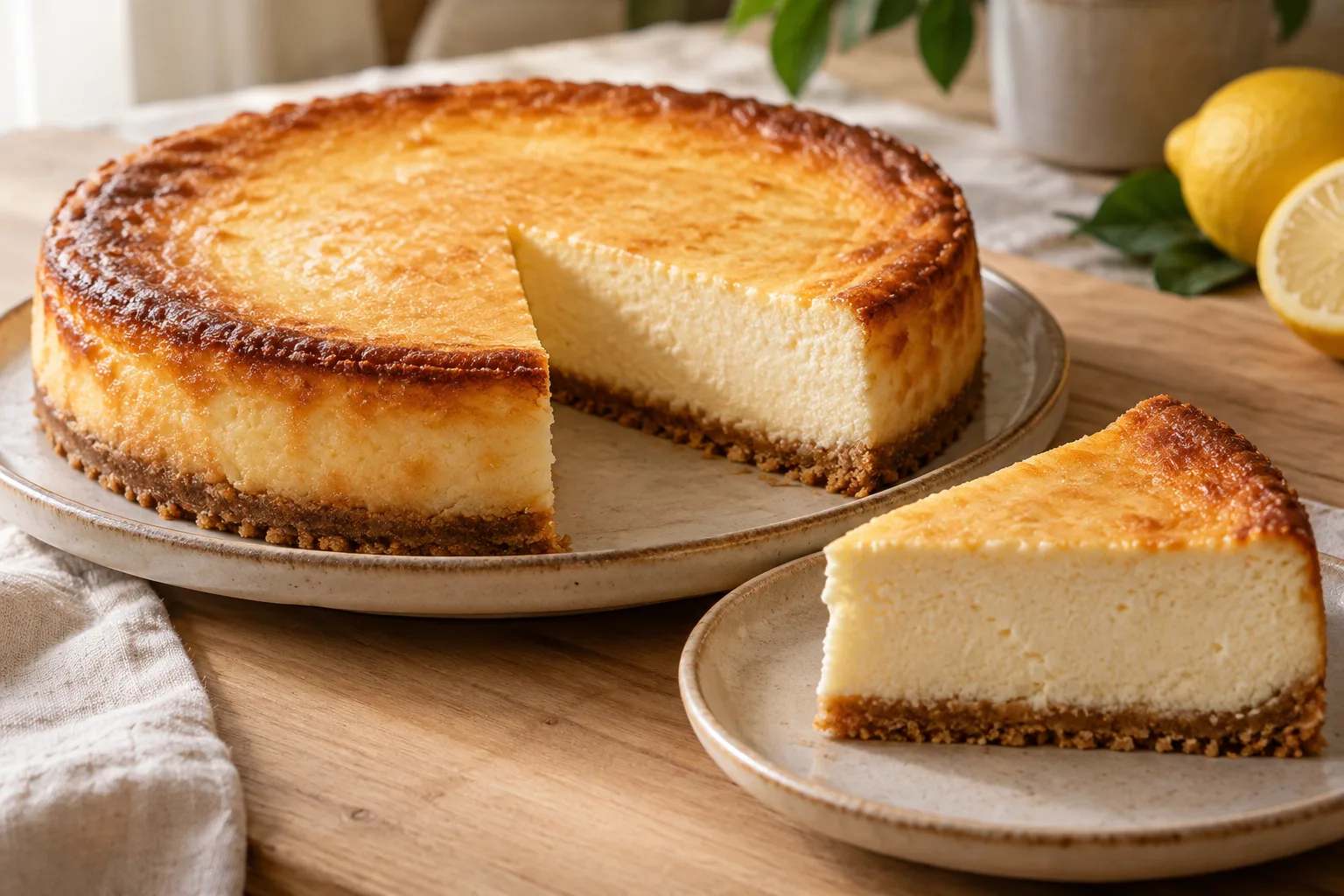
Examples include Kraków-style cheesecake with sugar icing and raisins, and szarlotka, a spiced apple cake with a crumbly topping.

Scope, method and limitations
Population or sample
Culinary description without a consumer sample.
Geographic scope
Poland; traditional repertoire examples, with no stated observation period.
Definition and method
Manual reading of a cultural account, not a consumption survey.
Comparison limitations
Partial qualitative coverage: it does not establish frequency, grams per serving or current national prevalence.
Portion sizes
Quantitative findingSurvey

The questionnaire defined a bread slice as 20 g, a wholemeal bread slice as 30 g and a meat or fish portion as 100 g.

Scope, method and limitations
Observation period
2020
Unit
g per questionnaire reference portion
Population or sample
312 adult participants in Poland, recruited through social media.
Geographic scope
Online survey from 29 April to 19 May 2020.
Definition and method
Reference portions set by the authors for reporting frequency and quantities before and during lockdown.
Comparison limitations
These are questionnaire units, not observed average servings or national recommendations. The volunteer sample does not represent the whole population.

Techniques and equipment

5/5
Techniques and equipment — Poland
IndicatorFindings and context
Cooking techniques
Qualitative descriptionSurvey

A historical regional survey documented potatoes cooked in a microwave oven, pressure cooker and steaming pot.

Scope, method and limitations
Population or sample
500 consenting adult respondents in Mazowieckie.
Geographic scope
Mazowieckie voivodeship, Poland; study published in 2008, with fieldwork dates not stated.
Definition and method
Direct interviews using a closed questionnaire about home preparation of vegetables and potatoes.
Comparison limitations
Partial qualitative historical regional coverage. It does not establish current national method frequencies or a complete distribution of preparations.
Vegetable preparation
Qualitative descriptionSurvey

The same regional survey documented green vegetables cooked in water and by steaming; these are not current national shares of raw and cooked vegetables.

Scope, method and limitations
Population or sample
500 consenting adult respondents in Mazowieckie.
Geographic scope
Mazowieckie voivodeship, Poland; study published in 2008, with fieldwork dates not stated.
Definition and method
Direct interviews using a closed questionnaire about home preparation of vegetables and potatoes.
Comparison limitations
Partial qualitative historical regional coverage. It does not establish current national method frequencies or a complete distribution of preparations.
Food preservation
Qualitative descriptionCultural context

The regional Kruszewo example preserves shredded white cabbage by fermentation and sells it with the acidic liquid produced.

Scope, method and limitations
Population or sample
Documentary record of a regional culinary tradition, without a consumer sample.
Geographic scope
Kruszewo / Podlaskie, Poland.
Definition and method
Reading of the official description of a traditional product.
Comparison limitations
Partial qualitative coverage. It does not quantify consumption or home-use frequency, establish shelf life or provide safety instructions.
Fermented foods
Qualitative descriptionCultural context

In the regional Kujawy tradition, the starter for żur is made from rye flour and water in an earthenware pot.

Scope, method and limitations
Population or sample
Documentary record of a regional culinary tradition, without a consumer sample.
Geographic scope
Kujawy, Poland.
Definition and method
Reading of the official description of a traditional product.
Comparison limitations
Partial qualitative coverage. It does not quantify consumption or home-use frequency, establish shelf life or provide safety instructions.
Kitchen equipment
Quantitative findingSurvey

In 2025, 71.6% of households had a microwave oven and 61.2% a dishwasher.

Scope, method and limitations
Observation period
2025
Unit
% of households
Population or sample
Polish households covered by the household budget survey.
Geographic scope
Poland, 2025; grand total of households, Table50, columnB.
Definition and method
Percentage of equipped households; literal reading of original XLSX cellsB36 andB38.
Comparison limitations
Partial equipment coverage: conventional ovens and pressure cookers are not established here. Ownership does not measure use; categories may overlap.

Drinks

3/3
Drinks — Poland
IndicatorFindings and context
Everyday drinks
Quantitative findingSurvey

In 2025, household records showed 6.1 l of mineral and spring waters and 0.8 l of fruit and vegetable juices per person per month.

Scope, method and limitations
Observation period
2025
Unit
l/person/month
Population or sample
People in private households covered by Poland’s household budget survey.
Geographic scope
Poland, 2025; grand-total household means in Table39.
Definition and method
Household quantity records including purchases, own production and free receipts; monthly mean per person.
Comparison limitations
Partial coverage: not measured individual intake or total hydration. Catering is excluded and not all beverages are described. Categories are not annualised or added together.
Coffee and tea preparation
Quantitative findingSurvey

In the 2025 survey, milk was reported as a coffee additive in 56.8% of responses and white or brown sugar in 37.1%.

Scope, method and limitations
Observation period
2025
Unit
% of survey responses
Population or sample
1004 adult residents of Poland participating in the survey.
Geographic scope
Poland, 12 September to7 October 2025.
Definition and method
CAWI online interview; sample balanced for sex, age and settlement size. Responses concern usual coffee additives.
Comparison limitations
Partial coffee coverage, without amounts in ml or grams or tea habits. Responses may overlap; they are not parts of a whole or measured intake.
Drinks with meals
Qualitative descriptionSurvey

A survey of adult tea consumers documented drinking tea during the first breakfast as well as between meals.

Scope, method and limitations
Population or sample
1700 adult tea consumers in Poland participating in an online survey.
Geographic scope
Poland; study published in 2022, with fieldwork dates not stated.
Definition and method
Online questionnaire distributed through social media, email and a student forum, asking about tea-drinking occasions.
Comparison limitations
Partial qualitative coverage of this sample. It does not establish dated shares of people taking each beverage with meals or a national distribution; inclusion probabilities are not detailed.

Nutrition and dietary patterns

3/3
Nutrition and dietary patterns — Poland
IndicatorFindings and context
Energy and nutrients
Quantitative findingObserved intake

Daily means in the omnivore subgroup: women, 1702.8 kcal, protein 59.8 g, fat 67.4 g, carbohydrates 229.2 g and fibre 17.4 g; men, 2413.5 kcal, 86.1 g, 101.1 g, 302.0 g and 22.2 g, respectively.

Scope, method and limitations
Observation period
2003–2005; 2013–2014
Unit
kcal/day and g/day
Population or sample
Adult female and male omnivore subgroups from an analysis of 13318 participants.
Geographic scope
Poland; pooled surveys from 2003–2005 and2013–2014.
Definition and method
24-hour recall and food-frequency-based dietary classification; daily sex-specific means in Table2.
Comparison limitations
Partial coverage: historical subgroups, not a current whole-population mean. One recall does not measure individual usual intake; no diet effects are inferred.
Salt and sugars
Quantitative findingObserved intake

Recorded dietary sodium, mean±standard deviation: 1903±1051 mg/day in nut consumers and 2026±1273 mg/day in non-consuming controls. Added salt and sodium in homemade dishes are excluded according to the study footnote.

Scope, method and limitations
Observation period
2003–2005; 2013–2014
Unit
mg sodium/day; mean±SD
Population or sample
299 nut consumers and1184 matched non-consuming controls from two WOBASZ surveys.
Geographic scope
Poland; pooled surveys from 2003–2005 and2013–2014.
Definition and method
24-hour recall; Table2 means and standard deviations, with matched controls.
Comparison limitations
Partial coverage: incomplete sodium, without conversion to salt or estimation of total sodium. Total, added and free sugars are not measured. Selected subsamples, not a national mean; no causal nut effect is inferred.
Dietary patterns
Quantitative findingSurvey

In the pooled analysis, 92.4% were classified as omnivores, 7.4% as flexitarians and 0.16% as vegetarians. These are study categories based on reported foods, not self-defined dietary identities.

Scope, method and limitations
Observation period
2003–2005; 2013–2014
Unit
% of classified participants
Population or sample
13318 adults aged20 or older with complete dietary data.
Geographic scope
Poland; pooled surveys from 2003–2005 and2013–2014.
Definition and method
Vegetarians exclude red meat, poultry and fish but may consume eggs, dairy and honey. Flexitarians regularly consume dairy and red meat or poultry from once a month to once a week; omnivores consume meat more than once a week.
Comparison limitations
Partial historical coverage: classification from food responses, not self-declared identity or current prevalence. No separate vegan category is established. Published percentages are rounded.

Shopping, prices and waste

7/7
Shopping, prices and waste — Poland
IndicatorFindings and context
Food expenditure
Quantitative findingSurvey

Food and non-alcoholic beverages accounted for 25.1% of total household expenditure.

Scope, method and limitations
Observation period
2025
Unit
% of total household expenditure
Population or sample
Polish households covered by the Household Budget Survey.
Geographic scope
Poland; household expenditure rather than individual intake.
Definition and method
Household Budget Survey; average monthly expenditure per person, generalised using the 2021 census and age and sex structure.
Comparison limitations
Partial coverage: expenditure share without a monthly food amount in PLN. Series preceding the generalisation change are not directly comparable.
Cost of a common basket
Quantitative findingSurvey

The selected Easter basket shows a 12.8% price increase in the 2026 report.

Scope, method and limitations
Observation period
01.04.2025–16.03.2026; base 07.04.2025
Unit
% price change for specified seasonal basket; not PLN
Population or sample
The product set and quantities specified in the report; not a household sample.
Geographic scope
Poland; seasonal basket including dark chocolate, not a complete household food basket.
Definition and method
Authors’ price index using Online CASE CPI data; reference figure with 07.04.2025=100 and observations through 16.03.2026.
Comparison limitations
Partial coverage: an index change rather than an absolute PLN cost. Easter timing affects same-month comparisons; this is not the CPI and cannot compare baskets with different contents.
Cost of specific meals
Quantitative findingPurchases

The Easter menu lists ruskie, cabbage-and-mushroom or spinach pierogi at PLN 35/kg.

Scope, method and limitations
Observation period
Easter 2026
Unit
PLN/kg of advertised pierogi
Population or sample
One prepared-food offer from Dwór Marcinkowo; no household or restaurant sample.
Geographic scope
Poland; one operator’s advertised price by weight for its Easter offer.
Definition and method
Direct reading of the operator’s seasonal Easter 2026 menu.
Comparison limitations
Partial local catering example: advertised price per kg with no portion weight; not a national mean or home-cooking cost. No per-person price has been calculated.
Grocery shopping locations
Quantitative findingSurvey

Of food shoppers, 49% said they made most of their purchases at discount stores; 24% said about half.

Scope, method and limitations
Observation period
7–13 March 2013
Unit
% of surveyed respondents
Population or sample
Representative random survey of 1060 adult residents of Poland; the outlet findings refer to people who shop for food.
Geographic scope
Poland; self-reported food-shopping habits during the historical survey period.
Definition and method
Self-reported answers in a national survey conducted 7–13 March 2013.
Comparison limitations
Historical partial coverage: percentages of shoppers and their stated purchasing proportions, not monetary expenditure shares by channel. Outlet categories overlap and must not be added.
Shopping frequency
Quantitative findingSurvey

38% reported shopping frequently as needed without stocking up; 32% made larger purchases every few days or less often and then topped them up.

Scope, method and limitations
Observation period
7–13 March 2013
Unit
% of surveyed respondents
Population or sample
Representative random survey of 1060 adult residents of Poland; the outlet findings refer to people who shop for food.
Geographic scope
Poland; self-reported food-shopping habits during the historical survey period.
Definition and method
Self-reported answers in a national survey conducted 7–13 March 2013.
Comparison limitations
Historical partial coverage: reported patterns without mean weekly visits or mean basket value or size; it does not describe current habits.
Prepared food and delivery
Qualitative descriptionPurchases

Among individual dishes ordered, thin-bread kebab led cheeseburger and Margherita pizza; across dish categories, pizza ranked above kebab.

Scope, method and limitations
Observation period
01.09.2024–30.09.2025
Population or sample
Orders recorded on Pyszne.pl in Poland; the release does not provide the sample size.
Geographic scope
One delivery platform; not all prepared meals or the whole population.
Definition and method
Analysis of internal order statistics over the stated observation period.
Comparison limitations
Dish types only. No usual ordering frequency or mean spending per person is estimated; individual dishes and categories use different rankings.
Household food waste
Quantitative findingSurvey

30% reported that their household had discarded food in the previous week: 22% once and 8% several times.

Scope, method and limitations
Observation period
14–27 August 2023; preceding-week recall
Unit
% of surveyed respondents
Population or sample
Representative random sample of 1024 adult residents of Poland, selected from the PESEL register.
Geographic scope
Poland; the respondent’s report about their household during the preceding week.
Definition and method
Survey conducted 14–27 August 2023 using the same questionnaire face to face, by telephone or online.
Comparison limitations
Historical partial coverage: reported occurrence without kg per person per year or a quantified edible/inedible split. It does not measure waste mass.

Seasons and celebrations

2/2
Seasons and celebrations — Poland
IndicatorFindings and context
Seasonal produce
Qualitative descriptionCultural context

In Poland, the main mushroom season falls in September and October; emergence depends on moisture and temperature.

Scope, method and limitations
Observation period
Seasonal description; source published 2024
Population or sample
Description of seasonal wild-mushroom availability; no household sample.
Geographic scope
Poland; general mushroom calendar without regional or species breakdown.
Definition and method
Qualitative synthesis of a public-health communication published in August 2024.
Comparison limitations
Partial coverage: mushrooms only, without a complete fruit and vegetable calendar or imported availability. Weather changes the season; this is not an identification or foraging guide.
Celebration food
Qualitative descriptionCultural context

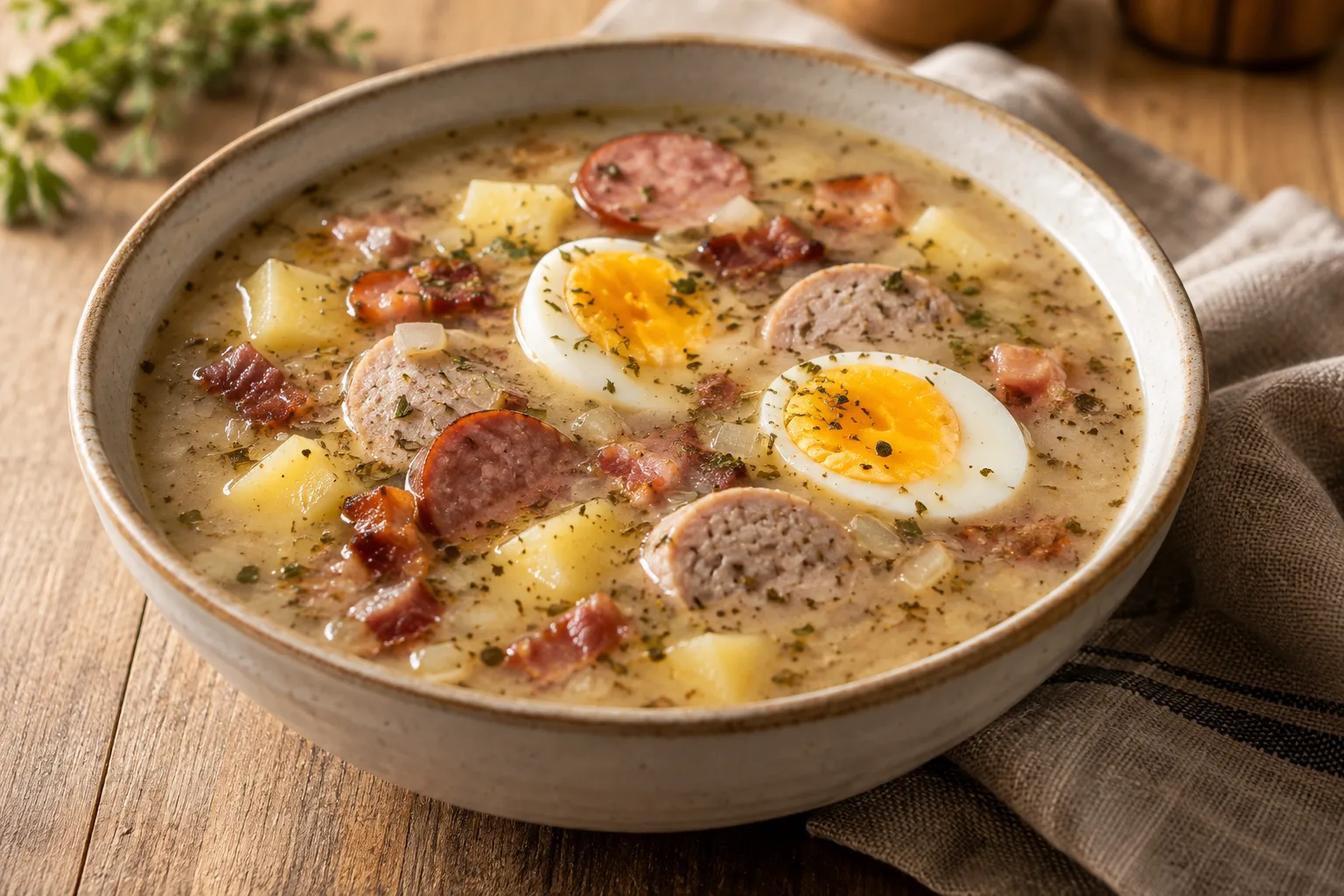
In the Easter tradition described, the święconka basket is prepared on Saturday with decorated eggs, bread, sausage and babka; its food is shared at the start of Sunday breakfast. Festive żurek includes white sausage, horseradish and eggs.

Scope, method and limitations
Observation period
Cultural description; source published 2020
Population or sample
Cultural description of Polish Easter; no survey or percentage of households.
Geographic scope
Poland; the Easter tradition described, without attributing it to every household or region.
Definition and method
Synthesis of an official cultural explanation published in April 2020.
Comparison limitations
Partial coverage: Easter only, without a complete festival inventory or measurement of current participation. Easter Saturday and Sunday are specified without assigning a fixed calendar date.

Coverage in progress

The editorial guide for this country is in preparation. You can already explore its recipes; regional attributions are added when documented.

Guide available in other languages: Español

Places and communities

One country, many cuisines

An initial selection of regions to explore. Culinary boundaries may differ from administrative divisions.

Poland

Casubia

Poland

Podlasia

Poland

Silesia

Cook

Recipes connected with Poland

Each recipe documents one version. Geographic associations do not imply an exclusive origin.
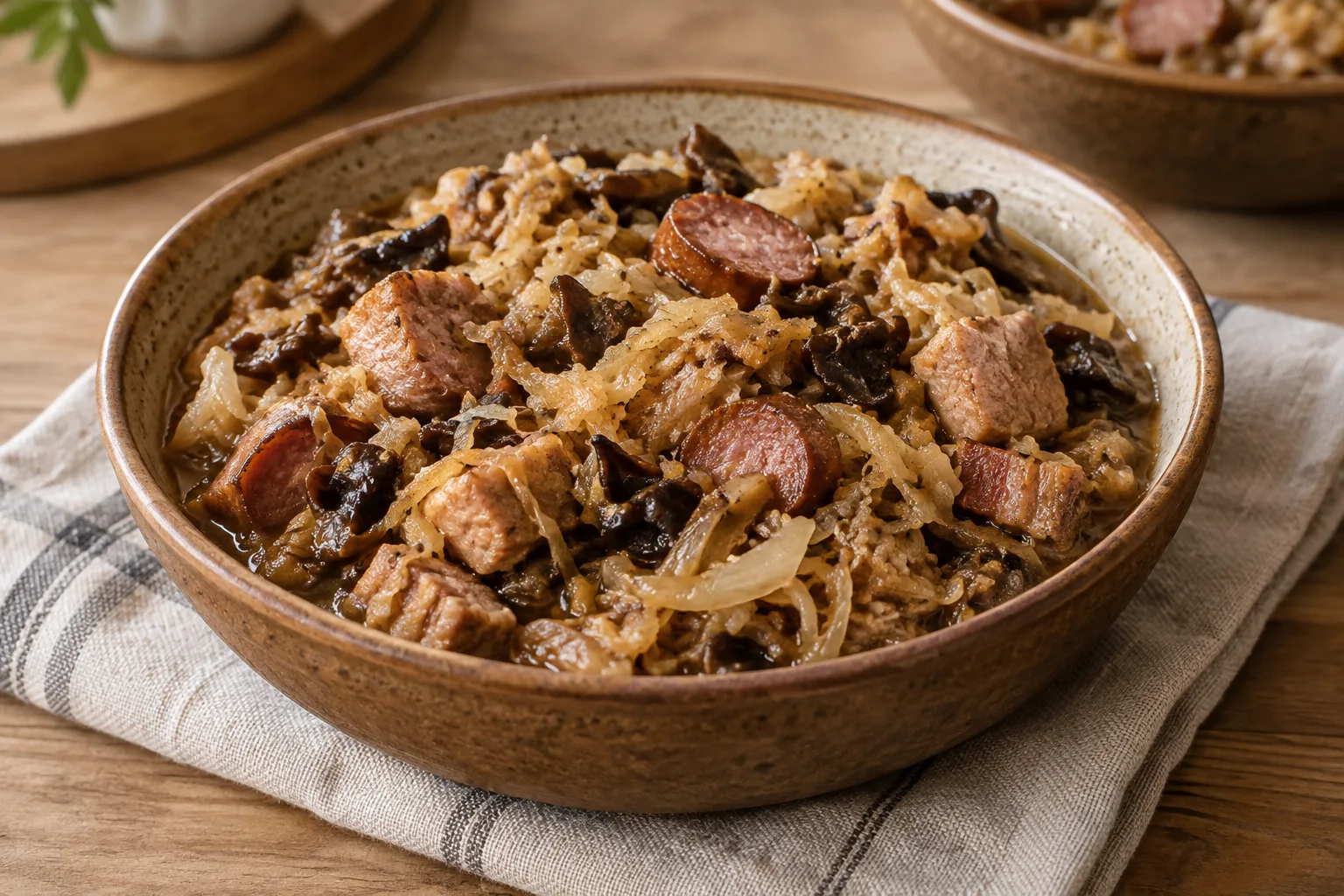
Polish Bigos
Image generated by the Kitchenpause team
75 minIntermediate

Polish Bigos

A Polish stew of fermented cabbage, meat, sausage and mushrooms, gently simmered in broth. Makes 5 servings.

View recipe
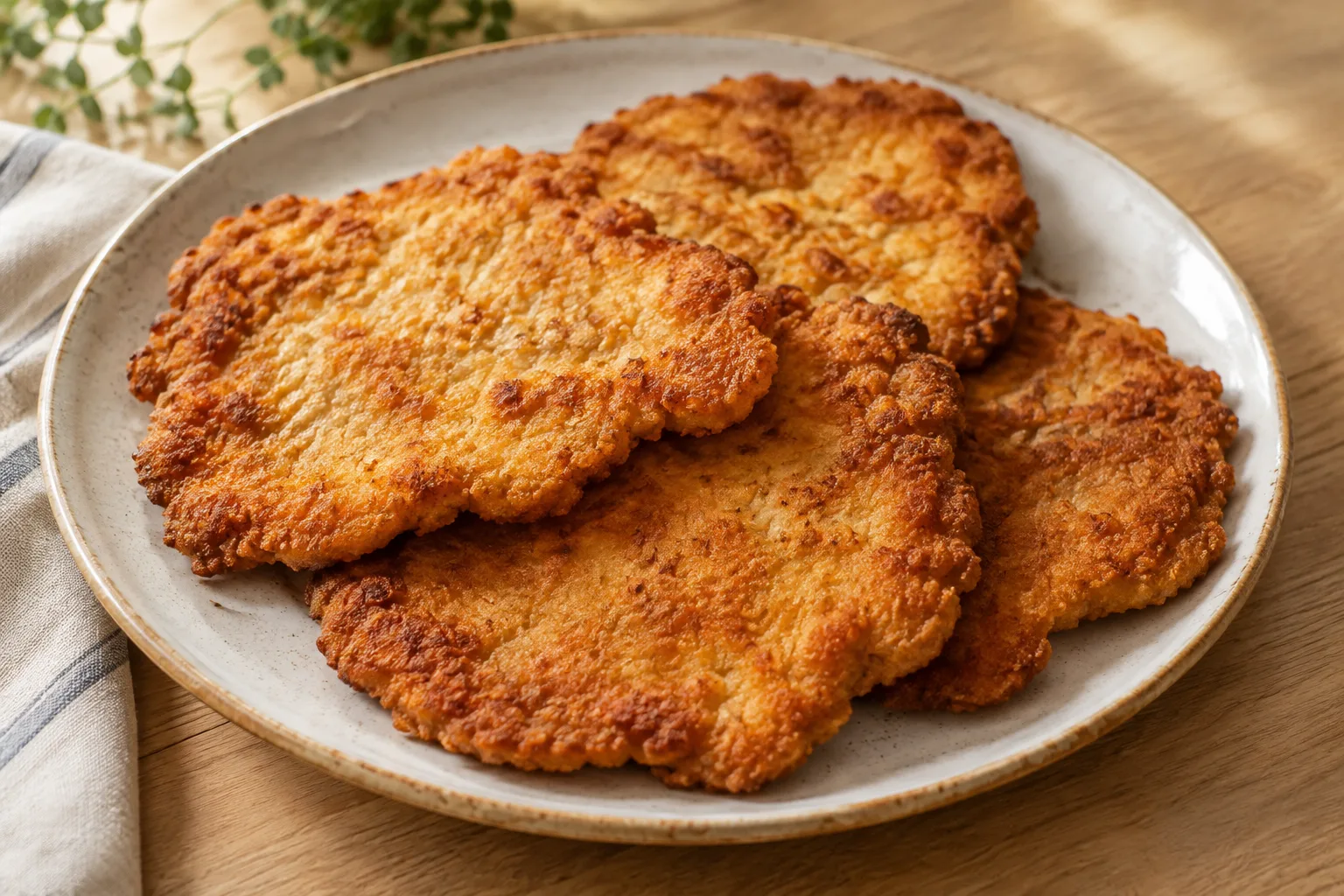
Polish Kotlet Schabowy
Image generated by the Kitchenpause team
23 minEasy

Polish Kotlet Schabowy

Pounded pork loin chops coated in flour, egg, and breadcrumbs, then fried until golden. Preparation and cooking take about 15 and 8 minutes, respectively; these times are estimates.

View recipe
Polish Pączki
Image generated by the Kitchenpause team
227 minIntermediate

Polish Pączki

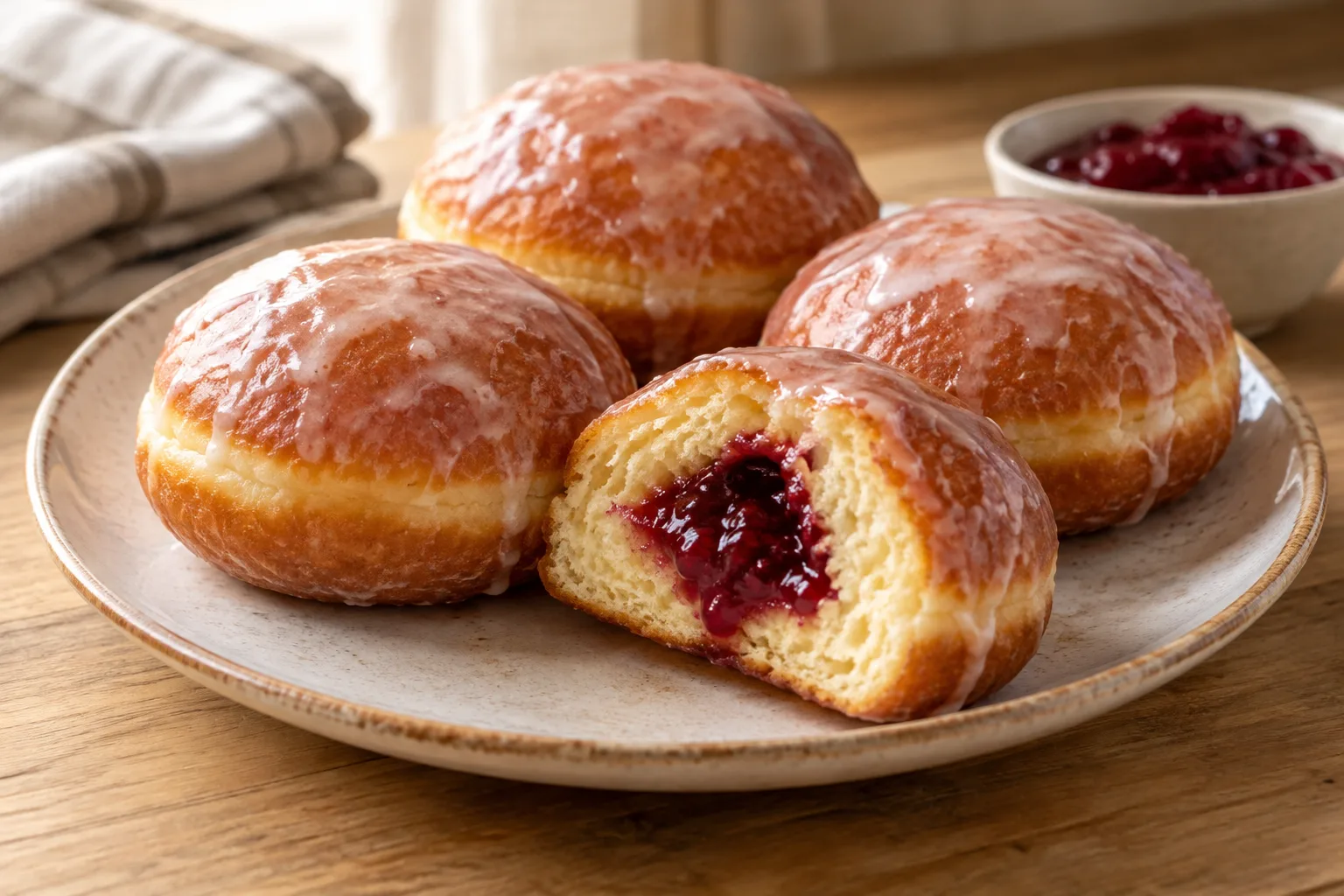
Polish yeasted doughnuts, fried until golden, filled with raspberry jam, and finished with a light glaze.

View recipe
Sources consulted

Read the sources and each document’s scope. A heritage inscription concerns a particular practice, not all of a country’s cuisine.

  1. Meal Timing Patterns Across 50 Countries: When the World Eats | Nutrola nutrola.app/en/blog/meal-timing-patterns-across-50-countries-when-the-world-eats nutrola.app Consulted: November 2, 2026
  2. Poland — National dietary and nutritional status survey 2019–2020 www.pzh.gov.pl/download/28206/ NIZP-PZH Consulted: November 2, 2026
  3. Poland — Food for thought: eating behavior in the United States, Poland and Armenia ora.ox.ac.uk/objects/uuid%3A915ca54f-e24e-45fa-9788-0bf79d893ae3/files/mf7b946c4e83188f8bd68… Ewa Jarosz; Oxford University Research Archive Consulted: November 2, 2026
  4. Poland — Distribution of energy and macronutrient intakes across eating occasions, CHOP link.springer.com/content/pdf/10.1007/s00394-022-02944-6.pdf Jaeger et al.; European Journal of Nutrition Consulted: November 2, 2026
  5. Poland — Time of dietary energy and nutrient intake: CHOP follow-up dates mdpi-res.com/d_attachment/nutrients/nutrients-14-04356/article_deploy/nutrients-14-04356.pdf Jaeger et al.; Nutrients Consulted: November 2, 2026
  6. Poland — Time budget of inhabitants of large cities during COVID-19 sciendo.com/2/v2/download/article/10.2478/pjst-2021-0024.pdf Piotrowski and Krukowska; Polish Journal of Sport and Tourism Consulted: November 2, 2026
  7. Poland — Nawyki żywieniowe, October2010 www.cbos.pl/SPISKOM.POL/2010/K_150_10.PDF CBOS Consulted: November 2, 2026
  8. Poland — Time Use Survey 2023, corrected publication stat.gov.pl/files/gfx/portalinformacyjny/en/defaultaktualnosci/3305/17/1/1/time_use_survey_2… Statistics Poland Consulted: November 2, 2026
  9. Poland — Average monthly household quantities of selected foodstuffs, 2025 plwliczbach.stat.gov.pl/en/pages/households.html Statistics Poland Consulted: November 2, 2026
  10. Poland — Household Budget Survey in 2025: methodological definition of food quantities stat.gov.pl/download/gfx/portalinformacyjny/en/defaultaktualnosci/3305/2/21/1/house_hold_bud… Statistics Poland Consulted: November 2, 2026
  11. Poland — KitchenPause original ingredient analysis of six published recipes, snapshot2026-11-02 www.kitchenpause.com/en/cocinas/polish KitchenPause published recipe catalogue; original manual analysis Consulted: November 2, 2026
  12. Poland — Household Budget Survey in 2025, original food quantity tables, Table39 stat.gov.pl/download/gfx/portalinformacyjny/en/defaultaktualnosci/3305/2/21/1/house_hold_bud… Statistics Poland Consulted: November 2, 2026
  13. Poland — Dietary protein sources in rural women, Mogielica/Beskid Wyspowy, original repeated-recall study pmc.ncbi.nlm.nih.gov/articles/PMC9718368/ Ban et al.; American Journal of Physical Anthropology Consulted: November 2, 2026
  14. Poland — Ćwikła z Werbkowic, Lubelskie regional traditional product record www.gov.pl/web/rolnictwo/cwikla-z-werbkowic Ministry of Agriculture and Rural Development, Poland Consulted: November 2, 2026
  15. Poland — Nutrition Behaviors in Polish Adults before and during COVID-19 Lockdown mdpi-res.com/d_attachment/nutrients/nutrients-12-03084/article_deploy/nutrients-12-03084.pdf Nutrients; original research by Błaszczyk-Bębenek et al. Consulted: November 2, 2026
  16. Poland — What’s for dinner? go2warsaw.pl/en/whats-for-dinner/ Warsaw Tourism Office Consulted: November 2, 2026
  17. Poland — A Typical Daily Menu in Poland culture.pl/en/article/a-typical-daily-menu-in-poland Adam Mickiewicz Institute / Culture.pl Consulted: November 2, 2026
  18. Poland — Ocena prawidłowości przygotowania potraw z warzyw i ziemniaków w warunkach domowych wydawnictwo.pttz.org/wp-content/uploads/2015/02/32_Namyslaw.pdf Żywność. Nauka. Technologia. Jakość; Namysław, Czarniecka-Skubina and Wachowicz Consulted: November 2, 2026
  19. Poland — Kruszewska kapusta kiszona www.gov.pl/web/rolnictwo/kruszewska-kapusta-kiszona Ministerstwo Rolnictwa i Rozwoju Wsi Consulted: November 2, 2026
  20. Poland — Żur kujawski www.gov.pl/web/rolnictwo/zur-kujawski Ministerstwo Rolnictwa i Rozwoju Wsi Consulted: November 2, 2026
  21. Poland — The Habits and Preferences of Poles Regarding Coffee Consumption and Perception ctmri.eu/wp-content/uploads/2026/06/CTMJ-Vol.03-Iss.01-2026-Art.01.pdf Coffee & Tea Marketing Journal; Anna Dąbrowska Consulted: November 2, 2026
  22. Poland — Consumer Choices and Habits Related to Tea Consumption by Poles mdpi-res.com/d_attachment/foods/foods-11-02873/article_deploy/foods-11-02873.pdf Foods; original consumer research Consulted: November 2, 2026
  23. Poland — Dietary Antioxidants, Quality of Nutrition and Cardiovascular Characteristics among Omnivores, Flexitarians and Vegetarians mdpi-res.com/d_attachment/antioxidants/antioxidants-12-00222/article_deploy/antioxidants-12-… Antioxidants; original WOBASZ dietary analysis Consulted: November 2, 2026
  24. Poland — The Consumption of Nuts is Associated with Better Dietary and Lifestyle Patterns in Polish Adults mdpi-res.com/d_attachment/nutrients/nutrients-11-01410/article_deploy/nutrients-11-01410.pdf Nutrients; original WOBASZ selected-subgroup analysis Consulted: November 2, 2026
  25. Sytuacja gospodarstw domowych w 2025 r. — Household Budget Survey publikacje.new.stat.gov.pl/sites/default/files/2026-05/sytuacja_gospodarstw_domowych_2025.pd… Statistics Poland (GUS) Consulted: November 2, 2026
  26. Pyszne.pl — order types in internal transactions, 01.09.2024–30.09.2025 newsroom.justeattakeaway.com/pl-PL/258446-cztery-bulki-sniadaniowe-i-gruzinska-uczta-za-4500… Just Eat Takeaway.com / Pyszne.pl Consulted: November 2, 2026
  27. Cennik dań i ciast na Wielkanoc2026 dwormarcinkowo.pl/wp-content/uploads/2026/02/Menu-wielkanoc-2026.pdf Dwór Marcinkowo Consulted: November 2, 2026
  28. Jak i gdzie kupujemy żywność — national food shopping survey, March2013 www.cbos.pl/SPISKOM.POL/2013/K_094_13.PDF CBOS / Akademia Leona Koźmińskiego Consulted: November 2, 2026
  29. Koszyk wielkanocny CASE2026 — specified seasonal food-basket price index case-research.eu/app/uploads/2026/03/Koszyk-wielkanocny-2026_okl.pdf CASE — Center for Social and Economic Research Consulted: November 2, 2026
  30. Deklaracje Polaków dotyczące marnowania żywności — August2023survey www.cbos.pl/SPISKOM.POL/2023/K_126_23.PDF CBOS Consulted: November 2, 2026
  31. Grzybobranie —13.08.2024 www.gov.pl/web/psse-kamien-pomorski/grzybobranie State Sanitary Inspection, PSSE Kamień Pomorski Consulted: November 2, 2026
  32. Traditional dishes of Polish Easter —12.04.2020 www.gov.pl/web/greece/dishes2 Republic of Poland, Embassy in Greece Consulted: November 2, 2026
  33. Get a Bite of Poland — cocina regional www.poland.travel/en/wp-content/uploads/sites/17/2025/12/Kulinaria_EN.pdf Polish Tourism Organisation
  34. Podlasia y sus cruces culturales www.poland.travel/en/podlaskie-voivodship-undiscovered-beauty/ Polish Tourism Organisation

We use session and security technologies to provide our features. Only with your permission do we load Google Analytics to measure visits and Google Maps on Contact. Choose separately, reject or accept both.

Withdraw either permission here. Withdrawing analytics reloads the page to unload the running tag.

Cookie policy