Asia · Western Asia
Turkey
Aegean vegetables, filled dough from Anatolia and Black Sea leaves offer routes through techniques, variants and shared preparations.
Food and eating habits
How people eat in Turkey
50 indicators exploring everyday meals, ingredients and food culture. Information is completed progressively from documented evidence.
50 of 50 indicators with documented information
Not all data are comparable: food supply, purchases and intake are different measures. Check the period, population and method for each finding. Qualitative descriptions do not establish percentages or amounts.
Timing and company
8/8
| Indicator | Findings and context |
|---|---|
| Meal times |
In this sample, mean first intake shifted from 9:29 before the pandemic to 10:45 during it; mean last intake shifted from 20:49 to 21:29. Scope, method and limitations
|
| Meals per day |
Breakfast is reported by 85%, lunch by 75.3% and dinner by 96.3%. Mid-morning snacks are reported by 39.8%, afternoon snacks by 51.2% and bedtime snacks by 64.5%. Scope, method and limitations
|
| Meal duration |
In the clinical sample, mean self-reported meal duration was 20.8 minutes in women with polycystic ovary syndrome and 23.8 minutes in controls. Scope, method and limitations
|
| Daily energy distribution |
In the Istanbul infant sample, breakfast made the largest energy contribution within the meal and snack pattern studied. Scope, method and limitations
|
| Weekdays and weekends |
Eating together at all three main meals was reported more often on weekends than weekdays. Dinner brought household members together most often in both cases. Scope, method and limitations
|
| Eating at home and away |
In the first daily recall, 65.5% of men and 79.8% of women ate breakfast at home; 81.0% and 86.9%, respectively, ate dinner at home. Scope, method and limitations
|
| Cooking frequency |
In the reference week, each person reported cooking lunch at home on an average of 1.9 days and dinner on 2.7 days. Scope, method and limitations
|
| Eating together |
Eating together “often or always”: weekdays, breakfast 45.0%, lunch 31.4%, dinner 77.1%; weekends, 70.1%, 59.9%, 81.9%, respectively. Scope, method and limitations
|
Pantry and recipes
2/2
| Indicator | Findings and context |
|---|---|
| Most consumed ingredients |
Wheat: 159.8 kg per capita; potatoes: 58.0 kg per capita, in marketing year 2023/24. Scope, method and limitations
|
| Ingredient prevalence in recipes |
In the regional recipe sample, onion, butter, wheat flour, tomato and pepper pastes and yogurt stand out among frequently shared ingredients. Scope, method and limitations
|
Cereals and plant foods
6/6
| Indicator | Findings and context |
|---|---|
| Cereals and cereal products |
Availability in primary-product equivalents: wheat 159.8, maize 15.6 and rice 8.3 kg per capita in 2023/24. Scope, method and limitations
|
| Bread |
Mean bread-group intake: 179.8 g per person per day. Includes white, whole-grain and other bread types such as pide and lavaş. Scope, method and limitations
|
| Pulses |
Dried-pulse availability in primary-product equivalents: chickpeas 4.9, red lentils 4.7 and dry beans 3.1 kg per capita in 2023/24. Scope, method and limitations
|
| Vegetables |
Mean fresh-vegetable-group intake: 256.2 g per person per day. The category includes leafy vegetables and potatoes. Scope, method and limitations
|
| Fruit |
Mean fresh-fruit-group intake: 158.8 g per person per day. Includes citrus and other fresh fruit. Scope, method and limitations
|
| Potatoes, roots and tubers |
Mean potato intake: 38.7 g per person per day, using the survey’s food coding. Scope, method and limitations
|
Protein foods
5/5
| Indicator | Findings and context |
|---|---|
| Meat |
Mean intake: red meat 39.1 g and poultry 28.2 g per person per day. Scope, method and limitations
|
| Fish and seafood |
Mean fish intake: 13.2 g per person per day. Scope, method and limitations
|
| Eggs |
Mean egg intake: 31.6 g per person per day. Scope, method and limitations
|
| Milk and dairy products |
Mean intake per person per day: milk 34.5 mL, yogurt 112.7 g and cheese 39.0 g. Scope, method and limitations
|
| Protein sources |
Published mean percentage of plant protein relative to total dietary protein: 58.0% in men and 60.7% in women. Scope, method and limitations
|
Fats, flavours and condiments
3/3
| Indicator | Findings and context |
|---|---|
| Cooking fats |
Mean intake per person per day: olive oil 5.2 mL, other liquid oils 16.6 mL and butter 5.0 g. Scope, method and limitations
|
| Herbs and spices |
In Gaziantep, mint is used in yogurt dishes, cumin in ciğer kebabı, fennel in aşure and cinnamon in sütlaç. Scope, method and limitations
|
| Sauces and condiments |
In Antalya, the tarator sauce served with bean piyaz combines tahini (sesame paste), lemon juice, vinegar, garlic and salt. Scope, method and limitations
|
Meal composition
6/6
| Indicator | Findings and context |
|---|---|
| Breakfast composition |
Breakfast is reported by 85%. The culinary description includes cheese, olives, bread, eggs and jam; that percentage does not measure consumption of those foods. Scope, method and limitations
|
| Main meal composition |
Lunch is reported by 75.3%. The culinary description of lunch includes stews, soup and salads; it does not identify the meal with the greatest energy intake. Scope, method and limitations
|
| Dinner composition |
Dinner is reported by 96.3%. The culinary description presents soup, a main course, salad and dessert as a dinner structure; it does not measure each component’s frequency. Scope, method and limitations
|
| Appetisers and snacks |
Mid-morning snacks are reported by 39.8%, afternoon snacks by 51.2% and bedtime snacks by 64.5%. The regional description of yatsilik mentions appetizers, fruit and nuts; this is not the measured composition of those snacks. Scope, method and limitations
|
| Desserts and sweets |
The dessert repertoire includes milk-and-sugar sweets such as sütlaç, kazandibi and sakızlı muhallebi, alongside baklava made with layers of phyllo dough, syrup and nuts. Scope, method and limitations
|
| Portion sizes |
In the staff dining hall studied, bread was served in 50 g bags. This is the observed distribution unit at that facility, without measuring how much bread each person ate. Scope, method and limitations
|
Techniques and equipment
5/5
| Indicator | Findings and context |
|---|---|
| Cooking techniques |
Chicken: oven/grill/oil-free Teflon pan, 36.9%; fish: frying in oil, 51.8%; dried pulses: pressure cooker, 50.6%; pasta: boiling and discarding the water, 74.5%. These are reported usual methods for each food. Scope, method and limitations
|
| Vegetable preparation |
For vegetable dishes with or without meat, 55.9% report the category of cooking in little or much water/buğulama, 1.3% steaming and 2.6% frying in oil. Scope, method and limitations
|
| Food preservation |
The winter preservation repertoire includes drying peppers, aubergines, tomatoes and fruit; preparing pickles with water, salt and vinegar; making jams, canning and storing food in freezers. Scope, method and limitations
|
| Fermented foods |
Tarhana is a soup base made with yogurt and cereals, sometimes also with vegetables. In the preparation described, the dough ferments and is then dried and crumbled; local variants exist. Scope, method and limitations
|
| Kitchen equipment |
Households report a gas/electric oven in 79.1%, a microwave oven in 24.2%, a deep freezer in 38.1% and a food processor/blender in 56.3%. Scope, method and limitations
|
Drinks
3/3
| Indicator | Findings and context |
|---|---|
| Everyday drinks |
Mean intake per person per day: water/mineral water/soda water, grouped, 1169.9 mL; coffee, 26.2 mL; total non-alcoholic beverages including water, 1721.8 mL. Scope, method and limitations
|
| Coffee and tea preparation |
The Turkish coffee described uses finely ground roasted beans, water and sugar according to preference, heated in a cezve and served in small porcelain cups; sade has no sugar. Black tea is brewed in a çaydanlık or samovar and served in small tulip-shaped glasses. Scope, method and limitations
|
| Drinks with meals |
The culinary pairings described include tea with breakfast and cold ayran with kebabs, köfte, meat dishes or pilaf. Scope, method and limitations
|
Nutrition and dietary patterns
3/3
| Indicator | Findings and context |
|---|---|
| Energy and nutrients |
Mean daily intake in men: energy 2209.3 kcal, protein 81.3 g, fat 83.2 g, carbohydrate 276.1 g and fibre 24.4 g. In women: energy 1624.8 kcal, protein 57.4 g, fat 64.7 g, carbohydrate 198.9 g and fibre 20.1 g. Scope, method and limitations
|
| Salt and sugars |
Mean intake per person per day: salt 10.2 g and table sugar 19.9 g. Scope, method and limitations
|
| Dietary patterns |
Vegetarian self-identification was reported by 0.7% of the surveyed population; the definition includes partial vegetarians and pescetarians. Scope, method and limitations
|
Shopping, prices and waste
7/7
| Indicator | Findings and context |
|---|---|
| Food expenditure |
Food and non-alcoholic beverages: 17.3% of household consumption expenditure. Scope, method and limitations
|
| Cost of a common basket |
Monthly basket per person: 315 TRY. Includes bread 7.5 kg; rice 3 kg; bulgur 1.5 kg; beans 1.5 kg; eggs 30 pieces; yoghurt 1.5 kg; white cheese 1.5 kg; tomatoes 0.9 kg; cucumber 0.9 kg; sunflower oil 0.75 L; sugar 1.5 kg; salt 0.15 kg; tea 0.15 kg. Scope, method and limitations
|
| Cost of specific meals |
Opening set meal of mushroom soup, roast köfte, bulgur pilaf and pear: 70 TRY; with İstanbulkart, 60 TRY. Scope, method and limitations
|
| Grocery shopping locations |
Snack expenditure: discount stores 41%, national chains 14%, local chains 8%, traditional trade 21% and other channels 15%. Scope, method and limitations
|
| Shopping frequency |
Snack purchases per household: 96 occasions per year and a mean 112 TRY per snack basket. Scope, method and limitations
|
| Prepared food and delivery |
Prepared-food consumption: approximately 5 occasions per person per month and 254 TRY per occasion. Delivery: 16.9% of occasions; on site: 64.2%; collection: 18.9%. Scope, method and limitations
|
| Household food waste |
Foods households identify as most wasted are fresh fruit and vegetables, followed by bread and dairy products. Scope, method and limitations
|
Seasons and celebrations
2/2
| Indicator | Findings and context |
|---|---|
| Seasonal produce |
Fresh Bursa Siyahı figs in the Mediterranean region: ripening from early August to mid-October. Scope, method and limitations
|
| Celebration food |
During Muharram, aşure is cooked and shared, combining wheat, beans, chickpeas, apricots and figs. In Ahlat, the feast ending Ramadan includes harse, stuffed cabbage, şile aşı and baklava. Scope, method and limitations
|
Explore its cuisinesRead as an article ↗
Turkey: the Aegean, Anatolia and tables shaped by dough
Documentary synthesis prepared with AI assistance. It does not replace specialist review or certify kitchen testing. · Updated 3 November 2026
Connecting a country through its crossroads
Turkey's cuisines bring together repertoires from the Aegean, Anatolia and the Black Sea, alongside cities and communities with traditions of their own. The olive oil and vegetables of one coastal route, the small filled dough parcels of another, and leaves wrapped around a filling reveal differences that a list of national dishes would miss.
Many names and techniques are also shared with neighbouring territories. The documented variants and movements offer ways to compare preparations without treating a political border as an absolute culinary boundary. An individual recipe remains the useful starting point when moving from history to home cooking.
Three regional routes
The Aegean: oil, herbs and vegetables
The regional repertoire connects olive groves, herbs, vegetables and the coast. Its examples invite us to see vegetables as the centre of a dish and recognise different ways of preparing small dishes for the table. They do not prescribe a compulsory combination of ingredients. The useful lesson is to identify which ingredient leads a dish and how it is handled before combining it with the others.
Central Anatolia: examining a filled dough parcel
The documentation on mantı identifies Kayseri's small, sealed parcels within a broader family. Sizes, fillings and cooking methods can vary. This diversity means that a mantı preparation cannot be assigned to Kayseri without identifying its particular version. In the KitchenPause collection, the recipe called Turkish mantı retains its national classification: the name alone does not justify a more precise regional origin.
The Black Sea: what a leaf contributes
The documentation on sarma and dolma includes Black Sea preparations using cabbage leaves. Distinguishing between wrapping a filling and stuffing an ingredient helps explain these culinary families. The leaf, its size and the preparation of the contents change the final structure. To learn a technique, choose a documented version and check which operations precede assembling each parcel.
Dough, leaves and fillings
These materials organise food in different ways: dough can close around a filling or provide a base for an open preparation; a leaf offers another kind of wrapper. Comparing their structures helps plan the work and identify the parts that require the most attention. Cooking methods and fillings should not be exchanged simply because two dishes look similar at first sight.
Shared work is also a tradition
Making mantı is associated with family gatherings and significant occasions because preparing and sealing numerous parcels takes work. The documentation on sarma and dolma also places these preparations within festive and domestic meals. Several people taking part can help pass on gestures, names and preferences. This social dimension complements the ingredient list and helps explain why a preparation can retain many versions.
A practical route for learning
Choose a structure: closed dough, an open dough base or a leaf wrapper. Then organise the components and consider the role of the accompaniment. The national selection in this guide provides a starting point without suggesting that one recipe represents every cuisine in the territory. Regional documentation allows further exploration and comparison once a first preparation is familiar.
A vocabulary of fillings and wrappers
- Mantı: a family of small filled dough parcels with different sizes and cooking methods.
- Sarma: a preparation that illustrates wrapping a filling.
- Dolma: a family associated with stuffing an ingredient, requiring the precision of a particular version.
- Zeytinyağlı: a term referring to preparations with olive oil within the documented Aegean repertoire.
Size is a decision too
For mantı, dough thickness, the amount of filling and the seal shape the work. A small parcel is not organised in the same way as a large wrapper. The documented variants include boiling, steaming and baking, with accompaniments such as yoghurt and butter sauce. The name covers a broad family; an individual recipe identifies the intended structure and finish.
Cooking together is part of the knowledge
The labour of making mantı is associated with gatherings and special days. Sharing the tasks of rolling, filling and sealing reveals a social dimension that an ingredient list does not show. Aegean vegetable routes and Black Sea leaf preparations add other ingredients and methods. Each route offers a culinary gesture and the context in which it is passed on.
A route for comparing assembly
Start with beef mantı with yoghurt and paprika butter, which has its own entry in the recipe collection. Lamb lahmacun and walnut baklava offer further ways to explore the relationship between dough, filling and surface. Sarma and dolma preparations, including those using Black Sea leaves, extend the route through their documentation. Comparing them as cultural references helps identify what contains, what wraps and what needs advance preparation. Keep the regional names and consult each recipe's own sequence when moving from reading to cooking.
From the regions to the current recipe collection
The published mantı and lahmacun recipes allow a comparison between sealed dough and an open base. Read their complete entries and organise dough, filling and accompaniments separately. The atlas retains the national association of these recipes; their titles alone do not justify assigning them to one of this guide's regions.
Timing and company
Meals per day. Breakfast is reported by 85%, lunch by 75.3% and dinner by 96.3%. Mid-morning snacks are reported by 39.8%, afternoon snacks by 51.2% and bedtime snacks by 64.5%.
Non-institutionalized civilian population of Türkiye aged 15 or older; 12986 completed survey questionnaires, with table-specific denominators. Fieldwork September–December 2017; national TBSA survey, historical figures from that round. Three-stage cluster sampling, one selected person per household and weighted percentages; participant counts are unweighted. Interview on main-meal and snack habits. Partial coverage: proportion reporting each meal, not mean daily meals or days per week. Categories overlap and are not a partition; not the first-day recall and excludes children and institutions.
Eating at home and away. In the first daily recall, 65.5% of men and 79.8% of women ate breakfast at home; 81.0% and 86.9%, respectively, ate dinner at home.
Non-institutionalized civilian population of Türkiye aged 15 or older; 12986 completed survey questionnaires, with table-specific denominators. Fieldwork September–December 2017; national TBSA survey, historical figures from that round. Three-stage cluster sampling, one selected person per household and weighted percentages; participant counts are unweighted. First retrospective one-day dietary recall, by sex. Denominators include people who skipped that meal. Eating place differs from preparation place. Partial breakfast/dinner coverage; interview scheduling underrepresents Fridays and Saturdays. No combined national mean or habitual frequency inferred.
Eating together. Eating together “often or always”: weekdays, breakfast 45.0%, lunch 31.4%, dinner 77.1%; weekends, 70.1%, 59.9%, 81.9%, respectively.
Household members in Türkiye; survey of non-institutionalized civilians aged 15 or older, with a household informant. Fieldwork from 16 August to 15 November 2021; reported weekday and weekend habits. Face-to-face survey with two-stage stratified cluster sampling; national table combining the response categories “often” and “always”. Partial coverage of meals shared by household members, not friends or other people. Reported habits, not shares of all observed meals or daily meal counts; categories must not be added as a partition.
Weekdays and weekends. Eating together at all three main meals was reported more often on weekends than weekdays. Dinner brought household members together most often in both cases.
Fieldwork from 16 August to 15 November 2021; reported weekday and weekend habits. Partial coverage of meals shared by household members, not friends or other people. Reported habits, not shares of all observed meals or daily meal counts; categories must not be added as a partition. Does not measure changes in clock times, duration or total meal counts.
Meal times. In this sample, mean first intake shifted from 9:29 before the pandemic to 10:45 during it; mean last intake shifted from 20:49 to 21:29.
340 adult residents of Türkiye recruited through social media; non-probability sample. Survey in July–September 2020; retrospective comparison of pre-pandemic and pandemic periods. Cross-sectional web questionnaire with snowball sampling; self-reported times and weekly weighted averages of work and free days. Partial first/last intake coverage, not modal breakfast, lunch and dinner times. Means in reported hour:minute format in Türkiye, not meal duration; exceptional period and retrospective recall without national representativeness.
Meal duration. In the clinical sample, mean self-reported meal duration was 20.8 minutes in women with polycystic ovary syndrome and 23.8 minutes in controls.
Observation period: 2009–2010. 18 patients and 17 controls with duration data at a Hacettepe clinic, Ankara; selected sample of women. Study July 2009–December 2010; baseline habits, not duration of the experimental meal. Baseline face-to-face habits questionnaire, self-reported duration per meal; separate group means. Partial historical clinical coverage without separate breakfast, lunch and dinner. Not a national mean or representative of men, other ages or all people with the syndrome; not external timing or a causal difference.
Cooking frequency. In the reference week, each person reported cooking lunch at home on an average of 1.9 days and dinner on 2.7 days.
Observation period: 2018–2019. Resident non-institutionalized civilian population of Türkiye aged 15 or older, including people who do not cook. 2018 wave; global fieldwork ran 6 April 2018–6 January 2019. The report does not give separate Turkish dates. Weighted national probability survey; recall of the past seven days of personally cooking at home, mainly from ingredients. Lunch and dinner frequencies may overlap on the same day and must not be added as distinct days. Excludes breakfast and does not measure preparation minutes or meals eaten but cooked by others. Self-report; the report does not detail the Turkish sample size here.
Daily energy distribution. In the Istanbul infant sample, breakfast made the largest energy contribution within the meal and snack pattern studied.
Cross-sectional study conducted May–September 2012; later publication, not a national sample. Partial qualitative coverage of this infant sample. Establishes no national energy shares or shares for other ages. Night and between-meal breastfeeds were not counted as a meal or snack; estimates depend on maternal records and milk calculations.
Pantry and recipes
Most consumed ingredients. Wheat: 159.8 kg per capita; potatoes: 58.0 kg per capita, in marketing year 2023/24.
National crop product balance for Türkiye, per capita. Marketing year 2023/24; two selected products. National supply-and-use balance in primary-product equivalents. Human consumption is generally estimated as a balancing item; published per-capita values and rounding are retained. Partial coverage of apparent food availability. Does not measure individual intake, purchases or the weight of bread or prepared dishes. Does not rank all foods.
Ingredient prevalence in recipes. In the regional recipe sample, onion, butter, wheat flour, tomato and pepper pastes and yogurt stand out among frequently shared ingredients.
Recipes from a single Turkish cooking website, selected by city names and grouped by region. Qualitative finding from a study published in 2023. The recipe collection date is not reported. The frequency dataset excludes recurring recipes and retains original ingredients. The denominator is each region’s recipe set after that exclusion. Partial qualitative coverage: no percentages because the collection date is missing. Detailed deduplication rules are not reported. Selection by city and a single website prevents generalization to all Turkish cuisine or population intake.
Cereals and plant foods
Cereals and cereal products. Availability in primary-product equivalents: wheat 159.8, maize 15.6 and rice 8.3 kg per capita in 2023/24.
Pulses. Dried-pulse availability in primary-product equivalents: chickpeas 4.9, red lentils 4.7 and dry beans 3.1 kg per capita in 2023/24.
National Türkiye balance expressed per capita; not an intake sample. Marketing year 2023/24; product-specific periods. Supply-and-use balance in primary-product equivalents. Human consumption is generally a balancing estimate; published per-capita values and table rounding are retained. Partial apparent food availability. Primary-product equivalents are not converted to cooked rice, pasta or pulses, or amounts eaten. Not a complete ranking.
Bread. Mean bread-group intake: 179.8 g per person per day. Includes white, whole-grain and other bread types such as pide and lavaş.
Non-institutionalized civilian population of Türkiye aged 15 or older; 12453 participants in the intake table. Fieldwork September–December 2017; historical figures from that national survey. Published mean quantities of foods coded in the TBSA survey. Repeated dietary recalls used a portion photograph catalogue and BEBİS analysis; published figures are retained. Partial coverage: reported intake subject to recall and coding. Not food supply, purchases, recommendations or serving size. No annualization or raw-to-cooked weight conversion. Does not provide amounts or ingredients for each bread type here.
Vegetables. Mean fresh-vegetable-group intake: 256.2 g per person per day. The category includes leafy vegetables and potatoes.
Non-institutionalized civilian population of Türkiye aged 15 or older; 12453 participants in the intake table. Fieldwork September–December 2017; historical figures from that national survey. Published mean quantities of foods coded in the TBSA survey. Repeated dietary recalls used a portion photograph catalogue and BEBİS analysis; published figures are retained. Partial coverage: reported intake subject to recall and coding. Not food supply, purchases, recommendations or serving size. No annualization or raw-to-cooked weight conversion. No vegetable-specific ranking or weekly frequency here. Potatoes are included and must not be added again.
Fruit. Mean fresh-fruit-group intake: 158.8 g per person per day. Includes citrus and other fresh fruit.
Non-institutionalized civilian population of Türkiye aged 15 or older; 12453 participants in the intake table. Fieldwork September–December 2017; historical figures from that national survey. Published mean quantities of foods coded in the TBSA survey. Repeated dietary recalls used a portion photograph catalogue and BEBİS analysis; published figures are retained. Partial coverage: reported intake subject to recall and coding. Not food supply, purchases, recommendations or serving size. No annualization or raw-to-cooked weight conversion. No species breakdown here; not juice, dried fruit or consumption frequency.
Potatoes, roots and tubers. Mean potato intake: 38.7 g per person per day, using the survey’s food coding.
Non-institutionalized civilian population of Türkiye aged 15 or older; 12453 participants in the intake table. Fieldwork September–December 2017; historical figures from that national survey. Published mean quantities of foods coded in the TBSA survey. Repeated dietary recalls used a portion photograph catalogue and BEBİS analysis; published figures are retained. Partial coverage: reported intake subject to recall and coding. Not food supply, purchases, recommendations or serving size. No annualization or raw-to-cooked weight conversion. Potatoes only. No preparation breakdown or standardized raw/cooked weight; not a defined cooked-potato serving. Included in the vegetable group.
Protein foods
Meat. Mean intake: red meat 39.1 g and poultry 28.2 g per person per day.
Non-institutionalized civilian population of Türkiye aged 15 or older; 12453 participants in the intake table. Fieldwork September–December 2017; historical figures from that national survey. Published mean quantities of foods coded in the TBSA survey. Repeated dietary recalls used a portion photograph catalogue and BEBİS analysis; published figures are retained. Partial reported intake, subject to recall and coding. Not food supply, purchases, recommendations or serving size. Red-meat and poultry categories only; no beef/pork breakdown or self-calculated total. Coded food quantities, not carcass weight or standardized raw/cooked weight.
Fish and seafood. Mean fish intake: 13.2 g per person per day.
Non-institutionalized civilian population of Türkiye aged 15 or older; 12453 participants in the intake table. Fieldwork September–December 2017; historical figures from that national survey. Published mean quantities of foods coded in the TBSA survey. Repeated dietary recalls used a portion photograph catalogue and BEBİS analysis; published figures are retained. Partial reported intake, subject to recall and coding. Not food supply, purchases, recommendations or serving size. No species, shellfish or fresh/preserved breakdown. Coded food amount, without conversion to catch or purchase weight.
Eggs. Mean egg intake: 31.6 g per person per day.
Non-institutionalized civilian population of Türkiye aged 15 or older; 12453 participants in the intake table. Fieldwork September–December 2017; historical figures from that national survey. Published mean quantities of foods coded in the TBSA survey. Repeated dietary recalls used a portion photograph catalogue and BEBİS analysis; published figures are retained. Partial reported intake, subject to recall and coding. Not food supply, purchases, recommendations or serving size. Original daily gram unit retained. No conversion to whole eggs or an annual total.
Milk and dairy products. Mean intake per person per day: milk 34.5 mL, yogurt 112.7 g and cheese 39.0 g.
Non-institutionalized civilian population of Türkiye aged 15 or older; 12453 participants in the intake table. Fieldwork September–December 2017; historical figures from that national survey. Published mean quantities of foods coded in the TBSA survey. Repeated dietary recalls used a portion photograph catalogue and BEBİS analysis; published figures are retained. Partial reported intake, subject to recall and coding. Not food supply, purchases, recommendations or serving size. Published units retained; mL and grams are not equated and products are not added. No variety or fat-content breakdown.
Protein sources. Published mean percentage of plant protein relative to total dietary protein: 58.0% in men and 60.7% in women.
Non-institutionalized civilian population of Türkiye aged 15 or older; tables for 5570 men and 6883 women. Fieldwork September–December 2017; historical figures from that national survey. Published mean quantities of foods coded in the TBSA survey. Repeated dietary recalls used a portion photograph catalogue and BEBİS analysis; published figures are retained. Published plant-protein percentages of total protein (TP) are retained by sex at the same age threshold. Partial reported intake, subject to recall and coding. Not food supply, purchases, recommendations or serving size. Aggregate plant contribution only; no split among pulses, meat, fish, eggs or dairy. Published mean percentages are not a self-calculated ratio of mean gram intakes; no animal share is derived by subtraction.
Fats, flavours and condiments
Cooking fats. Mean intake per person per day: olive oil 5.2 mL, other liquid oils 16.6 mL and butter 5.0 g.
Non-institutionalized civilian population of Türkiye aged 15 or older; 12453 participants in the intake table. Fieldwork September–December 2017; historical figures from that national survey. Published mean quantities of foods coded in the TBSA survey. Repeated dietary recalls used a portion photograph catalogue and BEBİS analysis; published figures are retained. Partial reported intake. Not food supply, purchases or the amount added exclusively during cooking. mL and grams are not equated and products are not added; no breakdown of other liquid oils.
Herbs and spices. In Gaziantep, mint is used in yogurt dishes, cumin in ciğer kebabı, fennel in aşure and cinnamon in sütlaç.
Regional cultural description; no statistical observation period. Partial qualitative coverage. Does not establish frequencies or percentages in a defined recipe sample; not a national ranking or intake measurement.
Sauces and condiments. In Antalya, the tarator sauce served with bean piyaz combines tahini (sesame paste), lemon juice, vinegar, garlic and salt.
Regional culinary description; no statistical observation period. Partial coverage of one sauce and regional preparation. Does not represent all tarator variants or quantify frequency, portions or national intake.
Meal composition
Breakfast composition. Breakfast is reported by 85%. The culinary description includes cheese, olives, bread, eggs and jam; that percentage does not measure consumption of those foods.
Main meal composition. Lunch is reported by 75.3%. The culinary description of lunch includes stews, soup and salads; it does not identify the meal with the greatest energy intake.
Dinner composition. Dinner is reported by 96.3%. The culinary description presents soup, a main course, salad and dessert as a dinner structure; it does not measure each component’s frequency.
Appetisers and snacks. Mid-morning snacks are reported by 39.8%, afternoon snacks by 51.2% and bedtime snacks by 64.5%. The regional description of yatsilik mentions appetizers, fruit and nuts; this is not the measured composition of those snacks.
Non-institutionalized civilian population of Türkiye aged 15 or older; 12986 completed survey questionnaires, with table-specific denominators. Fieldwork September–December 2017; national TBSA survey, historical figures from that round. The culinary description is independent of the survey and has no observation date. Three-stage cluster sampling, one selected person per household and weighted percentages; participant counts are unweighted. Interview on main-meal and snack habits. Partial coverage: proportion reporting each meal, not mean daily meals or days per week. Categories overlap and are not a partition; not the first-day recall and excludes children and institutions. Partial qualitative coverage of a culinary repertoire, without an observation period. Does not measure frequency, portions, intake or national preferences.
Desserts and sweets. The dessert repertoire includes milk-and-sugar sweets such as sütlaç, kazandibi and sakızlı muhallebi, alongside baklava made with layers of phyllo dough, syrup and nuts.
Qualitative examples without a stated observation period. Partial qualitative coverage of a culinary repertoire, without an observation period. Does not measure frequency, portions, intake or national preferences.
Portion sizes. In the staff dining hall studied, bread was served in 50 g bags. This is the observed distribution unit at that facility, without measuring how much bread each person ate.
Staff food service at Sultanbeyli State Hospital in Istanbul; does not represent households or all of Türkiye. Observation from 4 November to 3 December 2019 during lunch and dinner services; size of the bread packet served. Descriptive study recording and weighing served foods and waste. The report directly identifies the bread bag format; weight is not derived by dividing totals or using dietary standards. Partial coverage of one food and one dining hall. Not a mean individual serving or intake: unopened packets could remain. No bread-type breakdown, diner demographics or portions for other foods.
Techniques and equipment
Cooking techniques. Chicken: oven/grill/oil-free Teflon pan, 36.9%; fish: frying in oil, 51.8%; dried pulses: pressure cooker, 50.6%; pasta: boiling and discarding the water, 74.5%. These are reported usual methods for each food.
Vegetable preparation. For vegetable dishes with or without meat, 55.9% report the category of cooking in little or much water/buğulama, 1.3% steaming and 2.6% frying in oil.
Non-institutionalized civilian population of Türkiye aged 15 or older; 12986 completed survey questionnaires, with table-specific denominators. Fieldwork September–December 2017; national TBSA survey, historical figures from that round. Cooking-habits interview: one usual-method response per food, with weighted percentages; no direct kitchen observation. Partial coverage: questionnaire categories kept grouped, without splitting or renormalizing. Includes people who do not cook or do not know; does not measure days per week, intake quantities, raw vegetables or appliance ownership.
Food preservation. The winter preservation repertoire includes drying peppers, aubergines, tomatoes and fruit; preparing pickles with water, salt and vinegar; making jams, canning and storing food in freezers.
Fermented foods. Tarhana is a soup base made with yogurt and cereals, sometimes also with vegetables. In the preparation described, the dough ferments and is then dried and crumbled; local variants exist.
Qualitative examples without a stated observation period. Partial qualitative coverage of a culinary repertoire, without an observation period. Does not measure frequency, portions, intake or national preferences.
Kitchen equipment. Households report a gas/electric oven in 79.1%, a microwave oven in 24.2%, a deep freezer in 38.1% and a food processor/blender in 56.3%.
Observation period: 2018–2019. Households in the main national TDHS sample; 11056 completed household interviews. TDHS 2018 round; fieldwork 10 October 2018–10 February 2019. National total column for household possessions. Two-stage stratified cluster sampling; household questionnaire and weighted percentages adjusted for non-response. Partial historical coverage of reported ownership, without use frequency, operating condition or pressure-cooker ownership. Not percentages of people or shares of energy consumption.
Drinks
Everyday drinks. Mean intake per person per day: water/mineral water/soda water, grouped, 1169.9 mL; coffee, 26.2 mL; total non-alcoholic beverages including water, 1721.8 mL.
Non-institutionalized civilian population of Türkiye aged 15 or older; 12453 participants in the intake table. Fieldwork September–December 2017; historical figures from that national survey. Published mean quantities of foods coded in the TBSA survey. Repeated dietary recalls used a portion photograph catalogue and BEBİS analysis; published figures are retained. Partial reported intake for the defined population, without juice, soft-drink or alcohol breakdowns. The total includes the other categories and is not added to them. Not a serving per consumer, purchases, supply or total water also provided by foods.
Coffee and tea preparation. The Turkish coffee described uses finely ground roasted beans, water and sugar according to preference, heated in a cezve and served in small porcelain cups; sade has no sugar. Black tea is brewed in a çaydanlık or samovar and served in small tulip-shaped glasses.
Qualitative examples without a stated observation period. Partial qualitative coverage of traditional preparations. No measured cup volume, consumer proportions by sugar or milk, or frequency of each method; the variants described do not represent every preparation.
Drinks with meals. The culinary pairings described include tea with breakfast and cold ayran with kebabs, köfte, meat dishes or pilaf.
Qualitative examples without a stated observation period. Partial qualitative coverage, without an observation period or population sample. Does not quantify the proportion of people taking each beverage with meals, their frequency or the volume served.
Nutrition and dietary patterns
Energy and nutrients. Mean daily intake in men: energy 2209.3 kcal, protein 81.3 g, fat 83.2 g, carbohydrate 276.1 g and fibre 24.4 g. In women: energy 1624.8 kcal, protein 57.4 g, fat 64.7 g, carbohydrate 198.9 g and fibre 20.1 g.
Non-institutionalized civilian population of Türkiye aged 15 or older; 12453 participants in the intake table. Fieldwork September–December 2017; historical figures from that national survey. Published mean quantities of foods coded in the TBSA survey. Repeated dietary recalls used a portion photograph catalogue and BEBİS analysis; published figures are retained. Per-person means for the published male and female groups; no combined national mean calculated. Historical reported intake, not requirements or recommendations; micronutrients not covered.
Salt and sugars. Mean intake per person per day: salt 10.2 g and table sugar 19.9 g.
Non-institutionalized civilian population of Türkiye aged 15 or older; 12453 participants in the intake table. Fieldwork September–December 2017; historical figures from that national survey. Published mean quantities of foods coded in the TBSA survey. Repeated dietary recalls used a portion photograph catalogue and BEBİS analysis; published figures are retained. Salt is the published estimate combining food sodium and added salt; it is not a urinary measurement. Table sugar is not equivalent to total, added or free sugars. No conversions applied; partial historical coverage.
Dietary patterns. Vegetarian self-identification was reported by 0.7% of the surveyed population; the definition includes partial vegetarians and pescetarians.
Non-institutionalized civilian population of Türkiye aged 15 or older; item-specific denominator for vegetarian self-identification. Fieldwork September–December 2017; historical figures from that national survey. TBSA food-habits question and published weighted percentage, retaining questionnaire categories; not calculated from nutrient intake. Weighted self-report with a broad definition: partial vegetarians may eat chicken or fish. Not strict vegetarianism or current prevalence. Veganism dashes are not interpreted as zero; other diets remain unquantified.
Shopping, prices and waste
Food expenditure. Food and non-alcoholic beverages: 17.3% of household consumption expenditure.
Households in Türkiye; excludes institutional and nomadic populations. Results of the national household budget survey for 2025. Stratified two-stage cluster sample, interviews and monthly spending diaries; weighted results. Consumption includes purchases and non-monetary components. Partial coverage: share of total consumption, not income. No monthly monetary amount per person or restaurant spending provided here; not dietary intake.
Cost of a common basket. Monthly basket per person: 315 TRY. Includes bread 7.5 kg; rice 3 kg; bulgur 1.5 kg; beans 1.5 kg; eggs 30 pieces; yoghurt 1.5 kg; white cheese 1.5 kg; tomatoes 0.9 kg; cucumber 0.9 kg; sunflower oil 0.75 L; sugar 1.5 kg; salt 0.15 kg; tea 0.15 kg.
Contracted shops in the refugee camp voucher programme in Türkiye. December 2021; fixed monthly programme basket per person. WFP and Turkish Red Crescent price monitoring. A normative basket reflecting refugee preferences; the published rounded cost is retained without adding or converting quantities. Historical reference for those shops, not current cost or mean spending of all households. Series with different brands and qualities are not equated.
Cost of specific meals. Opening set meal of mushroom soup, roast köfte, bulgur pilaf and pear: 70 TRY; with İstanbulkart, 60 TRY.
Opening set meal at Ataşehir Kent Lokantası, Istanbul. Historical reference in the municipal bulletin published on 19 September 2025. Advertised price for the complete set meal and İstanbulkart discount; dishes identified in the original announcement. Local historical price, not a current tariff or national mean. No individual dish prices, portion weights or home-cooking costs given.
Grocery shopping locations. Snack expenditure: discount stores 41%, national chains 14%, local chains 8%, traditional trade 21% and other channels 15%.
Households in the panel of purchases for home consumption in Türkiye. September 2024–August 2025; snacks only. Reported-purchase panel; includes biscuits, crackers, cakes, nuts, crisps, chocolates, ice cream, sweets and bars. The bulletin does not detail this wave’s sample or weights. Partial coverage: not all food expenditure or a share of shoppers. Rounded categories retained without normalization; no separate online share published.
Shopping frequency. Snack purchases per household: 96 occasions per year and a mean 112 TRY per snack basket.
Households in the panel of purchases for home consumption in Türkiye. September 2024–August 2025; snacks only. Reported-purchase panel; includes biscuits, crackers, cakes, nuts, crisps, chocolates, ice cream, sweets and bars. The bulletin does not detail this wave’s sample or weights. Partial coverage: snacks only, not all groceries or weekly shop visits. Annual frequency is not converted to weekly visits; rounded means are not used to calculate annual spending.
Prepared food and delivery. Prepared-food consumption: approximately 5 occasions per person per month and 254 TRY per occasion. Delivery: 16.9% of occasions; on site: 64.2%; collection: 18.9%.
Prepared-food consumers in Türkiye aged 14 or older; a panel of 3500 people. January–June 2025; prepared food eaten on site, delivered or collected. Consumption-occasion panel, represented by sex, age, socioeconomic status and region. Published monthly rounding and original chart percentages retained. Partial coverage of prepared-food consumers, not all residents. Percentages refer to occasions, not people. Mean spending covers the whole consumption occasion, not one dish or delivery orders alone.
Household food waste. Foods households identify as most wasted are fresh fruit and vegetables, followed by bread and dairy products.
Results of the national household budget survey for 2025. Partial qualitative coverage: no kg per person per year, weight percentages, reasons or edible/inedible split. Not extrapolated to municipal waste.
Seasons and celebrations
Seasonal produce. Fresh Bursa Siyahı figs in the Mediterranean region: ripening from early August to mid-October.
Horticultural description published in December 2016; not a measurement of the current harvest. Partial coverage of one cultivar and region. Ripening does not guarantee shop availability or identical dates every year; other foods, storage, imports and all of Türkiye are not covered.
Celebration food. During Muharram, aşure is cooked and shared, combining wheat, beans, chickpeas, apricots and figs. In Ahlat, the feast ending Ramadan includes harse, stuffed cabbage, şile aşı and baklava.
Cultural descriptions without a dated observation period. Muharram and the feast ending Ramadan follow the Islamic calendar; their Gregorian dates are not fixed. Partial qualitative examples. Aşure preparation dates and ingredients vary among communities. Not an exhaustive festival calendar or evidence of participation, individual frequency or serving sizes.
Places and communities
One country, many cuisines
An initial selection of regions to explore. Culinary boundaries may differ from administrative divisions.
Anatolia central
Mar Negro
Cook
Recipes connected with Turkey
Each recipe documents one version. Geographic associations do not imply an exclusive origin.
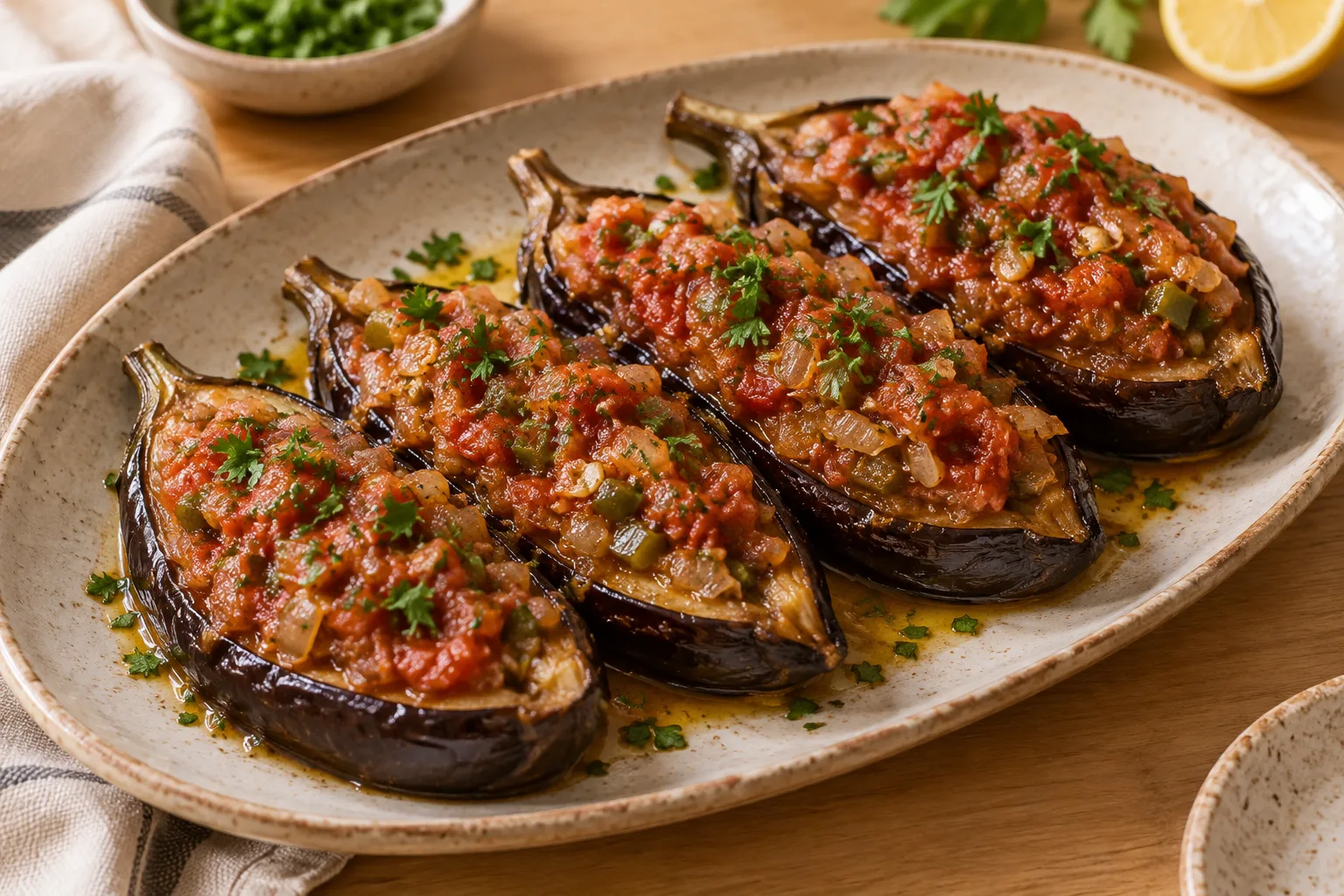
Imam bayildi (Turkish stuffed eggplants)
Tender eggplants filled with onion, garlic and tomato, baked with olive oil. Makes 4 servings; timings are approximate.
View recipe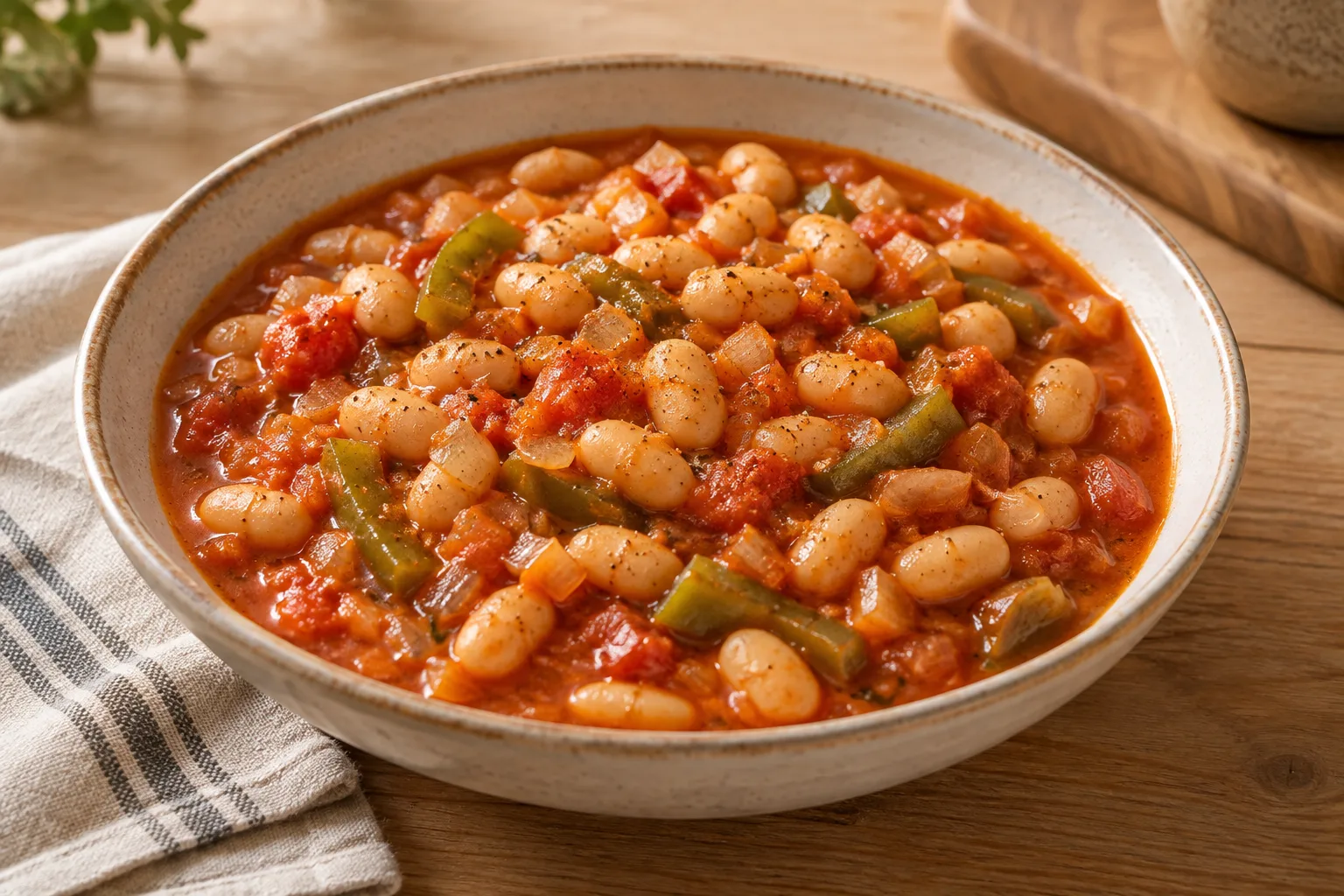
Vegetarian kuru fasulye
A Turkish white bean stew with tomato and pepper, made without meat. Serves 6; preparation times are approximate.
View recipe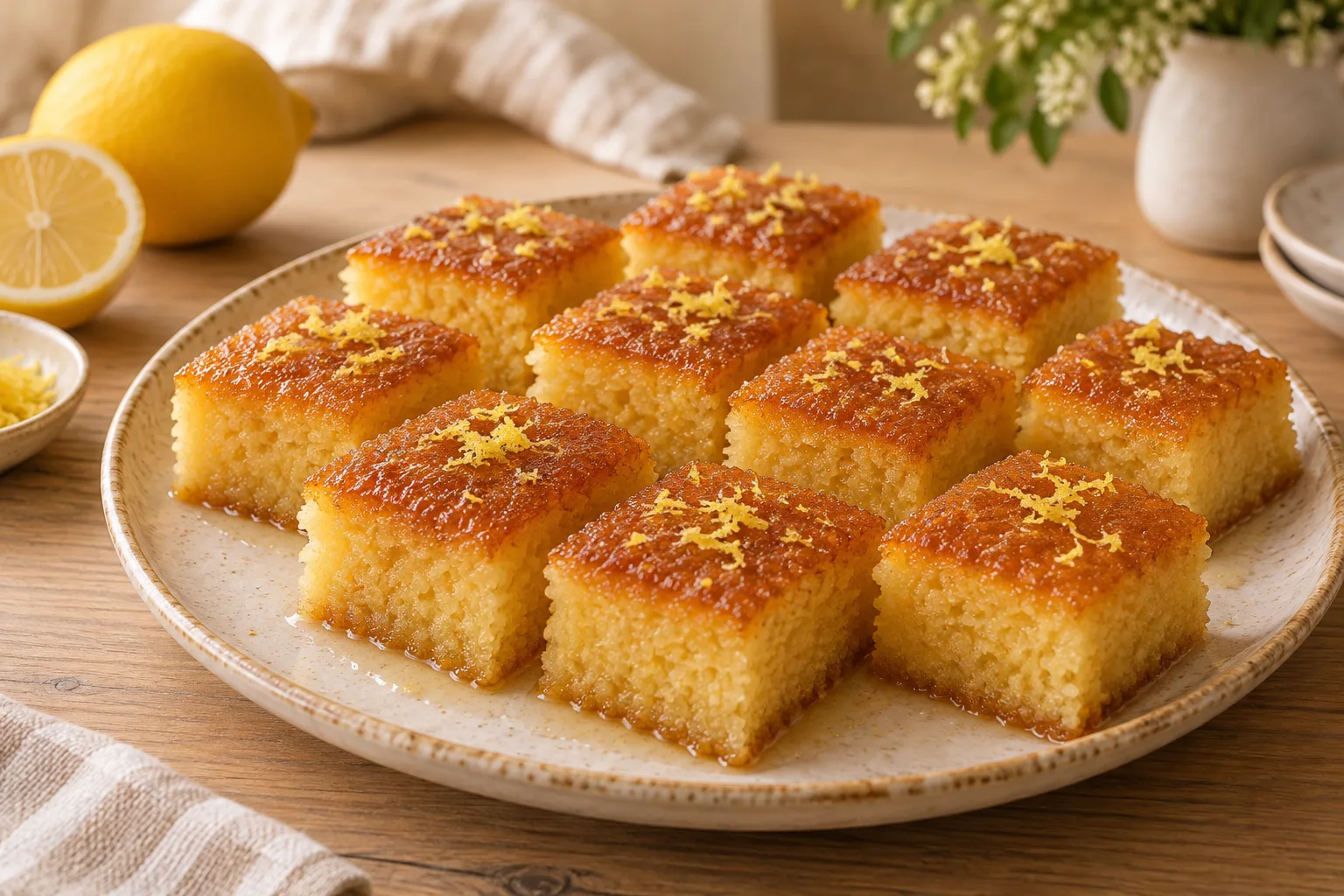
Turkish Revani with Semolina and Lemon
A Turkish semolina and yogurt cake soaked in lemon syrup. Makes 12 servings; timings are approximate: 20 minutes prep, 45 minutes cooking, and about 70 minutes resting.
View recipe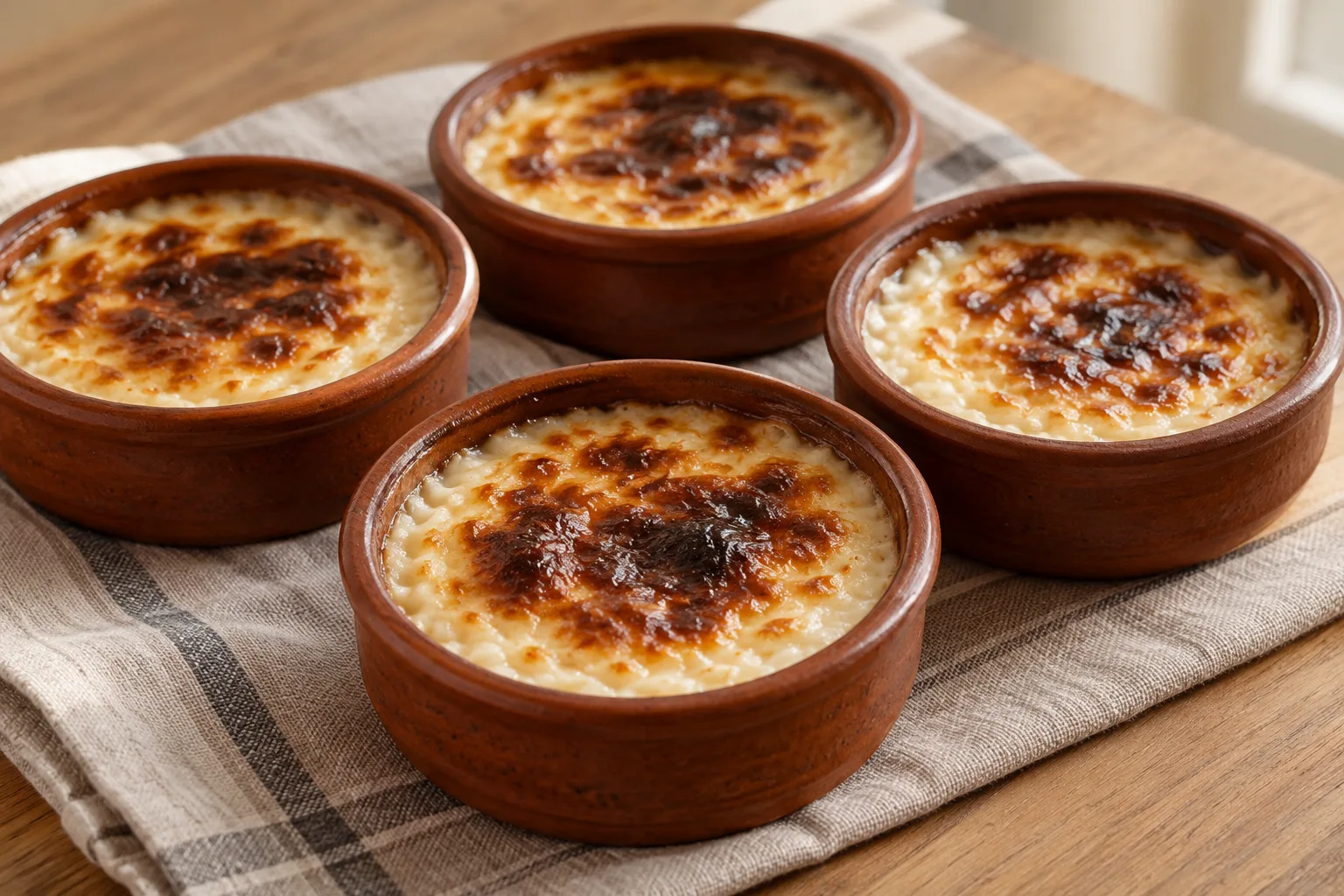
Turkish baked sütlaç (fırın sütlaç)
A Turkish rice-and-milk pudding baked until its surface is golden. Makes 4 servings.
View recipe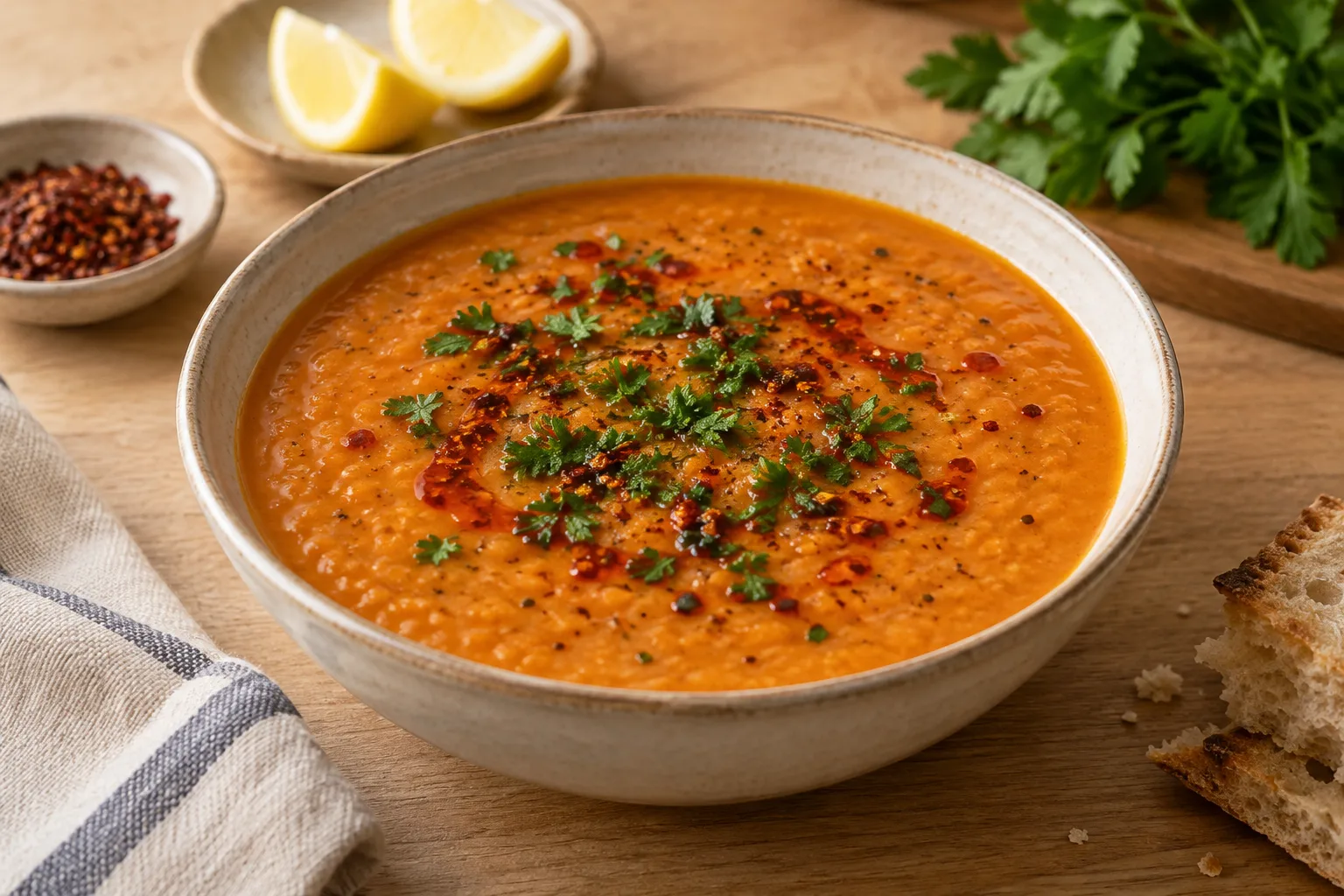
Turkish red lentil soup with carrot and potato
A creamy red lentil soup with carrot, potato, tomato and cumin, finished with chili oil, parsley and lemon. Serves 4.
View recipe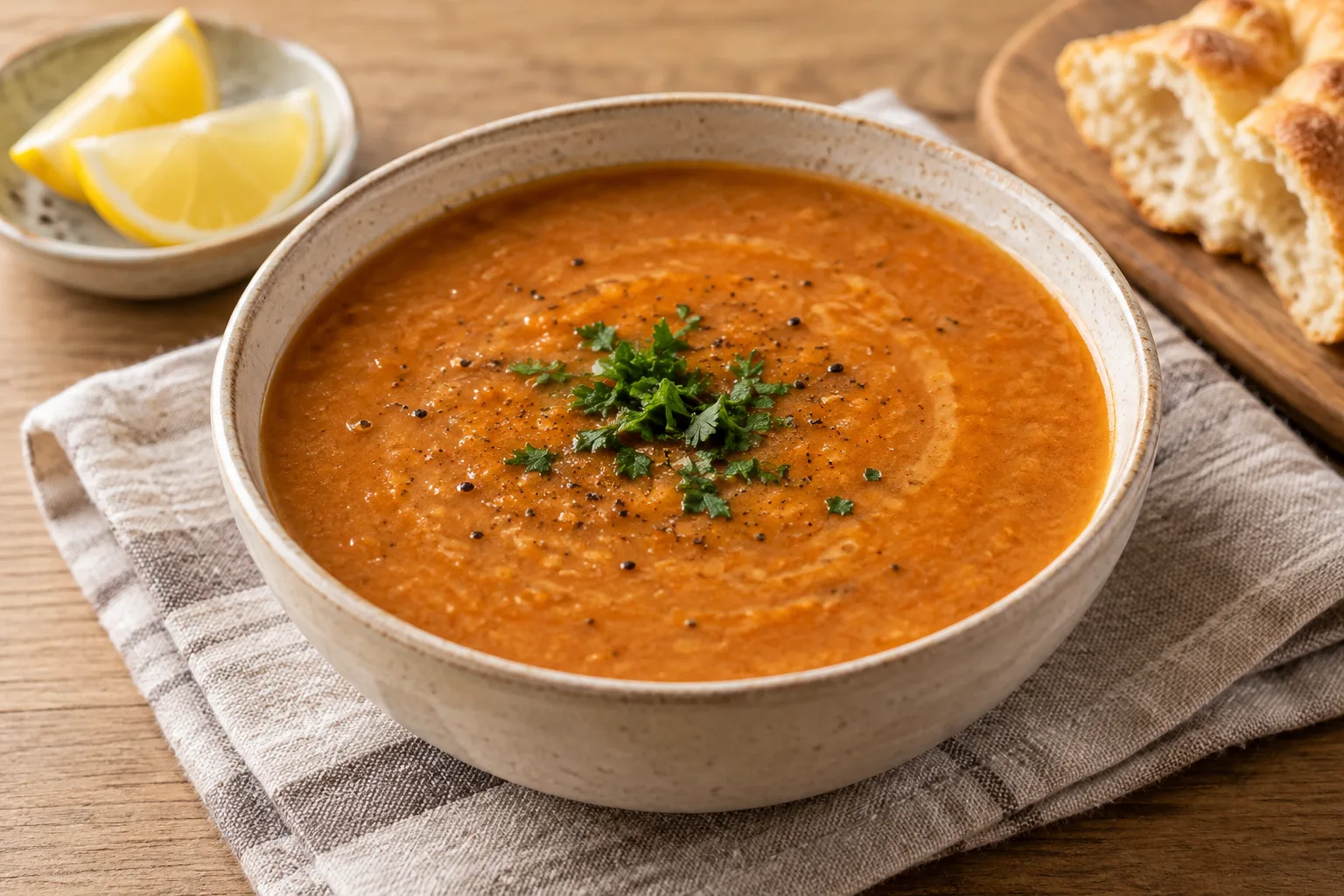
Turkish Red Lentil Soup (Mercimek çorbası)
A creamy Turkish soup of red lentils, onion and garlic, seasoned with cumin and tomato and finished with lemon.
View recipe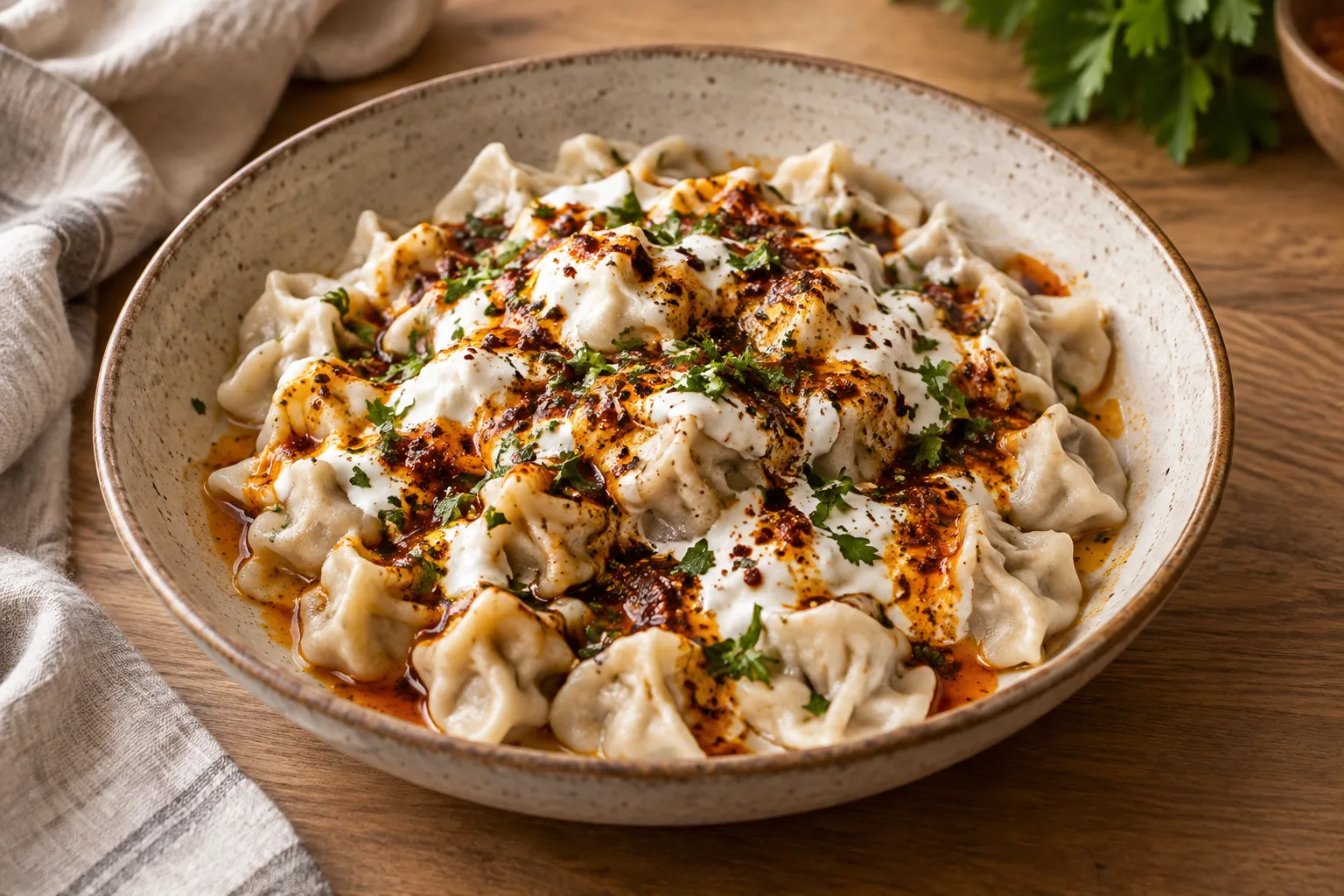
Turkish manti with beef, yogurt and paprika butter
Homemade Turkish manti filled with beef and served with yogurt and butter flavored with chili and paprika.
View recipe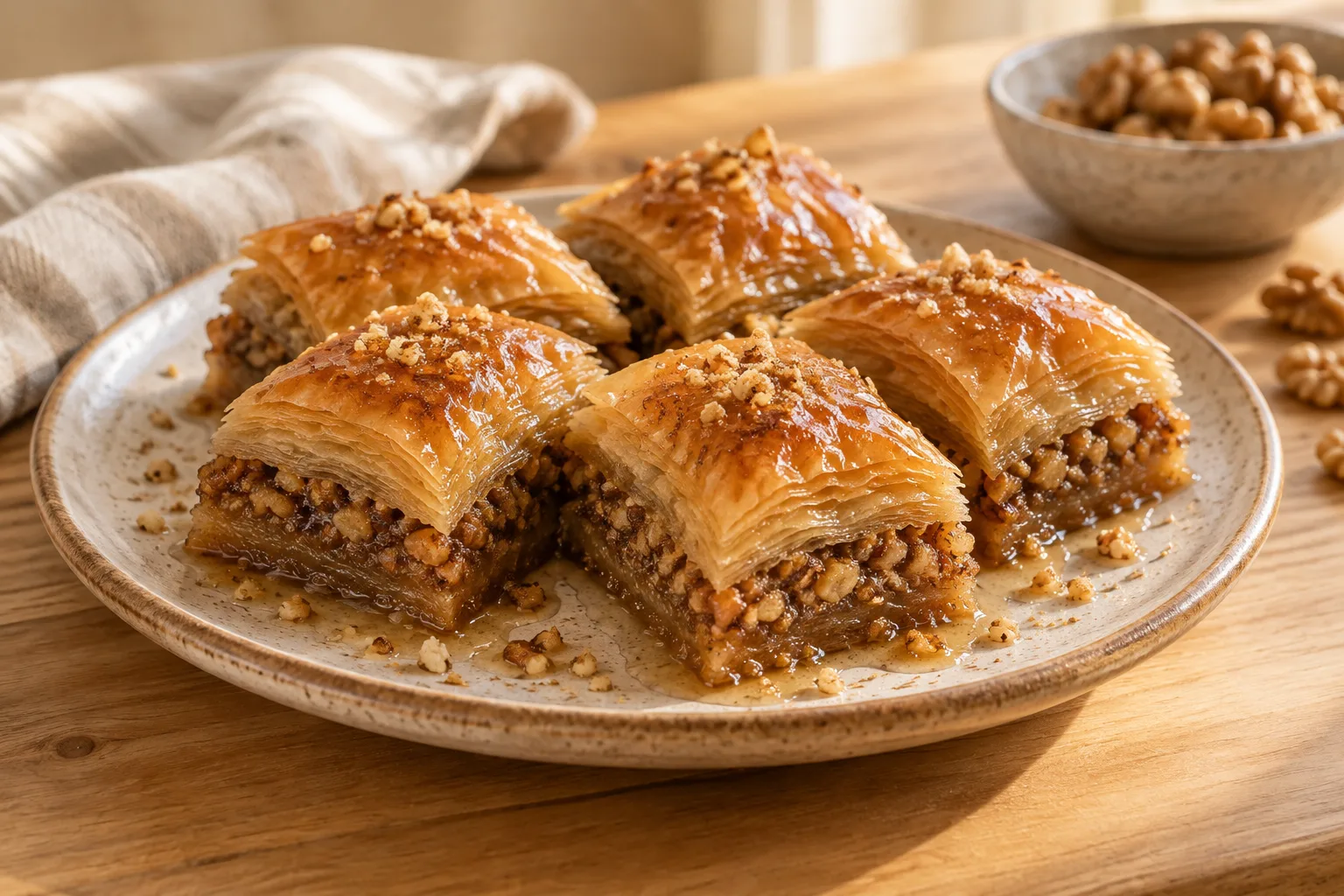
Turkish Walnut Baklava
A pastry made with layers of filo brushed with clarified butter, filled with walnuts, and finished with a syrup of sugar, water, and lemon.
View recipe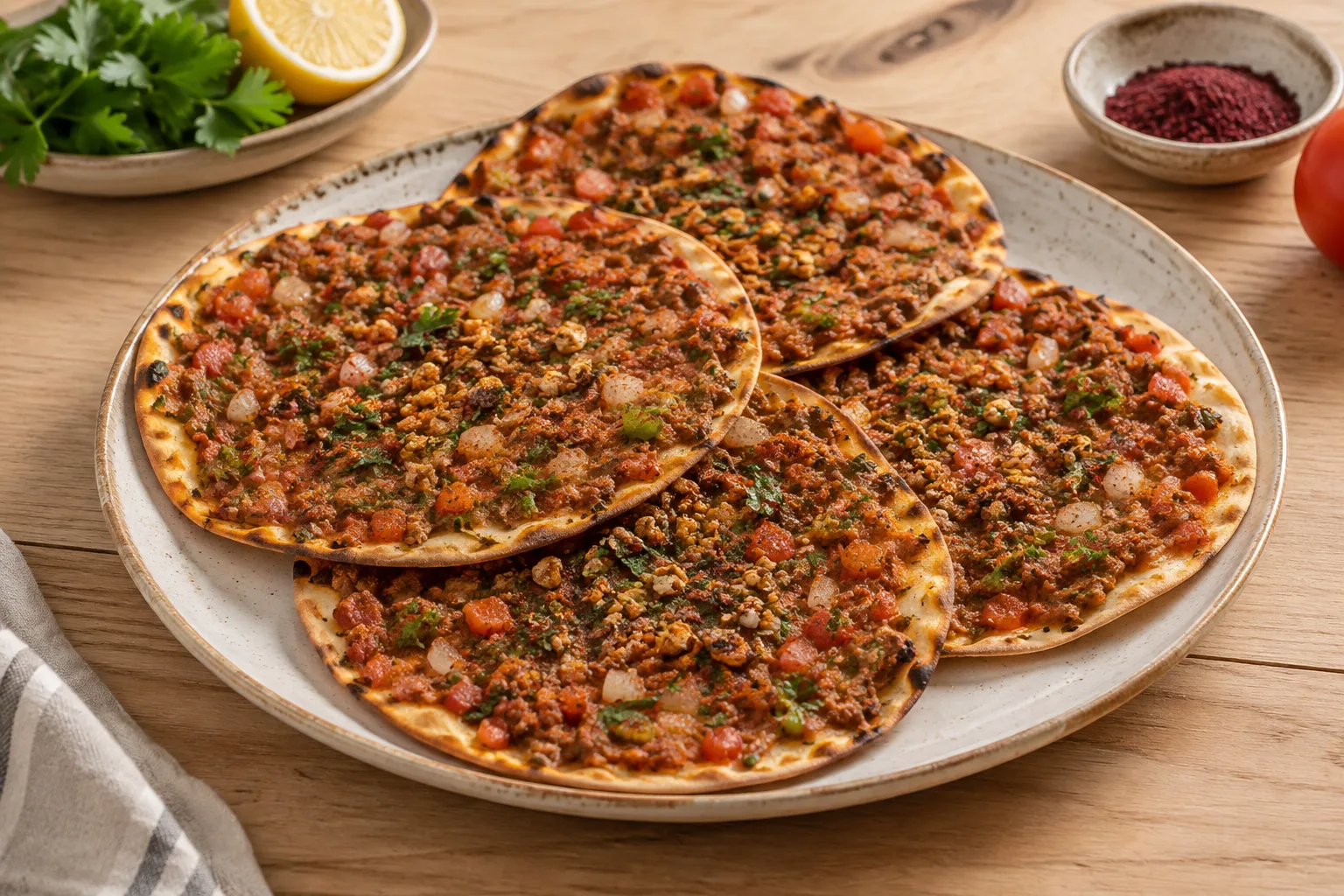
Turkish Lamb Lahmacun
Four thin, round Turkish flatbreads topped with minced lamb, vegetables, herbs, and spices.
View recipe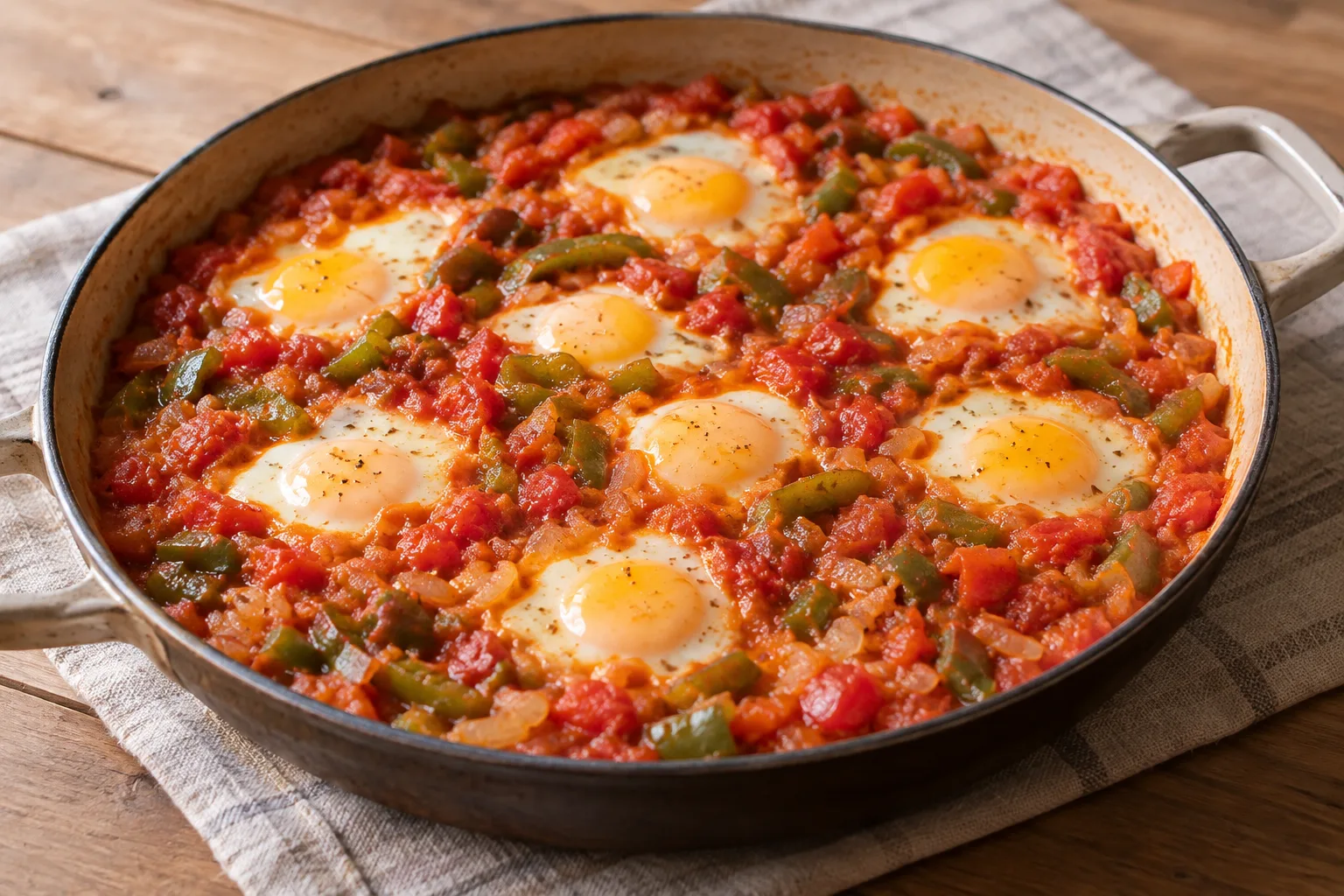
Turkish Menemen
Eggs cooked with tomatoes, green pepper, and onion in olive oil until tender and juicy.
View recipe
Sources consulted
Read the sources and each document’s scope. A heritage inscription concerns a particular practice, not all of a country’s cuisine.
- Türkiye Beslenme ve Sağlık Araştırması (TBSA) 2017 — original national report krtknadmn.karatekin.edu.tr/files/sbf/TBSA_RAPOR_KITAP_20.08.pdf Republic of Türkiye Ministry of Health; original report hosted by Çankırı Karatekin University Consulted: November 1, 2026
- Sağlık İstatistikleri Yıllığı 2021 — TBSA fieldwork period ushas.gov.tr/wp-content/uploads/2024/05/Saglik-Istatistikleri-Yilligi-2021-TR.pdf Republic of Türkiye Ministry of Health; official report hosted by USHAŞ Consulted: November 1, 2026
- Türkiye Aile Yapısı Araştırması 2021 — official household and family survey takvim.tuik.gov.tr/media/announcements/turkiye_aile_yapisi_ara%C5%9Ftirmasi_2021.pdf TÜİK and Ministry of Family and Social Services Consulted: November 1, 2026
- COVID-19 pandemic-associated changes in sleep–wake patterns and chrononutrition behaviors in adults — Türkiye 2020 dergipark.org.tr/en/download/article-file/6033193 Özata Uyar and Yıldıran; Turkish Journal of Health Research, original study Consulted: November 1, 2026
- Polikistik over sendromlu olgularda öğün tolerans testinde hormon dinamikleri ve doygunluk indeksinin araştırılması nek.istanbul.edu.tr/ekos/TEZ/52921.pdf Gülcan Arusoğlu, Hacettepe University doctoral thesis2012; original research hosted by Istanbul University Consulted: November 1, 2026
- A Global Analysis of Cooking Around the World — 2018 wave, Turkey country result www.gallup.com/file/analytics/513245/Gallup-Cookpad-Global%20Analysis%20Report-Year%201.pdf Gallup and Cookpad; original2018wave report2020 Consulted: November 1, 2026
- Diversity and Nutrient Composition of the Diets of Breastfed Infants — Istanbul2012 original study openaccess.marmara.edu.tr/server/api/core/bitstreams/c653b1ba-9eb9-411c-8446-faa83dbf59ec/co… Perran Boran and Şule Aktaç, Türkiye Klinikleri Journal of Pediatrics2018; original paper in Marmara University repository Consulted: November 1, 2026
- Crop Products Balance Sheets: Cereals and Other Crop Products, 2000/01–2024/25 veriportali.tuik.gov.tr/tr/press/53941 Turkish Statistical Institute (TÜİK) Consulted: November 1, 2026
- Bitkisel Ürün Denge Tabloları2024: official methodology veriportali.tuik.gov.tr/tr/press/53941/metadata Turkish Statistical Institute (TÜİK) Consulted: November 1, 2026
- Computational gastronomy: A study to test the food pairing hypothesis in Turkish cuisine (2023) acikerisim.gelisim.edu.tr/server/api/core/bitstreams/5f6dec79-72ab-4ab7-b44c-99029dd76132/co… Murat Doğan and Ahmet Hakan Değerli; International Journal of Gastronomy and Food Science; Istanbul Gelişim University repository Consulted: November 1, 2026
- Gaziantep Mutfağı — Türkiye Culture Portal kulturportali.gov.tr/turkiye/gaziantep/neyenir/gazantep-mutfagi Republic of Türkiye Ministry of Culture and Tourism Consulted: November 1, 2026
- A taste of the Turkish Riviera — Antalya cuisine goturkiye.com/tr/gastronomy/blog/a-taste-of-the-turkish-riviera GoTürkiye — Türkiye Tourism Promotion and Development Agency Consulted: November 1, 2026
- Food and Beverages Eaten at Meals www.ktb.gov.tr/EN-98793/food-and-beverages-eaten-at-meals.html Republic of Türkiye Ministry of Culture and Tourism Consulted: November 1, 2026
- Turkish Cuisine — desserts goturkiye.com/gastronomy/turkish-cuisine GoTürkiye — Türkiye Tourism Promotion and Development Agency Consulted: November 1, 2026
- A Study of Plate Waste in a Food Service — observed hospital bread serving www.mattioli1885journals.com/index.php/progressinnutrition/article/download/11007/9489/65457 Aysun Yüksel and Hülya Yılmaz Önal; Progress in Nutrition Consulted: November 1, 2026
- Preparing Food and Beverages for Winter www.ktb.gov.tr/EN-98795/preparing-food-and-beverages-for-winter.html Republic of Türkiye Ministry of Culture and Tourism Consulted: November 1, 2026
- Preparing Dried Tarhana www.ktb.gov.tr/EN-99032/preparing-dried-tarhana.html Republic of Türkiye Ministry of Culture and Tourism Consulted: November 1, 2026
- 2018 Turkey Demographic and Health Survey — household possessions and methods dhsprogram.com/pubs/pdf/FR372/FR372.pdf Hacettepe University Institute of Population Studies; Presidency Directorate of Strategy and Budget; TÜBİTAK Consulted: November 1, 2026
- Turkish Coffee — preparation and regional characteristics www.ktb.gov.tr/EN-98850/turkish-coffee.html Republic of Türkiye Ministry of Culture and Tourism Consulted: November 1, 2026
- Culture of Çay — preparation and serving in Türkiye yakegm.ktb.gov.tr/TR-345170/culture-of-cay-tea-a-symbol-of-identity-hospitality-and-social-i… Republic of Türkiye Ministry of Culture and Tourism Consulted: November 1, 2026
- Turkish Buttermilk (Ayran) — meal pairings www.ktb.gov.tr/EN-98849/turkish-buttermilk.html Republic of Türkiye Ministry of Culture and Tourism Consulted: November 1, 2026
- 11–17 Mayıs Tuz Haftası — TBSA salt estimation method huyukdh.saglik.gov.tr/TR-1541528/11-17-mayis-tuz-haftasi.html Republic of Türkiye Ministry of Health, Hüyük State Hospital Consulted: November 1, 2026
- Hanehalkı Tüketim Harcaması, 2025 veriportali.tuik.gov.tr/tr/press/58010 Turkish Statistical Institute (TÜİK) Consulted: November 1, 2026
- Household consumption expenditure 2025 — definitions and survey methodology veriportali.tuik.gov.tr/tr/press/58010/metadata Turkish Statistical Institute (TÜİK) Consulted: November 1, 2026
- Q4 2021 Türkiye in-camp e-voucher programme — market price monitoring docs.wfp.org/api/documents/WFP-0000138116/download/ World Food Programme Consulted: November 1, 2026
- Atabülten, issue 56, 19 September 2025 — Ataşehir opening meal price atasehir.bel.tr/upload/files/56-daee88af-d86d-46c8-8eeb-ef04c92a537e.pdf Ataşehir Municipality Consulted: November 1, 2026
- Panel Postası 6 — household snack purchases, September 2024–August 2025 www.ipsos.com/sites/default/files/ct/news/documents/2025-10/Panel%20Postas6-M%C3%BC%C5%9Fter… Ipsos Türkiye Consulted: November 1, 2026
- Panel Postası 5 — prepared food occasions, January–June 2025 www.ipsos.com/sites/default/files/ct/news/documents/2025-10/Panel%20Postas%C4%B1%205.%20Say%… Ipsos Türkiye Consulted: November 1, 2026
- Panel Postası 5 — original full report, population and sampling www.ipsos.com/sites/default/files/ct/news/documents/2025-09/PANEL%20POSTASI%205.%20SAYI.pdf Ipsos Türkiye Consulted: November 1, 2026
- Bursa Siyahı fig — regional ripening description, published 26 December 2016 osmaniye.tarimorman.gov.tr/Haber/353/Bursa-Siyahi-Incir-Fidani-Dagitim-Toreni Republic of Türkiye Ministry of Agriculture and Forestry, Osmaniye Provincial Directorate Consulted: November 1, 2026
- Aşure — ingredients, Muharram tradition and variation among communities www.kulturportali.gov.tr/portal/asure Republic of Türkiye Ministry of Culture and Tourism Consulted: November 1, 2026
- Ahlat cuisine — foods for special occasions ekitap.ktb.gov.tr/TR-81043/ozel-gun-yemekleri.html Republic of Türkiye Ministry of Culture and Tourism Consulted: November 1, 2026
- Una ruta culinaria por la costa egea goturkiye.com/branding/press-releases/embark-on-a-culinary-journey-along-turkiyes-aegean-coa… Türkiye Tourism Promotion and Development Agency Consulted: October 20, 2026
- Mantı: tradiciones y variantes regionales goturkiye.com/blog/turkish-manti Türkiye Tourism Promotion and Development Agency Consulted: October 20, 2026
- Sarma y dolma: hojas, rellenos y transmisión goturkiye.com/blog/sarma-dolma Türkiye Tourism Promotion and Development Agency Consulted: October 20, 2026