- Category
- Vegetables
- State
- Fresh
- Usual unit
- unit
What it is
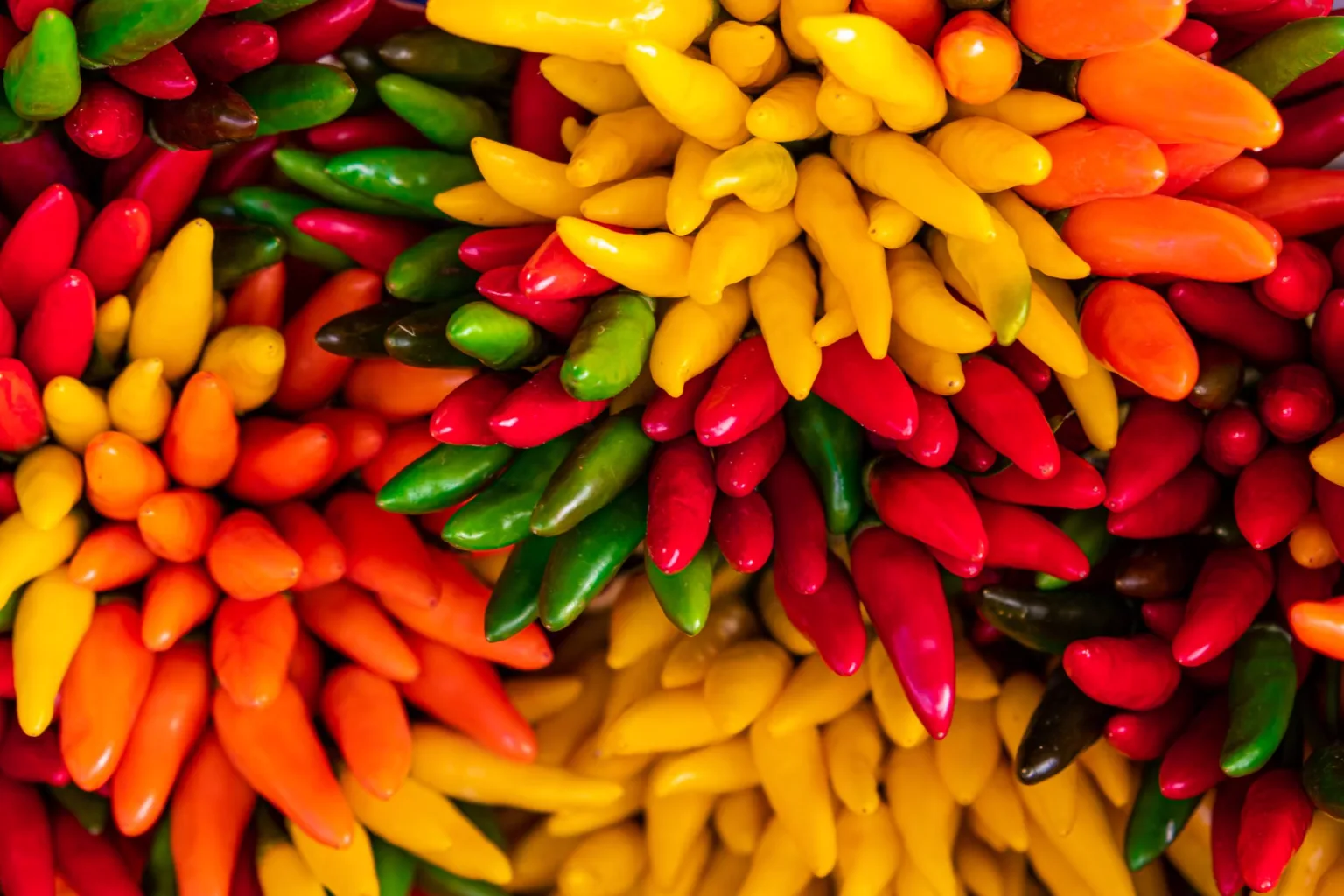
Bird’s-eye chilli is a small, hot chilli, listed here in its fresh state. The name is used for similar-looking chillies, and the available descriptions mention fruits in different colours and more than one botanical identification; it is therefore best treated as a culinary name rather than a single guaranteed botanical variety. It is used in several Southeast Asian cuisines and also appears in dishes from other regions. Its clearest kitchen role is to add intense heat in a small amount: it can be chopped into curries, soups, salads, stir-fries, sauces or marinades, or served raw as an accompaniment. Do not judge its heat by its small size. A dried form is also sold, but it is a different product state from the fresh chilli covered here.
When to use it
Use it when you want pronounced heat, particularly in curries, soups, salads and stir-fries. It can also go into a sauce or marinade, or be served fresh on the side. Because its heat can be strong and cannot reliably be judged from the size of an individual chilli, begin with a small amount and taste before adding more. If you do not want a dominant chilli heat, choose another ingredient or use less; removing some inner parts may moderate the heat, but does not guarantee a mild result.
How to use it
Remove the stem and finely chop the chilli to distribute it through a dish. Add a small amount to a curry, soup, salad, stir-fry, sauce or marinade, mix, and taste before adding more. You can also leave it whole or slice it to serve as a fresh accompaniment. The seeds and pale inner parts can be removed if you want to moderate the heat, though this does not guarantee a mild result. Handle it carefully: avoid touching your eyes or nose after cutting it, and wash your hands. Do not confuse the fresh product with dried chillies that shops may sell under similar names; use the form specified by your recipe.
Flavour and texture
Its most distinctive culinary feature is intense heat, which can dominate a dish if used too freely. Some descriptions note a fruity character, but flavour can vary between fruits and forms. Fresh, it can be chopped or served as an accompaniment; the dried form has a different texture and should not be treated as identical to fresh. Add it gradually so you can assess its effect on the whole dish.
How to choose it
Check that the product is identified as bird’s-eye chilli and that it is fresh if that is the form you need; it is also sold dried. Available descriptions show both green and red fruits, so colour can vary and does not by itself identify a particular form. Since the heat may be intense, buy an amount you can portion carefully and use the product description to distinguish it from similar-looking chillies.
Storage
The available evidence does not establish a storage method or duration for fresh bird’s-eye chilli. To avoid guessing, follow the seller’s or package’s directions and use it as a fresh product. Do not automatically apply instructions intended for dried chillies: this entry covers the fresh fruit, while dried chilli is a different form. If no storage directions are provided, ask the seller before keeping it for an extended period.
Substitutions
Thai chilli can be a close culinary alternative, while serrano or jalapeño provide other heat options. Do not assume an exact equivalence or fixed amount: the chilli and preparation can differ in intensity. Substitute gradually and taste the dish before adding more. If you want to avoid chilli heat, choose a non-hot ingredient rather than another chilli.
Common mistakes
Do not judge heat by size: a small fruit can bring substantial heat. Another common mistake is adding several at once without tasting between additions. Removing seeds does not guarantee a mild result, and fresh chilli should not be confused with dried chilli. Handle it carefully and avoid touching your eyes or nose after cutting.
Safety and allergens
It can be very hot; start with a little if you do not know its intensity. After cutting, avoid touching your eyes or nose and wash your hands. If you have a food allergy, check the information for the specific product and preparation; this entry does not establish that it is free of allergens.
Culinary uses
- Add intense heat to curries, soups, salads and stir-fries.
- Season sauces, marinades and dishes served with fresh chilli.
Recommended techniques
- Finely chop and add a little at a time to control the heat.
- Use whole or sliced as a fresh garnish, or use a dried form where the recipe calls for it.
Pairs well with
- Curries, soups and stir-fried vegetables.
- Salads, sauces and marinades; it also appears in combinations with fish sauce and lime juice.
Frequently asked questions
How hot is bird’s-eye chilli?
It can be very hot, although intensity varies. Start with a small amount and taste the dish before adding more.
What dishes can I use it in?
It can be chopped into curries, soups, salads, stir-fries, sauces and marinades, or served fresh as an accompaniment.
Will removing the seeds make it mild?
Removing the seeds and pale inner parts may moderate the heat, but it does not guarantee that the chilli will be mild.
Ingredient allergens
Allergen listThere are no verified associations for these ingredients yet.
Estimated nutrition
- Fat
- 0 g
- Saturates
- 0 g
- Carbohydrate
- 0 g
- Sugars
- 0 g
- Fibre
- 0 g
- Protein
- 0 g
- Salt
- 1.5 g
Sources and review
Automatically researched, cross-checked and validated content. Sources consulted:
- Etiquetado de sustancias que causan alergias e intolerancias alimentarias www.aesan.gob.es/seguridad-alimentaria/informacion-alimentaria/etiquetado-sustancias
- Chile tailandés, el ojo de pájaro pungente - Koketo piri piri koketo.es/chile-tailandes
- Léxico gastronómico en crónicas de migración de autores ecuatorianos | OpenAlex openalex.org/W4404546411
- Chile ojo de pájaro - Wikipedia, la enciclopedia libre es.wikipedia.org/wiki/Chile_ojo_de_p%C3%A1jaro
- ¿Qué tiene el chile que no tenga el pájaro? Análisis de la productividad semántica entre ambos alburemas. | Signos Lingüísticos doi.org/10.24275/sling.v20n40.03
- Cayena ojo de pájaro | Usos y beneficios jetextramar.com/blog/cayena-ojo-de-pajaro-usos-y-beneficios/
- Cayena de rama de ojo de pájaro – Casa Perris casaperris.com/blogs/general/cayena-de-rama-de-ojo-de-pajaro?srsltid=AYCX9vKr7ddGEbN5s6c9kcW…
- Chile ojo de pájaro - Bird´s Eye - Cultivo, cuidado y Scoville chili-plants.com/es/variedades-chile-pimiento/variedad-birds-eye-ojo-pajaro/?srsltid=AYCX9vJ…
- Chilies Tailandeses Ojo de Pájaro - Toluca Foods tolucafoods.com/es/productos/chilies-tailandeses-ojo-de-pajaro/
- - YouTube www.youtube.com/watch?v=yIR6IKfszM0
- Chile ojo de pájaro: calorías e información nutricional | EatBetter www.eatbetter.app/es/alimento/chile-ojo-de-pajaro
- Técnicas de cocina primitiva: el sabor del fuego - Neomanía neomaniamagazine.com/es/tecnicas-de-cocina-primitiva/