- Category
- Dairy and eggs
- State
- Preserved
- Usual unit
- g
What it is
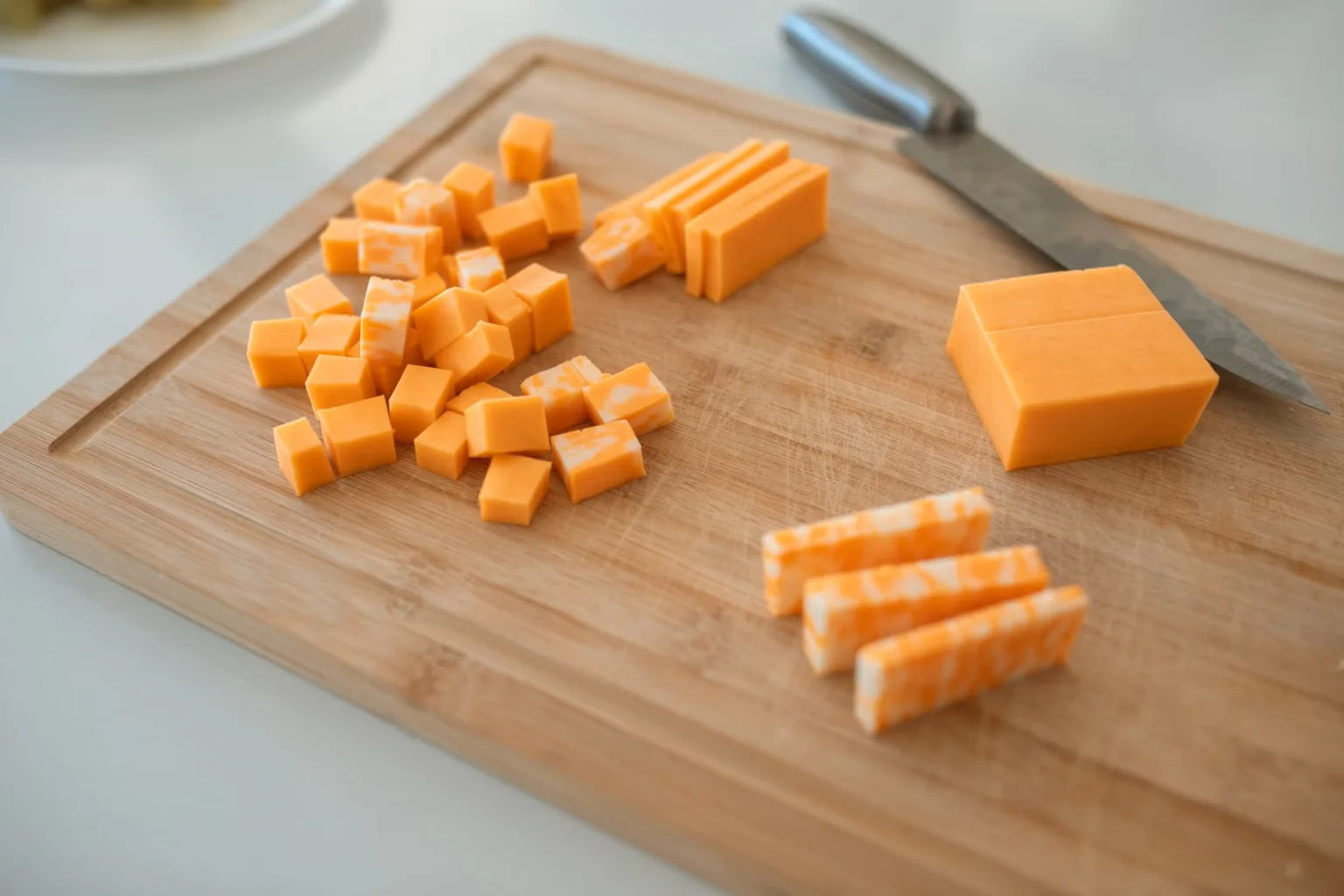
Cheddar is a firm, ripened cheese. Milk is coagulated into curds, which are worked and pressed before the cheese matures. The result is usually compact and firm, although flavor and texture vary between products and with ripening. Some cheddar is mild and relatively delicate; other varieties taste more pronounced, sharp, or dry. Its color may be pale or yellow-orange. Orange coloring can come from a food coloring such as annatto, so color alone does not indicate flavor intensity or quality. Cheddar is sold in blocks, slices, and grated forms, and processed cheese products can also be made using cheddar. Check the package to distinguish natural cheddar from a processed cheese product and to see its ingredients.
When to use it
Choose cheddar when you want a firm cheese that can be sliced, grated, or melted into a hot dish. A mild variety can accompany sandwiches and burgers without overwhelming other ingredients; a more pronounced cheddar brings a stronger flavor to simple dishes. Add grated cheese or small pieces to hot pasta, quesadillas, or nachos. For a cheese board, serve small pieces with bread. Keep in mind that melting results depend on the product: natural cheddar and processed cheese made with cheddar do not necessarily have the same texture.
How to use it
Slice cheddar for sandwiches or burgers, or grate it so it can be distributed easily over pasta, nachos, and quesadillas. For a sauce or pasta dish, add it gradually to the hot mixture and stir as it melts; do not assume every form will make an equally smooth sauce. You can also scatter grated cheese over a dish and bake or grill it until melted and browned, watching it so it does not dry out. For a cold serving, offer slices or cubes with bread. If you have a block, freshly grating it is a convenient option for cooking. More mature varieties often have a stronger taste, so adjust the amount to suit the recipe and your preference.
Flavour and texture
Cheddar is generally firm and compact, making it suitable for slicing or grating. Its flavor ranges from mild and milky to more pronounced, sharp, or dry, depending on the product and ripening. It can be pale or orange; color alone does not reveal how strong it tastes.
How to choose it
Choose a format for the job: a block for slicing or grating, slices for sandwiches, and grated cheese for convenient topping. Read the label to compare flavor descriptions and to distinguish natural cheddar from processed cheese made with cheddar. Orange color may come from annatto; cheddar can also be pale. Check that the package is intact and follow its storage directions.
Storage
Keep cheddar refrigerated, in its original package until you use it, and follow the manufacturer’s directions. Once opened, wrap it well or place it in a sealed container to limit exposure to air and help prevent drying or odor absorption. A block generally keeps its quality better than cheese that is already grated or sliced. If mold not intended as part of the product appears on grated or sliced cheese, discard it; follow appropriate food-safety guidance for other forms.
Substitutions
Colby can stand in for cheddar in dishes that suit a firm cheese, though it may taste milder. Monterey Jack is another option for hot dishes where melting matters, but it will change the flavor and texture. Adjust the amount and season at the end because products and salt levels vary.
Common mistakes
Do not choose cheddar by color alone: orange color may come from a coloring and does not mean the cheese tastes stronger. Do not assume every form melts the same way; processed cheese products and natural cheeses can behave differently. Avoid leaving cheese open and unwrapped, since it can dry out or pick up odors from other foods.
Safety and allergens
Cheddar is a dairy product and contains milk. Keep it refrigerated and follow the package directions. Discard grated or sliced cheddar if mold not intended as part of the product appears.
Culinary uses
- queso para fundir
- queso para rallar o servir en lonchas
Recommended techniques
- rallar
- fundir
- gratinar
- servir en lonchas
Pairs well with
- pan y sándwiches
- hamburguesas
- pasta
- nachos y quesadillas
Frequently asked questions
Is all cheddar orange?
No. Cheddar can be pale or orange; orange coloring may come from a food coloring such as annatto.
Which cheddar should I use for cooking?
A block is useful for slicing or grating, while grated cheese is convenient to add to dishes. Choose mild or stronger cheddar to suit the recipe, and remember that melting can vary by product.
How should I store cheddar after opening?
Keep it refrigerated and well wrapped or in a sealed container. Follow the specific directions on the package.
Ingredient allergens
Allergen listDocumented presence
-
Milk and milk products
Cheddar cheese
Estimated nutrition
- Fat
- 35.7 g
- Saturates
- 21.4 g
- Carbohydrate
- 3.57 g
- Sugars
- 0 g
- Fibre
- 0 g
- Protein
- 25 g
- Salt
- 1.7 g
Sources and review
Automatically researched, cross-checked and validated content. Sources consulted:
- Client Challenge doi.org/10.2307/jj.27939689.16
- Handling of Cheese for Safety & Quality | Home & Garden Information Center hgic.clemson.edu/factsheet/handling-of-cheese-for-safety-quality/
- 5 Major Cheese Styles Every Chef Should Know www.ice.edu/blog/cheese-styles-you-should-know
- Cheese • The Nutrition Source nutritionsource.hsph.harvard.edu/cheese/
- A Guide to Cheese: 30 Cheeses You Should Know - Escoffier www.escoffier.edu/blog/culinary-arts/a-complete-guide-to-cheese/
- Kitchen Companion: Your Safe Food Handbook ucanr.edu/sites/default/files/2020-09/336322.pdf
- ¡Conviértete En Experto Quesero! Descubre Los Secretos Del Queso Cheddar Y Sus Variedades | SaborUSA www.saborusa.com/blog/queso-cheddar/
- Todo lo que Debes Saber sobre el Queso Cheddar: Historia, Variedades y Cómo Elegir el Mejor – La Despensa de Andrés ladespensadeandres.com/2024/01/cheddar/
- Queso cheddar - Wikipedia, la enciclopedia libre es.wikipedia.org/wiki/Queso_cheddar
- Queso Cheddar Mexicana: sabor picante y versátil para tus platos www.elpaladar.es/es/blog/queso-cheddar-mexicana-el-cheddar-picante-que-revoluciona-tus-recet…
- Save Money & Waste Less with These 6 Food Storage Tips - Food Rescue MAINE umaine.edu/foodrescuemaine/2021/07/27/save-money-waste-less-with-these-5-food-storage-tips/
- Publicaciones de Seguridad alimentaria www.aesan.gob.es/actualidad/publicaciones-seguridad-alimentaria
- Center for Dairy Research | Cheese Safety/Storage cdr.wisc.edu/cheese-safety-storage
- Evidence of terroir in milk sourcing and its influence on Cheddar cheese. | Botany & Plant Pathology bpp.oregonstate.edu/publication/evidence-terroir-milk-sourcing-and-its-influence-cheddar-che…
- "Microstructure and Firmness of Processed Cheese Manufactured from Ched" by A. Y. Tamime, M. Kalab et al. digitalcommons.usu.edu/foodmicrostructure/vol9/iss1/4/
- El Queso Cheddar | La Boulette www.laboulette.com/blog/el-queso-cheddar