- Category
- Vegetables
- State
- Fresh
- Usual unit
- unit
What it is
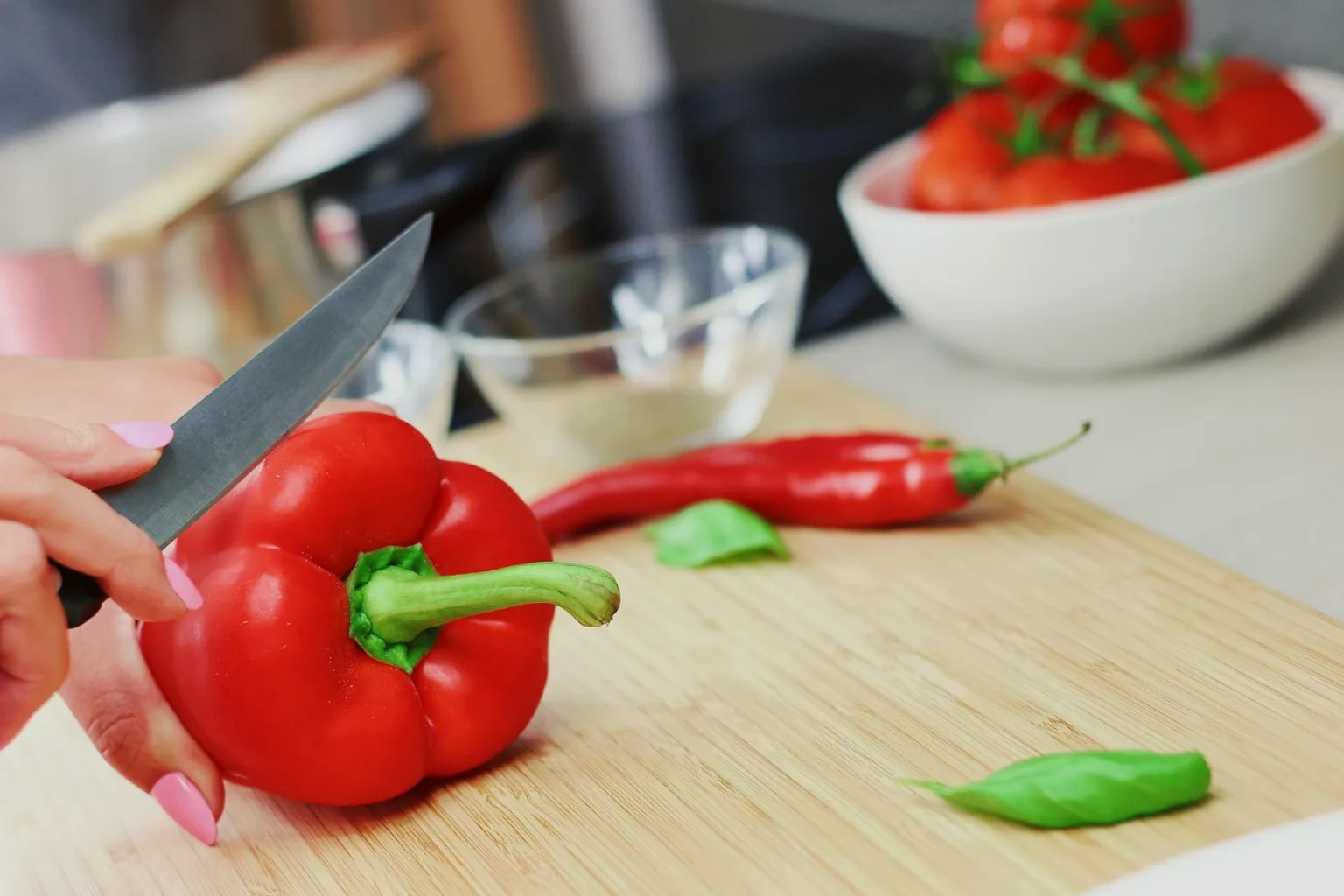
Red sweet pepper is the fresh fruit of a sweet pepper, commonly called a red bell pepper. The word “pepper” or “chile” can refer to sweet or hot varieties depending on the region; this profile is specifically about the sweet red pepper, not a hot chilli. Sweet peppers in red, green and yellow are included among peppers used fresh. They are sold whole and prepared by removing the stem, core and seeds before cutting. Red identifies the product’s color, but does not by itself establish a particular variety.
When to use it
Use it when you want a sweet-tasting fresh vegetable for a salad, or need strips or pieces of pepper for cooking. It also suits roasting or grilling: heat can loosen the skin, which you may remove afterward if you prefer. Food-preservation guidance also includes red sweet peppers for freezing and marinated preparations. Choose the fresh form when you want to control the cut and cook it straight away.
How to use it
Rinse the pepper gently under cold running water, and work with clean hands, surfaces and utensils. Remove the stem, core and seeds, then cut it into strips, rings or dice to suit the dish. Serve it raw in salads or add it to a cooked preparation. To roast or grill, cook until the skin separates, then peel it if desired. For freezing, cut the pepper into halves, strips, rings or dice; the guidance consulted describes both blanching and non-blanching options. For home canning, do not improvise proportions or processing times: use a tested recipe and follow its complete instructions.
Flavour and texture
This pepper is classified as sweet, not as a hot variety. Its fresh flesh can be eaten raw or cooked, and the cut determines whether it is served in strips, rings or dice. When roasted or grilled, its skin may separate and can be removed. Exact sweetness, firmness and texture vary among individual peppers; the available information does not establish a more precise sensory profile.
How to choose it
Choose peppers that are firm and free from visible damage or signs of disease or insect injury. The guidance consulted accepts sweet peppers in several colors, including bright red. If you plan to freeze them, start with fresh, firm peppers; do not rely solely on size or an unidentified variety when selecting them.
Storage
The information available here does not establish a specific fresh-pepper refrigerator life, so avoid assigning it a fixed storage period. Wash before preparing and do not soak. To freeze, remove the stem and seeds and cut the pepper; the guidance describes both blanching and a raw option intended to preserve a crisper texture. For shelf-stable home canning, use only tested procedures appropriate to the product; do not adapt a recipe on your own.
Substitutions
Green, yellow or another color of sweet pepper can stand in for red sweet pepper. The preservation guidance includes sweet peppers in several colors, but color alone does not guarantee exactly the same flavor or appearance. Do not use a hot chilli as a direct substitute if you want to keep the result sweet and mild.
Common mistakes
Do not confuse “sweet pepper” with a hot chilli: regional naming can be misleading. Do not skip washing before cutting, or improvise times and proportions for canning. If you want the skin to release during roasting or grilling, let the heat loosen it before trying to peel it.
Safety and allergens
Rinse the pepper under cold running water and use clean hands, utensils and surfaces. For home canning, follow a tested recipe and its complete processing instructions; do not infer times or methods from a different recipe.
Culinary uses
- Fresh vegetable for salads and raw preparations
- Sweet vegetable ingredient for cooked dishes, sauces and preserves
Recommended techniques
- Wash under cold running water and slice, dice or cut into strips
- Roast or grill until the skin loosens, then peel if desired
- Freeze in pieces, either raw or blanched, following tested food-preservation instructions
Pairs well with
- Tomato
- Onion
- Vinegar
Frequently asked questions
Is red sweet pepper hot?
No. This profile is about red sweet pepper, not a hot chilli variety. Regional names can vary, so check that the product is identified as sweet.
Does the skin need to be removed?
Not always. When roasted or grilled, the skin may separate; you can peel it afterward if you wish.
Can red sweet pepper be frozen?
Yes. The guidance consulted describes freezing cut sweet peppers, with both a blanching option and a raw-packing option. For a safe result, follow the full directions in a tested preservation guide.
Ingredient allergens
Allergen listThere are no verified associations for these ingredients yet.
Estimated nutrition
- Fat
- 12.8 g
- Saturates
- 1.56 g
- Carbohydrate
- 6.57 g
- Sugars
- 4.28 g
- Fibre
- 1.8 g
- Protein
- 1.04 g
- Salt
- 0.05 g
Sources and review
Automatically researched, cross-checked and validated content. Sources consulted:
- Client Challenge doi.org/10.2307/jj.27939689.16
- The Essential Glossary of Cooking Terms for the Culinary Arts - Escoffier www.escoffier.edu/blog/culinary-arts/the-essential-glossary-of-cooking-terms-for-the-culinar…
- Agencia Española de Seguridad Alimentaria y Nutrición www.aesan.gob.es/
- Eating Spain: National Cuisine Since 1900 - UKnowledge uknowledge.uky.edu/context/hisp_etds/article/1031/viewcontent/Eating_Spain_National_Cuisine_…
- El chile, ingrediente esencial en la cocina de México - Formacion en Gastronomia www.formacionengastronomia.com/cocina-latina/chile/
- filling gender gaps: determining how traditional knowledge of experts.esf.edu/view/pdfCoverPage?download=true&filePid=1356518480004826&instCode=01SUNY_ESF
- IEW Recipes | OISS | Rice University oiss.rice.edu/recipes
- Vamos a Conservar Alimentos: Chiles/Pimientos extension.psu.edu/vamos-a-conservar-alimentos-chiles-pimientos/
- Salsa de Chile II (Spanish) - National Center for Home Food Preservation nchfp.uga.edu/how/can/canning-salsa/chile-salsa-ii-spanish/
- Making Corn Tortillas and Salsa coloradosph.cuanschutz.edu/docs/librariesprovider151/default-document-library/inventasalsa--…
- Chiles rojos, crudos (orgánicos) | Fundación G+E www.diet-health.info/es/recetas/ingredientes/in/fs3667-chile-tabasco-rojo-crudo
- - YouTube www.youtube.com/watch?v=cDX86qkGbn4