- Category
- Vegetables
- State
- Fresh
- Usual unit
- unit
What it is
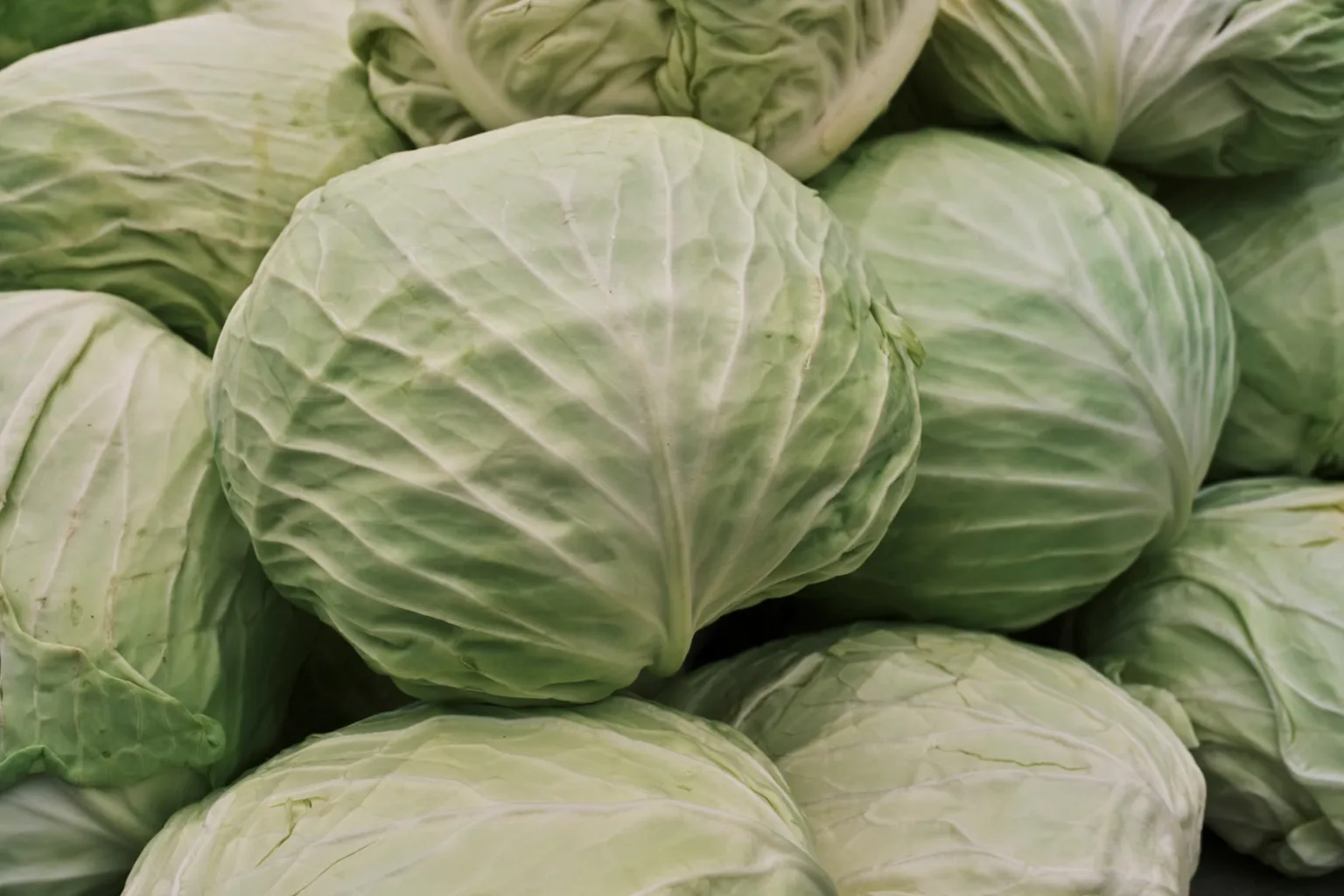
White cabbage, also called green cabbage, is a compact-headed vegetable made up of firm, closely layered leaves. The outer leaves are often very pale green, fading toward white at the center. Its crisp texture and versatility make it useful in straightforward everyday cooking: it can be shredded, cooked in pieces or fermented. It is distinct from red cabbage, which has purple leaves, and cauliflower, whose edible head has a different structure. White cabbage can be eaten raw or cooked, and the cut and cooking method affect its texture and the way its flavor comes through. Use it as a crunchy base for salads or soften it for a side, soup or stew.
When to use it
Use white cabbage raw when you want a firm, crunchy base for a salad, especially when finely sliced and paired with carrot or a creamy or tangy dressing. It also adds texture to sides, sandwiches and burgers. Cook it when you want softer leaves: it can be baked, boiled, sautéed or steamed, and it fits into soups and stews. For a fermented preparation, it can be used to make sauerkraut. Choose the cut and technique according to whether you want to keep its crunch or soften the leaves. Its range of uses makes it suitable for both simple raw dishes and warm meals.
How to use it
Remove any damaged outer leaves, then cut the cabbage into quarters or manageable pieces. For salads and coleslaw, remove the firm core if you find it unpleasant to eat, and slice the leaves thinly; combine them with carrot and a creamy or lightly tangy dressing. For a side dish, cut the cabbage into pieces and bake, boil, steam or sauté it in a pan. Add chopped cabbage to soups and stews so it cooks with the other ingredients. It can also be fermented to make sauerkraut. Rinse the cabbage under running water before cutting and use clean utensils. Match the size of the cut to the texture you want: fine shreds work well raw, while larger pieces retain more body when cooked.
Flavour and texture
Raw white cabbage is firm, moist and crunchy, with a mild, vegetal flavor and a slight peppery edge. Cooking softens the leaves and makes the flavor sweeter and less sharp. The outer leaves can be greener than the paler inner leaves. Cut size makes a noticeable difference: fine shreds feel lighter in salads, while larger pieces keep more of their structure in cooked dishes.
How to choose it
Choose a compact head with firm, closely packed leaves and a fresh appearance. White cabbage can range from very pale green on the outside to white toward the center. Avoid heads with numerous wilted, torn or damaged outer leaves. Heads vary in size and shade; choose one that is manageable for the recipe and amount you plan to prepare. The variation in color does not mean that the cabbage is a different kind of vegetable.
Storage
Keep the whole head in the refrigerator until you are ready to use it, and avoid cutting it long in advance if you want to preserve its crunch. Cover and refrigerate any cut remainder, and use it promptly; there is no exact storage period that applies to every head and set of conditions. Remove any leaves that have deteriorated and rinse the cabbage under running water before preparation. Do not leave cut cabbage at room temperature longer than necessary.
Substitutions
Savoy cabbage can fill a similar role in salads and cooked dishes, though its leaves are more tender and its flavor milder. Red cabbage can also be used in raw or cooked preparations, but it brings purple color and a more pronounced flavor. In either case, adjust the cut and cooking to suit the variety; neither is identical to white cabbage.
Common mistakes
Cutting cabbage too coarsely for a salad can make it awkward to eat; fine shreds are usually more practical for raw dishes. Do not assume that all cabbage varieties have the same texture or flavor: Savoy cabbage is more tender, while red cabbage has a stronger flavor. Avoid cooking it longer than needed for the texture you want.
Safety and allergens
Rinse the cabbage under running water before cutting, and prepare it with clean hands, a clean board and clean utensils. Remove damaged leaves. No cabbage-specific warning requiring additional precautions is established here.
Culinary uses
- Raw salad vegetable
- Cooked vegetable for side dishes, soups and stews
Recommended techniques
- Shred or slice finely for raw salads
- Bake, boil, sauté or steam
- Ferment as sauerkraut
Pairs well with
- Carrot and a creamy or tangy dressing
- Apple in a raw salad
- Garlic and olive oil
Frequently asked questions
Can white cabbage be eaten raw?
Yes. Slice it finely for salads or coleslaw, and pair it with carrot and a creamy or tangy dressing if you like.
How can white cabbage be cooked?
It can be baked, boiled, sautéed or steamed. You can also add it to soups and stews.
Is white cabbage the same as red cabbage?
No. White cabbage has pale, compact leaves; red cabbage has purple leaves and a more pronounced flavor.
Ingredient allergens
Allergen listThere are no verified associations for these ingredients yet.
Sources and review
Automatically researched, cross-checked and validated content. Sources consulted:
- Client Challenge doi.org/10.2307/jj.27939689.16
- The Essential Glossary of Cooking Terms for the Culinary Arts - Escoffier www.escoffier.edu/blog/culinary-arts/the-essential-glossary-of-cooking-terms-for-the-culinar…
- Nutrition After Your Transplant - Health Online healthonline.washington.edu/sites/default/files/record_pdfs/Nutrition-After-Your-Transplant-…
- Best practices for harvesting and storing homegrown potatoes | OSU Extension Service extension.oregonstate.edu/news/best-practices-harvesting-storing-homegrown-potatoes
- Isla Blanca Park - Cameron County www.cameroncountytx.gov/parks-coastal-parks__trashed/parks-isla-blanca/
- Peña Blanca Community Center - Sandoval County www.sandovalcountynm.gov/departments/community-services/senior-services/pena-blanca-communit…
- Blanca Restrepo - Faculty - UTHealth Houston School of Public Health sph.uth.edu/faculty/?fac=hE%2BTLYMSmgdvjQdDcEU0ER65bRVVU0EyQu96wDSGR1c%3D
- Sneak Preview: Students Get First Look at Daniel Boulud’s New Restaurant, Opening September 17 | Institute of Culinary Education www.ice.edu/blog/students-preview-daniel-bouluds-new-restaurant
- Wartime & Military Cooking & Food - Food & Drink History Resources @Virginia Tech (and Beyond) - Research Guides at Virginia Tech guides.lib.vt.edu/c.php?g=10336&p=5063099
- Food Insufficiency Among LGBT Adults During the COVID-19 Pandemic - Williams Institute williamsinstitute.law.ucla.edu/publications/lgbt-food-insufficiency/
- How I Saved Money Grocery Shopping as a D.C. Intern resources.twc.edu/articles/how-i-saved-money-grocery-shopping-dc-intern
- About Data4Diets | ANH Academy inddex.nutrition.tufts.edu/data4diets/about
- St. George's Food Access Initiatives - Digital Commons @ Colby digitalcommons.colby.edu/context/honorstheses/article/2403/viewcontent/Frykholm_Thesis.pdf
- Coles blancas Km 0 de Lleida frescas, crujientes y ricas en fibra para una cocina saludable - Km0 km0andanifruits.com/coles-blancas-propiedades-beneficios-y-recetas-faciles/
- Col blanca - Florette www.florette.es/ingredientes/col-blanca/
- Tipos de col: variedades y características | Fine Dining Lovers www.finedininglovers.es/explorar/noticias/tipos-de-col-variedades-y-caracteristicas