Documentary synthesis prepared with AI assistance. It does not replace specialist review or certify kitchen testing. · Updated 31 October 2026
A geography of rivers, routes, and varied foodways
Sudan lies in northeastern Africa, with the Nile and the Red Sea coast among the geographic settings that shape accounts of its food. Cultivation, fishing, trade, and local habits produce different combinations of grains, legumes, vegetables, and animal foods. The result is not one fixed national menu but a collection of foodways that overlap and vary by place and household.
Grain foods give many meals their structure. Sorghum and millet can be ground for breads and thick cooked preparations; wheat is used for other breads, while beans and fava beans provide substantial dishes. Stews known as mullah may contain meat, vegetables, or legumes, and breads such as kisra and goraasa are served to accompany them. These are not merely side dishes: their different textures affect how a meal is eaten and how sauce is gathered.
The Nile is also a source of food and a historic route of contact, while Sudan’s position between African and neighboring Middle Eastern regions helps explain the circulation of ingredients and preparations. Fish appears in descriptions of river and Red Sea settings; other regional accounts note different crops and flavor influences. Such broad patterns should not be mistaken for a uniform diet. They provide a framework for understanding Sudanese food while leaving room for local knowledge and family preference.
Ancient Nubia and documented culinary exchange
Sudan’s food history is connected to a long record of settlement and exchange. The ancient kingdoms of Nubia—including Kerma, Napata, and Meroe—form part of the country’s deep history. Accounts of Sudanese food connect the cultivation of sorghum and millet and the use of fermented grain preparations with older regional traditions. The surviving evidence supports this broad context, not a claim that a present-day dish has remained unchanged since antiquity.
The Nile and trade routes encouraged contact with neighboring societies, and Sudanese cooking shares ingredients and dishes with other cuisines. Ful medames, for example, is popular in Sudan and Egypt; its presence across borders does not establish an exclusive origin in either country. Tamiya, molokhia, kamounia, and sweets such as basbousa also appear across national food traditions. These shared preparations have local forms, names, and serving habits.
Turkish and Levantine foods are also part of the documented culinary landscape, including kebab, kofta, shawarma, and baklava. Their presence illustrates exchange and adaptation rather than a simple one-way account of influence. The food of Sudan is therefore best understood as both locally grounded and connected to wider histories. The record does not justify treating every shared dish as a marker of a single origin, nor does it collapse Sudanese and South Sudanese cuisines into one category.
Grains, beans, okra, peanuts, and preserved foods
Sorghum and millet are central grains in many descriptions of Sudanese food. Ground into flour, they serve as the basis for breads and thick porridges; wheat and maize are also used in grain dishes. The form depends on the preparation: kisra is thin and flexible, whereas aseeda is cooked into a firm, thick mass. Wheat-based goraasa offers another substantial bread for serving with stews.
Fava beans are the base of ful medames, a popular dish that is often associated with breakfast. Chickpeas and other legumes appear in Sudanese cooking as well. Peanuts are used in foods ranging from sauces and salads to sweets, including ful sudani. Okra is cooked fresh or dried, and it can help give stews their characteristic body. Cebollas, tomatoes, leafy greens, and herbs and spices appear in particular dishes, with combinations differing from recipe to recipe.
Meat dishes include lamb, chicken, and beef. Fish is documented in communities and settings near rivers and the Red Sea coast. Drying is one way of preparing ingredients for later use: dried fish, dried meat, and dried okra are described as additions to cooked dishes. This practical range of ingredients supports many different meals rather than a single standard pantry. A representative larder might include:
- Sorghum and millet, ground for breads and porridge-like dishes.
- Fava beans and chickpeas, cooked into filling dishes.
- Okra, fresh or dried, used as a vegetable and in stews.
- Peanuts and sesame, appearing in sauces, sweets, and seasonings.
Sour grain, savory sauces, and varied textures
Sudanese dishes do not share one seasoning formula. In many meals, a savory sauce provides the main contrast to a bread or grain preparation. Mullah ahmar is a red stew; other mullah may be based on meat, vegetables, or legumes. Tomato and onion occur in specific stews, while dried okra or waika can thicken a sauce and give it a distinct texture. Some accounts describe niaimiya as a Sudanese spice mixture used in certain stews; the name does not imply a fixed blend used everywhere.
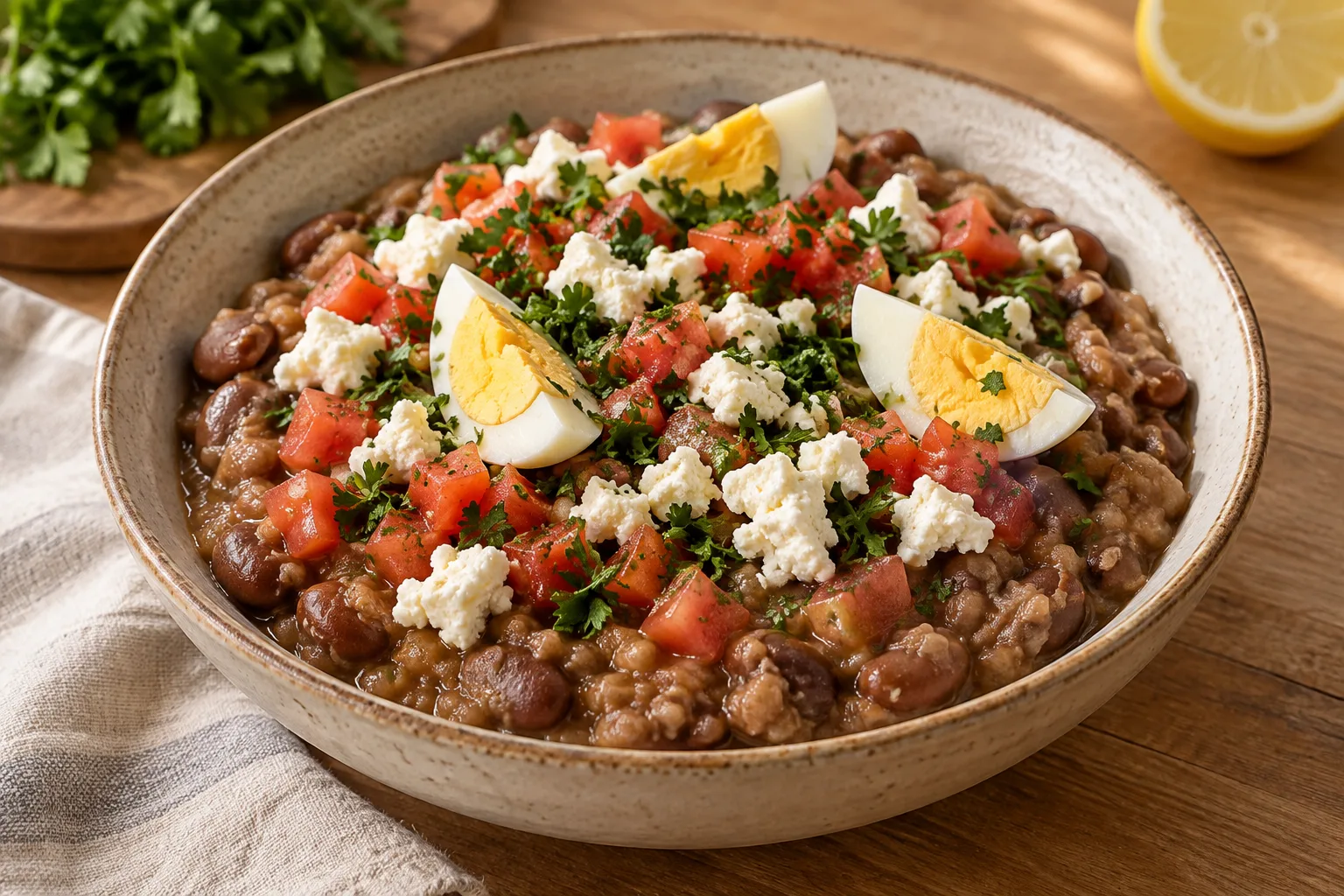
Spices such as cumin, coriander, black pepper, ginger, garlic, and cardamom are documented in particular preparations. Their combinations vary. Ful medames is made from softened fava beans and may be seasoned with cumin, oil, and other additions. A Sudanese version described with white cheese and egg offers a different set of contrasts from versions centered on beans, oil, and spices. Sesame oil is also associated with some Sudanese preparations of ful.
Texture is as important as seasoning. Fermented kisra is thin and pliable; goraasa is thicker, and aseeda is dense enough to hold its shape beside a stew. Okra can make a sauce more viscous, and beans may be partly mashed without becoming completely smooth. In eastern Sudan, moukhbaza combines ripe banana with chili, a specific sweet-and-hot pairing. These examples show a range of tastes and consistencies, not a single national flavor profile.
Hospitality, daily habits, and occasions
Sharing food with family, neighbors, and guests is described as part of Sudanese hospitality. It is expressed through ordinary meals as well as food offered to visitors, rather than through one ritual shared identically by every household. A stew set out with bread, or a filling dish of beans, can be eaten in different settings and with locally preferred accompaniments. The specific dishes and habits vary, so hospitality is better understood as a social practice than as a single prescribed menu.
Tea and coffee are important parts of the documented social landscape. Tea, sometimes served with milk, is sold in public settings by women known as tea sellers. Strong coffee may be prepared and served from a Sudanese coffee pot called a jabana. Karkadeh, an infusion made from hibiscus, is served cold in some contexts, particularly in hot weather. These drinks can extend social visits beyond a meal, though no one beverage is present at every gathering.
Fava bean dishes are associated with breakfast, including ful medames and shahan ful. One description notes shahan ful as a dish served in the morning and especially popular during Ramadan; accounts also mention shaaria, a sweet prepared for Ramadan. These examples document particular practices without suggesting that all Sudanese families observe the same food calendar. Peanut sweets such as ful sudani offer another way that pantry ingredients become a small, shareable treat. Cooking skills and preferences pass through homes and communities, with room for individual and regional variation.
Fermenting grain, simmering beans, and building stews
Grain preparation involves several distinct methods. To make kisra, sorghum flour and water are fermented into a batter, then spread thinly and cooked on a hot surface. The fermentation gives the bread its characteristic tang and distinguishes it from an unfermented flatbread. Goraasa uses a thicker wheat mixture and cooks into a more substantial bread. These differences matter at the table: a thin sheet folds easily, while a thicker piece can support a larger spoonful of stew.
For aseeda, flour and water are cooked together until they form a dense, cohesive mass. It is served with a sauce or stew rather than as a thin bread. Dried okra can be pounded or ground into waika and added to a stew, where it contributes both flavor and thickness. Dried meat or fish may also be incorporated into cooked preparations. These methods turn preserved ingredients into part of a complete dish.
Fava beans for ful medames are cooked until soft and may be partly mashed. Stews are simmered so that meat, vegetables, legumes, and seasonings can cook together; the ingredients and the consistency vary between versions. A useful way to distinguish these methods is by their result:
- Fermentation gives kisra a tang and a flexible, thin form.
- Thick cooking turns aseeda into a firm grain preparation served with sauce.
- Drying and pounding preserve ingredients and make okra useful as a stew thickener.
- Slow simmering softens beans and brings the components of a stew together.
Breads, stews, breakfast, and the shared meal
A meal may be organized around a stew and the grain or bread served with it. Kisra can be torn or folded to accompany a sauce; goraasa provides a thicker, softer base. Aseeda is served as a compact cooked grain preparation beside mullah. In each case, the bread or grain is part of how the sauce is eaten, not just an optional garnish. The accompanying stew may contain meat, vegetables, or legumes, so the same kind of bread can meet different flavors and textures.
Breakfast is a familiar setting for ful medames, and shahan ful is another fava bean preparation associated with morning meals. A version of Sudanese ful may combine beans with white cheese and egg, while other presentations use different condiments and accompaniments. The broad popularity of fava beans does not mean that there is only one way to season or serve them. The same care applies to mullah: a red stew, a meat-and-liver kamounia, and a vegetable-based sauce have different roles and ingredients.
Tea, coffee, and hibiscus drinks accompany social occasions as well as food. Sharing a dish and its bread can bring several people to one meal, while drinks may be served during a visit or apart from a main dish. The available KitchenPause recipe collection includes Sudanese ful medames with white cheese and egg and ful sudani peanut cookies. These are two specific preparations within a much wider culinary repertoire, not a complete inventory of Sudanese meals.
A glossary of Sudanese foods and preparations
Names are written in several transliterated forms, and spellings may vary. The terms below refer to specific foods or ingredients described in Sudanese culinary contexts; they should not be treated as labels for every version of a dish.
- Ful medames: Cooked fava beans, commonly served as a meal and especially associated with breakfast. Sudanese presentations can include additional toppings such as white cheese and egg.
- Kisra: A thin sorghum flatbread made from fermented batter, served with stews and sauces.
- Goraasa: A thicker wheat bread, served as an accompaniment to savory dishes.
- Aseeda: A dense preparation of cooked flour and water, made with grains such as wheat, maize, or sorghum and served with stew.
- Mullah: A general name for savory stews, which may contain meat, vegetables, or legumes.
- Waika: Pounded okra, sometimes dried, used in some stews as a seasoning and thickening ingredient.
- Karkadeh: A hibiscus infusion, also served cold.
- Ful sudani: A Sudanese peanut sweet, made in small pieces from ground peanuts and other ingredients.
One country, many cuisines
Khartoum and its surroundings
Khartoum is described as an urban meeting place for different culinary styles. Sudanese foods such as ful medames and mullah are present alongside dishes from elsewhere, reflecting the variety found in the capital. This urban setting offers one view of Sudanese foodways, but it should not be taken as a representation of every community or household in the country.
Northern Sudan
Accounts of northern Sudan connect the region with the Nile Valley and describe a Mediterranean-leaning food profile, including fresh vegetables, fish, and olive oil. These are regional patterns noted in descriptions of the area, not ingredients found in every northern household or foods exclusive to the north. The Nile also provides a broader geographic context for regional food exchange.
Western Sudan and Darfur
Descriptions of Darfur and other western areas note culinary links with West Africa and mention peanuts, dried fish, and leafy greens. These ingredients are part of a varied regional food landscape, where local resources and preferences differ. The examples point to documented tendencies rather than a single recipe, fixed cuisine, or uniform practice shared by all western communities.
Eastern Sudan
Eastern Sudan’s proximity to Eritrea and Ethiopia is reflected in descriptions of regional culinary connections. Those accounts mention spicy berbere blends, spongy fermented breads, and moukhbaza, made with ripe banana and chili. These examples show links and local variation across neighboring foodways; they do not establish rigid boundaries between Sudanese and neighboring cuisines.
Central Sudan
Central Sudan is described as an area where sorghum and millet are important staples, used for porridge, bread, and other grain preparations. The region is also noted for its varied communities and food options. These grains connect the pantry to foods such as kisra and aseeda, but recipes and everyday practices can still differ between localities and households.
Cook