Documentary synthesis prepared with AI assistance. It does not replace specialist review or certify kitchen testing. · Updated 3 November 2026
A cuisine shaped by place and exchange
Georgia lies in the Caucasus, on the eastern shore of the Black Sea, between Europe and Asia. That position is a useful starting point for understanding its food, but not a shortcut to a single national flavor. The landscape includes a Black Sea coast, lowlands, valleys, and mountain communities; culinary sources describe different breads, fillings, ingredients, and methods from one region to another. The result is a cuisine best read as a family of local traditions connected by shared foods and social habits.
Khachapuri makes that variety especially visible. The name covers cheese breads with distinct shapes and regional forms. Adjara’s open, boat-shaped version is commonly known as adjaruli; other documented versions include the round cheese-filled imeruli and the cheese-topped megruli. These differences are not decorative details: shape, dough, filling, and serving method identify particular preparations. The country’s food is not reducible to khachapuri, however. Vegetable dishes with walnuts, bean preparations, meat cooked on skewers, dumplings, and grape-based sweets all belong to the documented repertoire.
A useful way to explore the cuisine is to follow ingredients through more than one use. Grapes become wine, but grape must can also be thickened into pelamushi or used in churchkhela. Cornmeal appears in bread and in preparations that bring it together with cheese. Walnuts can form a rich sauce for vegetables or meat, rather than serving only as a garnish. Such examples show how regional knowledge and culinary technique give familiar ingredients different roles.
Eating together is another important part of the picture. The supra, a Georgian feast associated with hospitality and toasts, offers one setting for shared dishes; it does not define every meal or every household’s routine. Everyday foods such as bread, beans, and dumplings sit alongside special-occasion preparations. This atlas therefore follows documented regional associations and traditions without treating them as exclusive origins or as a complete account of every Georgian community.
Historical crossings and culinary continuity
Georgia’s location between the Black Sea and the Caucasus has made it a meeting point for routes and neighboring cultures. Food histories describe influences and exchanges associated with trade and with connections extending toward the Mediterranean, Persia, the Ottoman world, and Russia. These broad contacts help explain why Georgian cooking can share ingredients or techniques with cuisines beyond the country. They do not make individual dishes simple copies: local cooks adapted ingredients and methods within their own foodways, and regional variation remains central to how dishes are identified.
Georgia also has a long history of grape cultivation and winemaking. The country’s wine tradition is commonly described as extending back thousands of years, and the qvevri—a large clay vessel used for fermenting, aging, or storing wine—is a distinctive element of Georgian winemaking. The vessel and the grape harvest are relevant to food as well as drink. Must, the juice from pressed grapes, can be concentrated or thickened for preparations such as churchkhela, tatara, and pelamushi. A harvest product thus moves into sweets and preserved foods as well as into wine.
Not every account agrees on the precise origins or chronology of a particular dish. Khachapuri, for example, is described through a wide range of regional forms, while some accounts propose a specific place of origin. The safer culinary history is to emphasize the documented regional varieties and their continuing presence, rather than claim an exclusive birthplace for the whole family. The same care applies to dumplings: khinkali are associated particularly with mountain communities in northeastern Georgia in several accounts, while the dish is now known throughout the country.
Historical continuity also appears in household and festive practices. Gozinaki, made from nuts bound with honey, is especially associated with New Year celebrations. Grape sweets connect seasonal work with family meals and festive tables. These foods preserve methods of transformation—roasting, boiling, thickening, drying, and setting—while allowing variation in ingredients and form. Historical exchange and local continuity are not opposites: Georgian food has developed through contact and adaptation, while particular preparations remain rooted in regional names, skills, and occasions.
Grains, cheese, walnuts, and the grape harvest
A Georgian pantry brings together grains, dairy, vegetables, nuts, meat, herbs, and fruit products. Wheat flour and water form the basis of breads and dumpling wrappers; cornmeal has its own notable place in western Georgian preparations. The use of corn in ghomi and elarji shows how a grain can serve as a substantial base, with elarji combining corn and cheese into a stretchy, cohesive preparation. These dishes are associated particularly with Samegrelo in the evidence available here, while similar ingredients and methods can cross regional boundaries.
Cheese is not a single interchangeable ingredient. Georgian cheese breads depend on a filling that melts and has a suitable balance of salt and acidity. Sources name cheeses such as imeruli and sulguni in connection with khachapuri and other regional dishes. The form of the bread can change along with the cheese and method: a round, enclosed bread differs from an open adjaruli boat, and a version with cheese both inside and on top differs from either. Local cheese traditions matter to the finished texture, not merely to flavor.
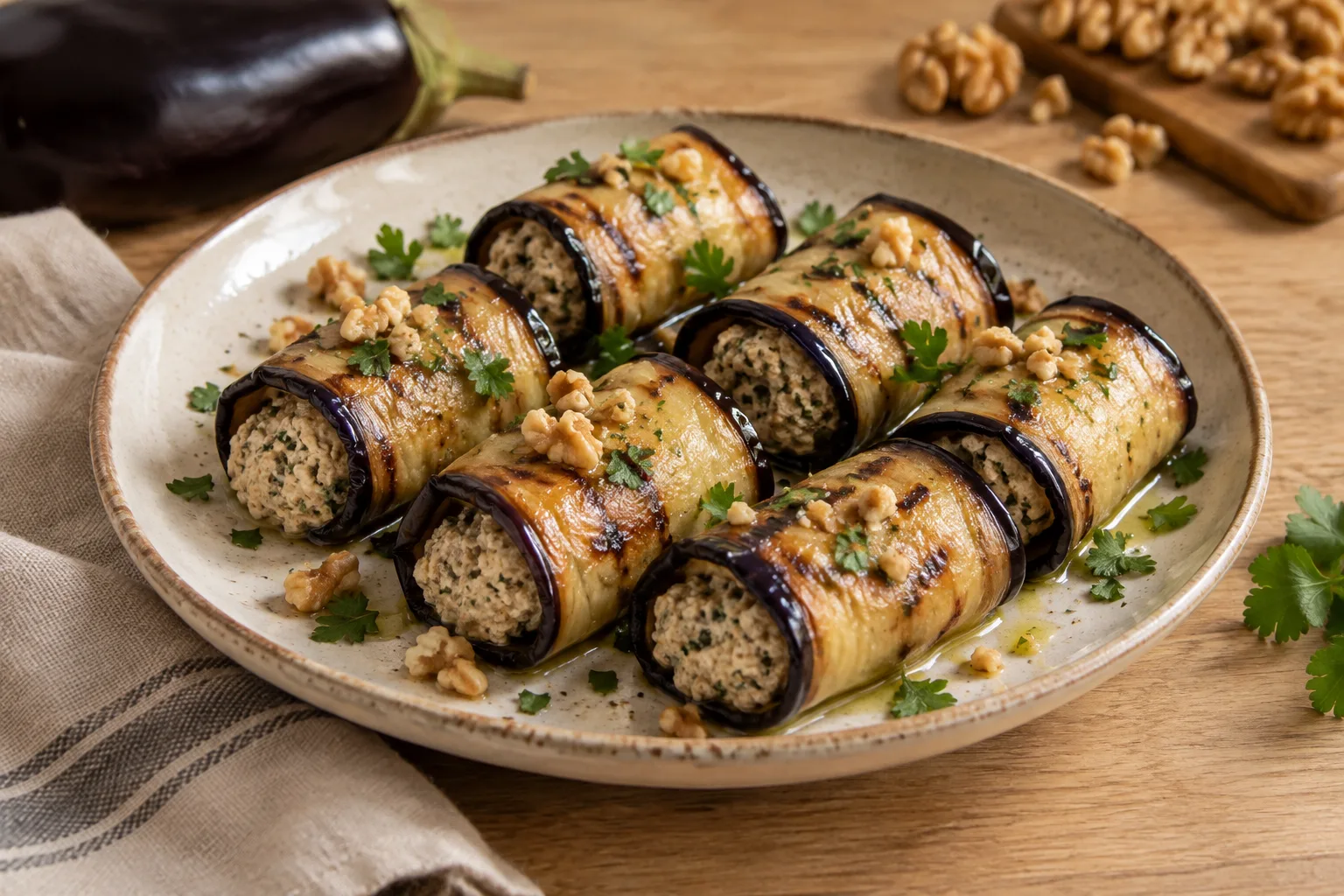
Walnuts are another defining pantry ingredient. They can be ground into sauces for vegetables, used in satsivi, or paired with eggplant in badrijani. In pkhali, cooked or prepared vegetables are combined with a walnut-based mixture and herbs. These uses demonstrate how nuts can contribute body and texture as well as flavor. Garlic, cilantro, and other herbs contribute aromatic freshness; sour plums and sauces such as tkemali bring a sharper, fruit-based contrast.
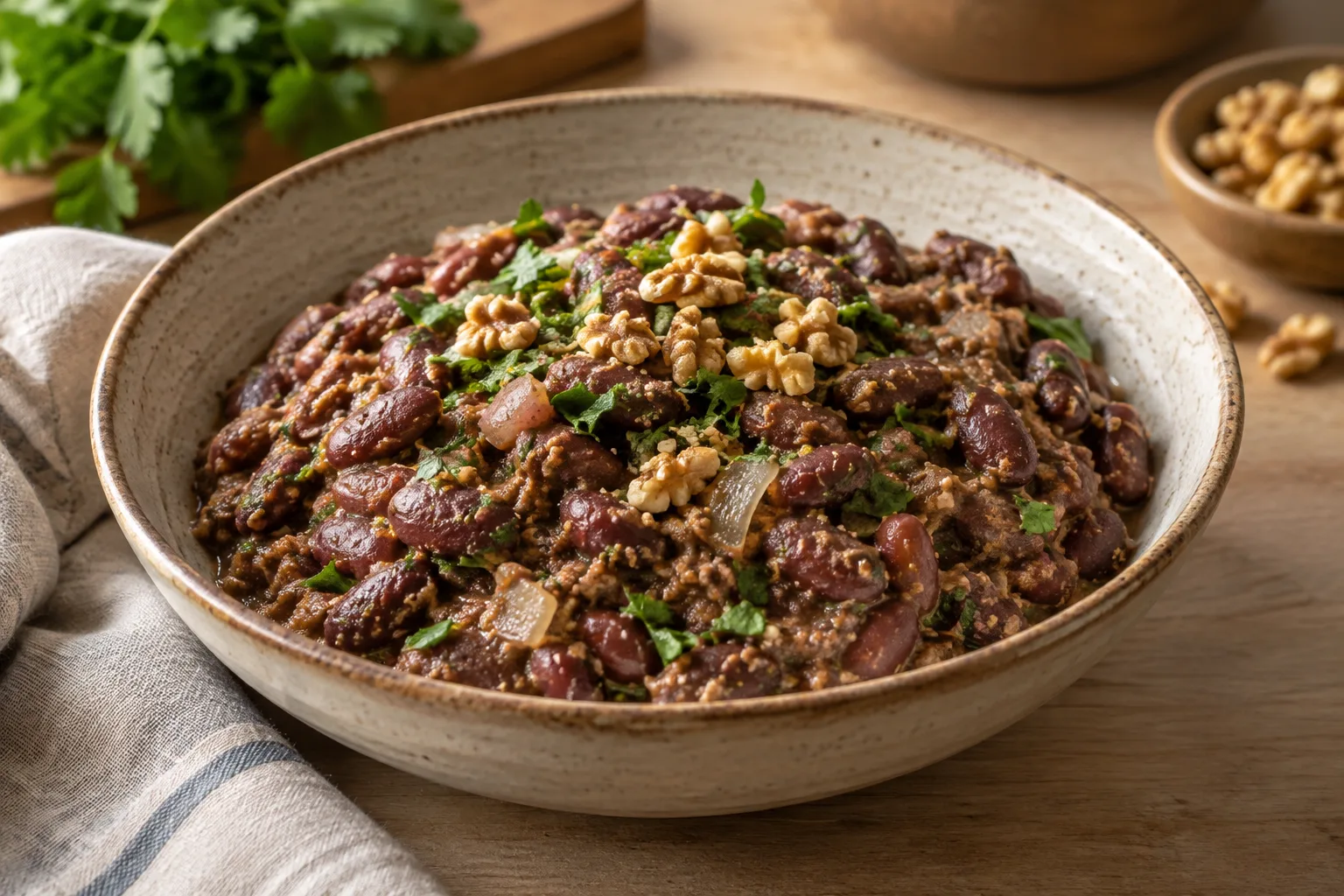
Grapes supply both fresh fruit and processed ingredients. Wine is made from local grape varieties, while pressed grape juice can be reduced to badagi or used as must in sweets. Churchkhela coats strings of nuts with a thickened grape mixture that is then dried; pelamushi thickens grape juice with flour, often corn flour in some versions. The exact flour and preparation can vary. Beans, eggplant, tomatoes, leafy greens, and meat round out this varied store cupboard. Their roles become clearest in specific dishes rather than in a generic list: beans in lobio, eggplant in ajapsandali or walnut-filled rolls, and meat in skewered mtsvadi or dumplings.
Contrasts of richness, freshness, and acidity
Georgian flavors are not defined by a single spice blend or by meat and cheese alone. The repertoire pairs rich, substantial foods with vegetables, herbs, fruit acidity, and nuts. A cheese bread offers warm dough and a salty, melting center; adjaruli adds egg and butter to the cheese-filled hollow. By contrast, a walnut-and-herb preparation can taste earthy, aromatic, and gently sharp, depending on its ingredients. These different combinations help explain why a table can include hearty baked foods alongside vegetable dishes without becoming monotonous.
Walnuts provide a characteristic depth and a soft, dense texture. In badrijani, thin eggplant slices are filled or rolled around a walnut mixture, often seasoned with garlic and herbs; pomegranate seeds may provide a tart, juicy accent. In pkhali, vegetables are mixed with a walnut dressing, producing a compact preparation whose flavor depends on the vegetable and its seasoning. Walnut sauce also appears in satsivi, a family of dishes often made with poultry. The nut’s role therefore ranges from filling to sauce to binder, rather than being a uniform garnish.
Acidity can come from sour fruit, vinegar, or grape products at different stages of preparation. Plum-based tkemali offers a sour-fruit counterpoint, while grape must contributes sweetness and fruit character to pelamushi and churchkhela. The latter is chewy and concentrated after drying; pelamushi is soft and pudding-like when set. The grape’s transformation changes its texture and use as much as its taste. Harvest sweetness is also distinct from the sharpness of a sour plum sauce.
Herbs provide another point of contrast. Cilantro and other fresh herbs can brighten meat, vegetables, or walnut preparations. In dishes such as mtsvadi, the cooking over embers contributes a smoky exterior and a savory, juicy interior; the meat itself remains the central flavor. In khinkali, by contrast, the seasoning is held inside a sealed wrapper with the broth, so the first taste may be aromatic liquid before the dumpling’s meat or other filling. Across these dishes, flavor comes from the relationship among ingredient, preparation, and serving—not from treating every Georgian meal as uniformly hot, rich, or heavily spiced.
Feasts, New Year sweets, and passing on skills
The supra is a well-documented Georgian feast and an important expression of hospitality. It brings people around a table with shared dishes and toasts; accounts describe a toast leader, the tamada, as part of this particular feast tradition. A supra is a distinctive occasion, not a template that should be imposed on every meal. Its significance lies in the combination of food, speech, company, and hospitality, while everyday meals also have their own rhythms and choices.
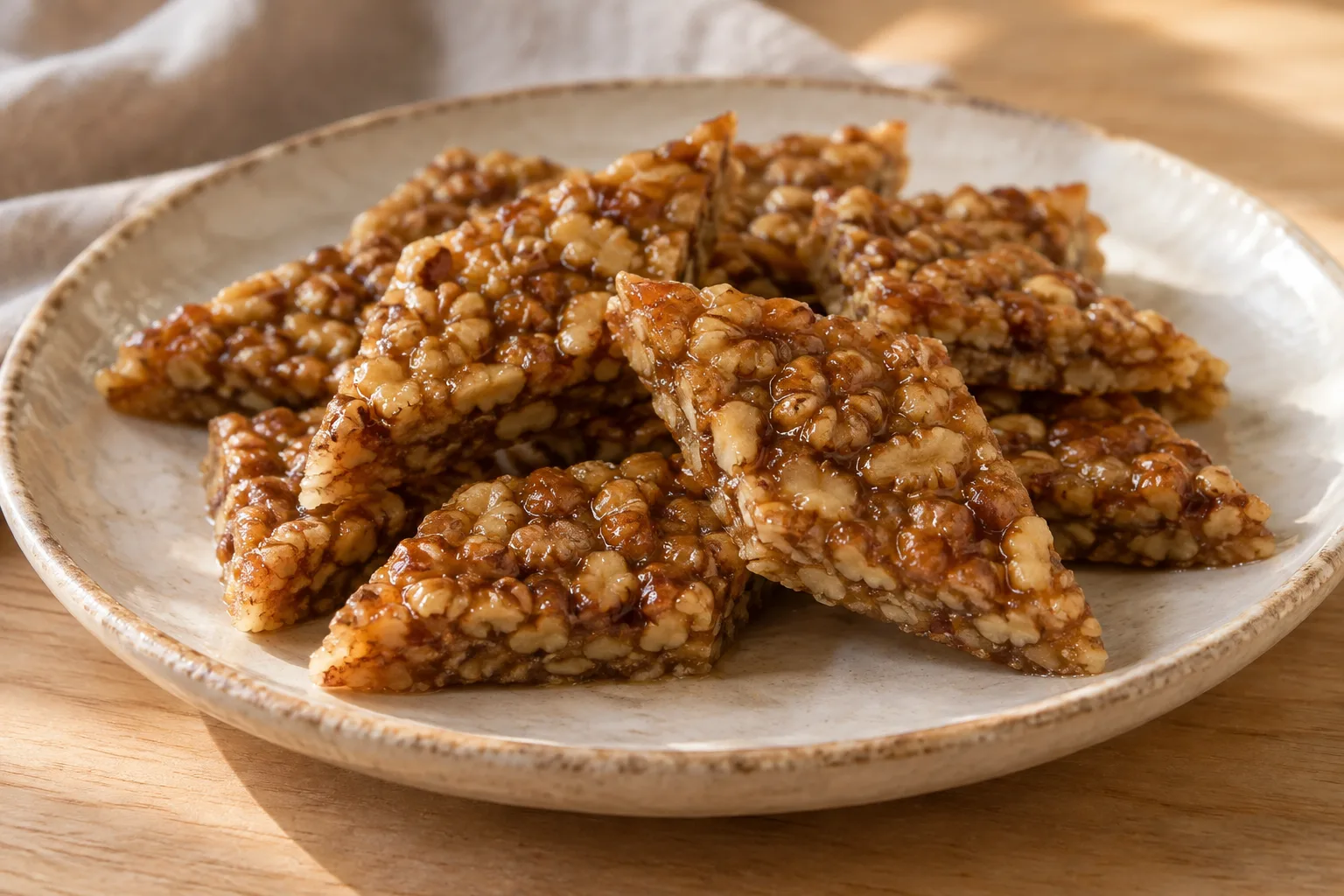
Some foods have especially clear festive associations. Gozinaki, a crisp sweet made by binding nuts with hot honey, is strongly linked with New Year. It is cut into small pieces and shared as a seasonal confection. Accounts also describe families preparing it at home, where attention to the honey’s consistency and the nuts’ preparation determines whether the mixture sets. The festive meaning rests not only on the finished sweet but on the repeated household work and the act of offering it to others. Variations in nuts and family methods are possible; the New Year association is the more consistently documented feature.
The grape harvest provides another occasion for collective work and transmission. Must can be used in sweets as well as in winemaking: families or cooks make preparations such as churchkhela and pelamushi from the grape crop. Churchkhela requires repeated coating and drying around nuts threaded on strings; pelamushi requires grape juice to be thickened with flour. These are distinct products, but both show how seasonal ingredients are transformed into foods for sharing. The calendar and the methods connect knowledge of harvest, ingredients, and texture.
Skills are passed on through observation and practice: shaping bread, sealing dumplings, judging a thickened grape mixture, or handling honey and nuts. Khinkali-making can involve repeated folding and sealing, and the dish is commonly eaten by hand so its broth can be enjoyed without spilling. Khachapuri also teaches through its form: the open adjaruli bread is served hot, and pieces of its rim can be used to gather the filling. Such practices are concrete and dish-specific, not universal rules for all Georgian dining. Across family kitchens and shared meals, the transmission of names and methods helps preserve regional distinctions while allowing cooks to adapt them.
Folding, baking, grilling, and thickening
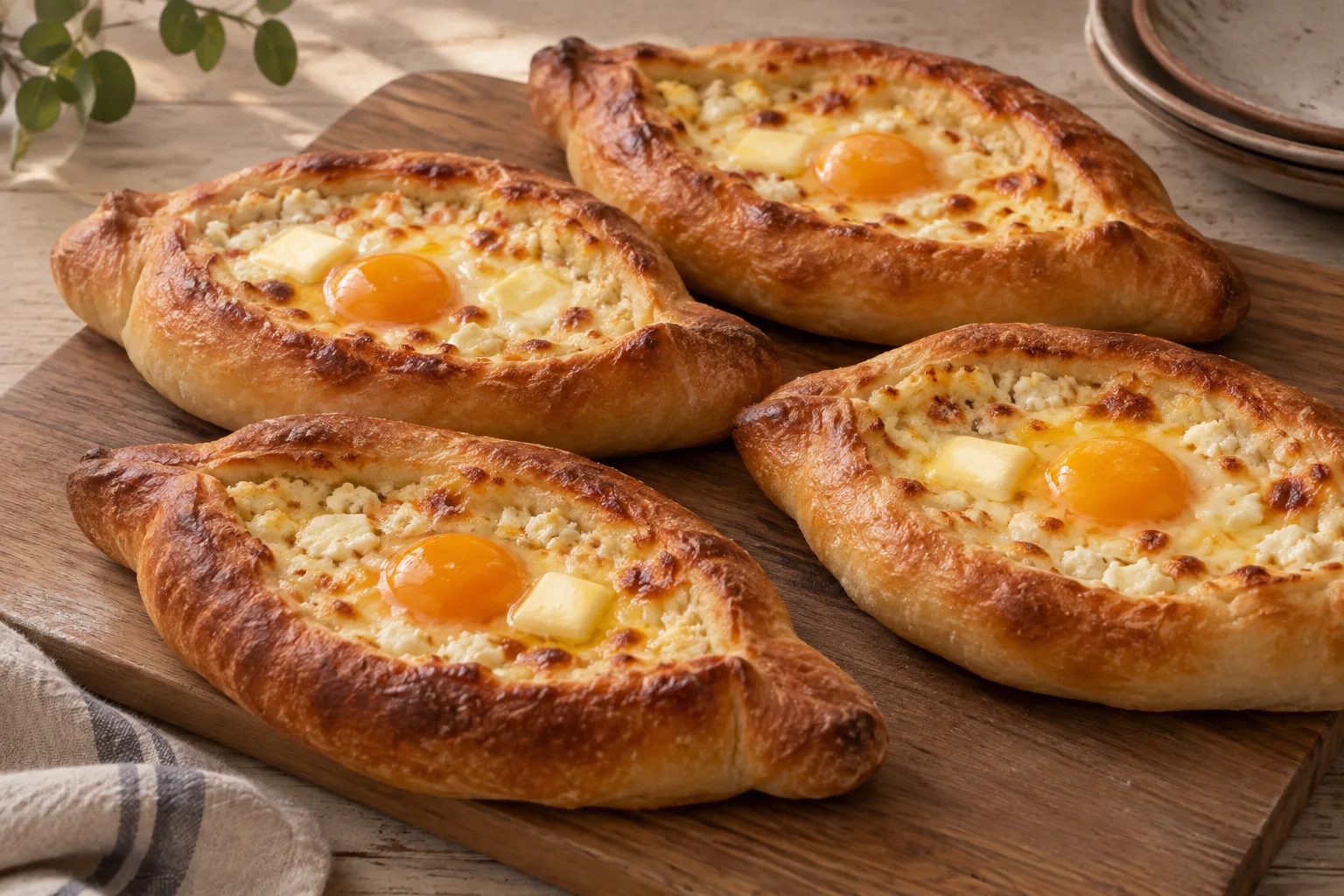
Georgian cooking includes techniques suited to different ingredients and desired textures. For bread, dough is kneaded, rested, shaped, and baked. In the open adjaruli khachapuri, the dough is formed into an oval boat with a raised rim, filled with cheese, and baked; egg and butter are added at or near the end of cooking in many descriptions. The hot filling remains soft enough to mix, and the rim becomes an edible scoop. Other khachapuri forms enclose their cheese, or include cheese on the top as well as inside. The regional name signals a particular construction rather than one fixed national formula.
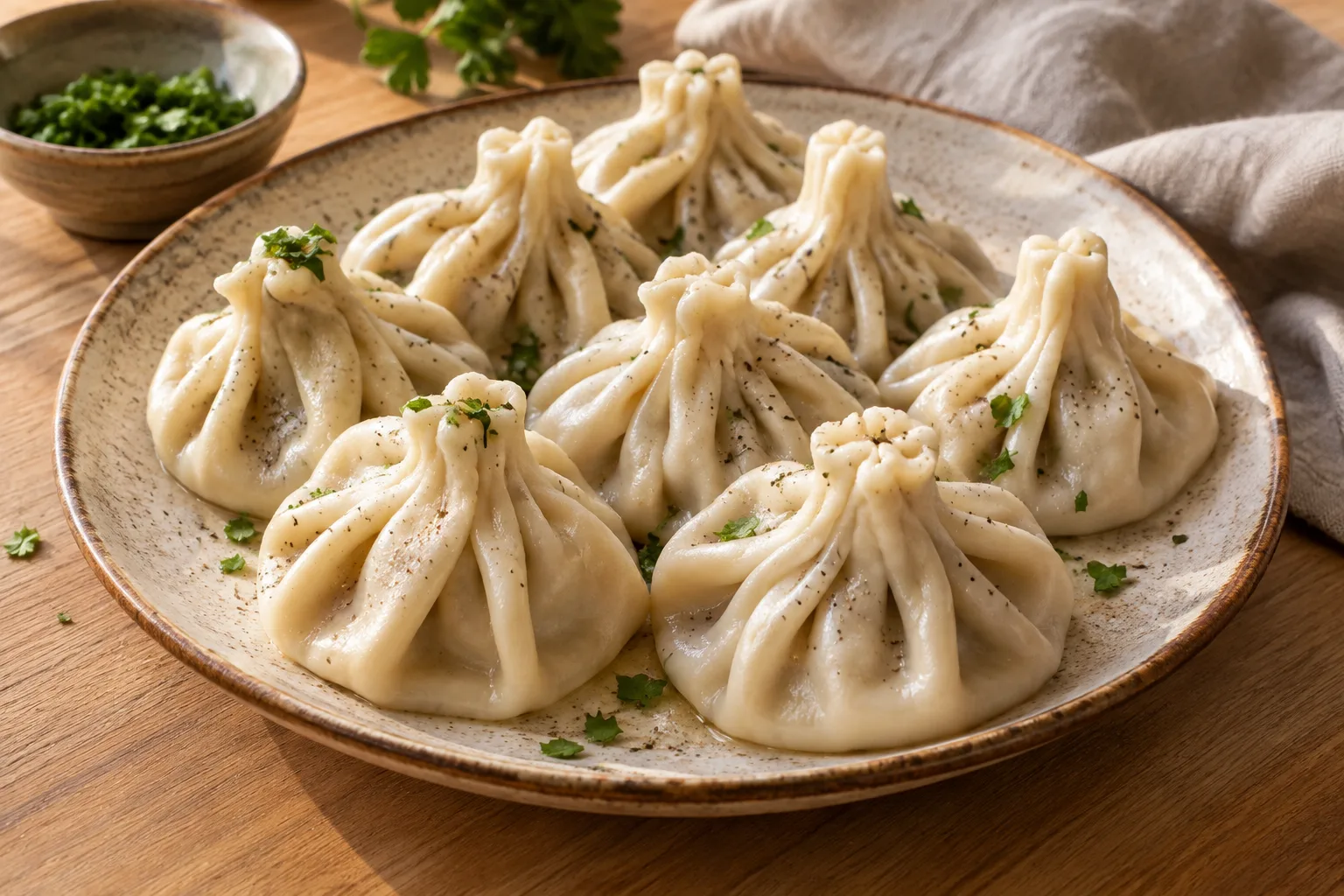
Khinkali depends on a different kind of shaping. A wrapper is filled, gathered into folds, and sealed at the top to retain its filling and liquid during boiling. The dumplings are cooked in water and served hot. A meat filling can release or contain broth within the wrapper, making a sound seal important. Eating the dumpling by hand, opening it carefully, and sipping the broth is a practical response to its structure. The thicker gathered top is commonly left uneaten in descriptions of the dish, though details of technique and custom can vary.
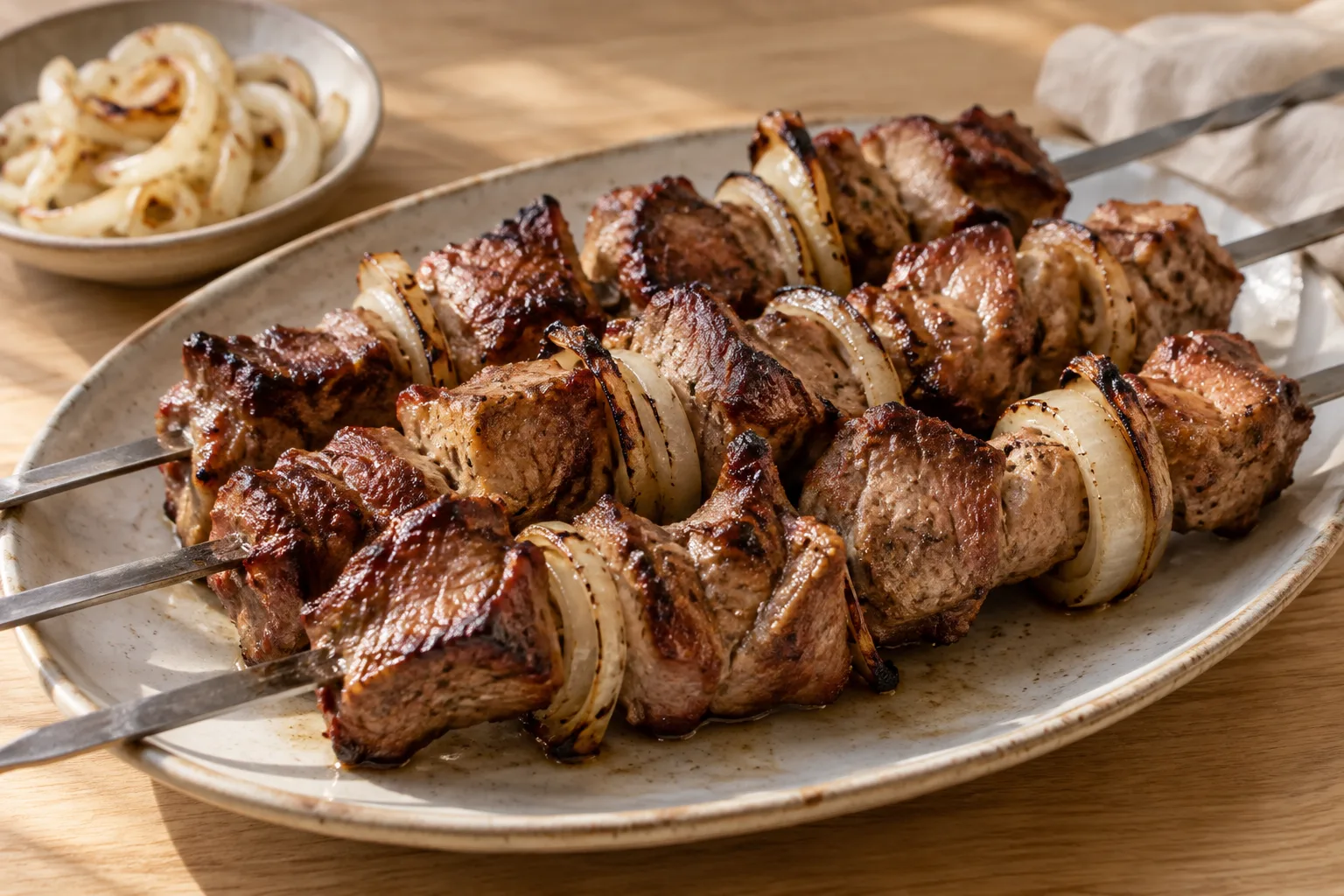
Grilling mtsvadi relies on skewers and a controlled fire. The meat is cut into pieces and cooked above embers; accounts describe regional and household variation in meat choice, seasoning, and treatment. In Kakheti, sources associate a particular method with grapevine wood embers. This is a regional preparation, not a requirement for every mtsvadi. The method emphasizes the direct relationship between heat, smoke, and meat rather than a heavy sauce.
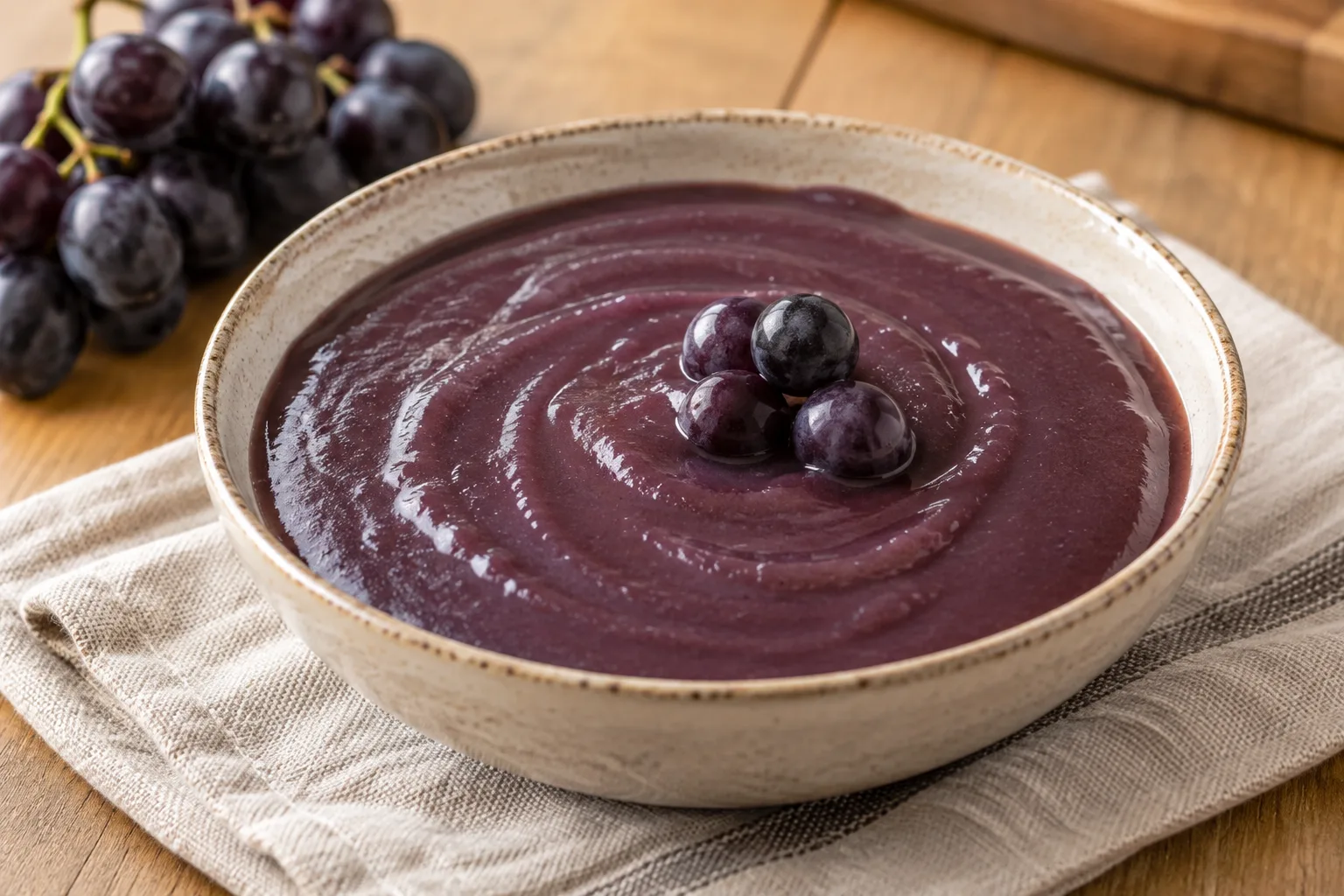
Grape preparations use heat for a different purpose. For pelamushi, grape juice is combined with flour and stirred as it cooks until it thickens. Continuous stirring helps produce an even texture. In churchkhela, a thickened grape mixture coats nuts threaded on a string, and drying firms the coating. Gozinaki involves heating honey and combining it with nuts so the mixture can be shaped and set. These techniques demand attention to texture: elastic dough, sealed dumpling wrappers, steady embers, smooth thickened juice, or a honey-and-nut mixture firm enough to cut. Traditional ovens such as the tone are used for Georgian bread, while other methods and household equipment also appear in contemporary cooking.
Everyday eating and occasions for sharing
Georgian tables range from ordinary meals built around bread and prepared dishes to elaborate feasts. Bread, including puri baked in a traditional tone oven, is an important accompaniment in descriptions of Georgian food. Khachapuri is more than a side bread in many settings: a substantial adjaruli can serve as a main dish, while other forms can be shared or eaten as part of a larger meal. The way it is served follows its shape. With the open version, diners tear off pieces of the rim and use them to gather the hot cheese mixture; it is often served promptly after baking.
Khinkali is usually served hot, and the broth within makes it a dish to approach carefully. Diners commonly hold each dumpling by its gathered top, make an opening, and sip the liquid before eating the rest. This is not merely a formal rule; it is a method that suits the food. Khinkali may be ordered as a meal in its own right, and meat and non-meat fillings are documented. The table practice of eating by hand is associated with this dumpling in particular, not with every dish in the cuisine.
Vegetable and bean dishes offer other ways to compose a meal. Pkhali can appear as a small vegetable preparation seasoned with walnuts and herbs; lobio is a bean dish; eggplant may be served with walnut filling or as part of a cooked vegetable preparation. These can accompany bread or form part of a broader spread. Their presence counters any narrow image of Georgian food as only meat and cheese, while still leaving room for substantial meat dishes such as mtsvadi or poultry in walnut sauce.
A supra gathers people for a more formal shared feast, with an abundant spread and toasts. New Year offers another documented occasion for sharing, especially gozinaki, the nut-and-honey confection. The grape harvest connects work and food through products made from must, including churchkhela and pelamushi. Such occasions are specific: not every family uses an identical menu, and not all Georgian meals follow a ceremonial structure. Their common thread is that dishes often carry their social meaning through how they are prepared, presented, and passed among people at the table.
A glossary of Georgian foods and table terms
The following terms name concrete dishes, ingredients, and settings discussed in this guide. Spellings can vary when Georgian words are transliterated into English or other languages. A shared name may also cover different regional forms, so a dish name is best understood together with its ingredients and method.
- Adjaruli khachapuri: An open, boat-shaped cheese bread associated with Adjara. It is commonly finished with egg and butter, and its rim is used to gather the hot filling.
- Churchkhela: A sweet made by coating nuts threaded on a string with thickened grape must, then drying the coating.
- Elarji: A western Georgian preparation combining cornmeal and cheese into a stretchy, cohesive dish; it is associated especially with Samegrelo.
- Gozinaki: A crisp Georgian sweet of nuts bound with honey, especially associated with New Year celebrations.
- Khachapuri: A broad family of Georgian cheese breads. Regional forms differ in shape, filling, and baking method; imeruli, megruli, and adjaruli are distinct examples.
- Khinkali: A gathered, sealed dumpling, commonly filled with seasoned meat and broth, though other fillings are also documented. It is generally eaten by hand.
- Mtsvadi: Georgian meat cooked on skewers over fire or embers. Meat choice and details of preparation vary; Kakhetian descriptions include cooking over grapevine embers.
- Pkhali: A family of preparations made from vegetables mixed with walnuts, herbs, and seasoning. The vegetable can vary, so the term does not refer to one fixed vegetable.
- Pelamushi: A soft, pudding-like preparation made by thickening grape juice or must with flour. It is distinct from churchkhela, even though both use grape products.
- Puri: Georgian bread. Tonis puri is baked in a traditional tone oven.
- Qvevri: A large clay vessel used in Georgian winemaking for fermentation, aging, or storage.
- Supra: A Georgian feast centered on hospitality, shared food, and toasts. It is a particular social occasion, not a name for every meal.
- Tkemali: A sour plum sauce used as a condiment; its fruit acidity offers a contrast to richer foods.
- Tone: A traditional Georgian oven used for baking bread.
These definitions are concise guides, not exhaustive recipes. Regional variants and household methods can alter ingredients and details without making the names meaningless. A khachapuri remains part of a broad bread family, while its regional adjective identifies a particular form; a grape-based sweet is identified by its own process, not just by its shared raw ingredient.
One country, many cuisines
Adjara
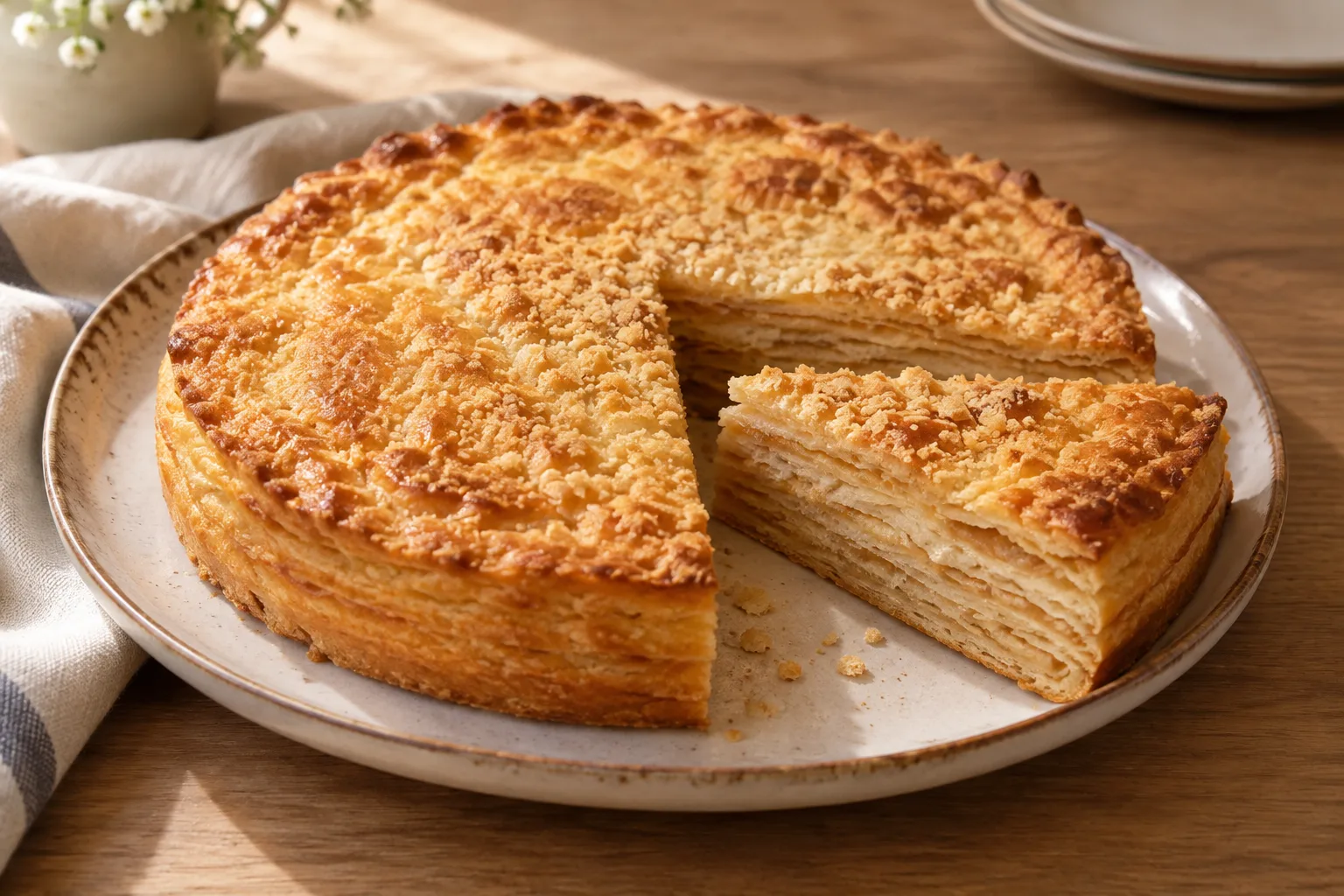
Adjara, on Georgia’s Black Sea coast, is associated with adjaruli khachapuri, an open, boat-shaped bread filled with cheese and commonly finished with egg and butter. Its form affects how it is eaten: pieces of the raised bread edge are used to gather the warm filling. Adjara is also documented in connection with achma, a layered cheese-and-butter preparation, and with regional grape-must terminology. These associations describe particular preparations, not the entirety of Adjara’s cuisine.
Kakheti
Kakheti in eastern Georgia is documented in connection with grape cultivation and wine, including the use of qvevri in Georgian winemaking. Grape products also appear in sweets: must can be thickened for preparations such as churchkhela and pelamushi. Sources further associate Kakheti with a particular style of mtsvadi cooked over grapevine embers. These foods show several uses of regional products, but they do not imply that every Kakhetian meal is organized around grapes or meat.
Samegrelo
Samegrelo, also called Mingrelia in some sources, is associated with corn-and-cheese preparations such as elarji and with the broader western Georgian repertoire of vegetable dishes and walnut seasonings. It is also linked to megruli khachapuri, a cheese bread with cheese inside and on top, and to regional uses of herbs and pungent condiments. These documented examples highlight distinctive local preparations while recognizing that ingredients and techniques are shared across western Georgia and beyond.
Cook
Pantry and recipes
Most consumed ingredients. Among the products covered by the 2025 balances, annual availability per person was 111 kg of wheat calculated as flour, 60 kg of vegetables and 48 kg of potatoes.
Georgia’s population used as the denominator in the national food balance sheets. Reference year 2025; national food supply per person, in kg per year. Supply and utilization balances: reading the per-capita consumption rows; wheat uses the flour basis specified in the table. Partial coverage: selected products, without an exhaustive ranking of all foods. Apparent availability, not measured individual intake or cooked portions. Population and balance revisions affect comparability between editions.
Ingredient prevalence in recipes. Flour, cheese, egg and yeast appear in the sampled published recipes for Imeretian, Ajarian and Meskhetian khachapuri.
Purposeful sample of three regional khachapuri recipes published on Georgia’s official tourism portal. Qualitative ingredient example within one family of filled breads; read on the first of November 2026. Selected the Imeretian, Ajarian and Meskhetian recipe pages. One recipe per canonical URL, without language duplicates; regional variants retained as distinct recipes. Manual comparison of ingredient lists. Partial coverage biased towards khachapuri: not representative of all Georgian recipes and does not measure prevalence percentages, amounts eaten or population frequency.
Timing and company
Meal times. Lunch started at around 2 pm and dinner at around 8 pm, in local time.
Observation period: 2020–2021. People aged fifteen or over in private households in Georgia; Abkhazia, South Ossetia and institutional households excluded. September 2020 to September 2021; national time use survey. One weekday and one weekend diary in ten-minute intervals; probability sampling and weighting. Partial coverage: approximations described from the aggregate daily profile, with no breakfast time, modal intervals or regional meal differences. The period overlapped pandemic restrictions.
Meals per day. 49% of surveyed adolescents ate breakfast every weekday.
School pupils aged eleven, thirteen and fifteen in Georgia; sample of 4235 pupils in 123 schools. National school survey in 2018; habitual weekday breakfast participation. Anonymous self-administered classroom questionnaire following the HBSC protocol. Partial coverage: no total meal or snack count or weekend estimate. School self-report cannot be extrapolated to adults.
Weekdays and weekends. Average daily eating and drinking time was 1.5 hours on weekdays and 1.6 hours on weekend days.
Observation period: 2020–2021. People aged fifteen or over in private households in Georgia; Abkhazia, South Ossetia and institutional households excluded. September 2020 to September 2021; national time use survey. One weekday and one weekend diary in ten-minute intervals; probability sampling and weighting. Partial coverage: daily eating and drinking total across all people, not the duration or count of individual meals. Source table precision retained, without conversion to minutes or claims of statistical significance. Pandemic period.
Eating at home and away. 52% had gone to a restaurant in the six months before the survey.
Adults in Georgia; sample of 2317 people aged eighteen or over, excluding Abkhazia and South Ossetia. Nine October to four November 2019; recall of the preceding six months. Household survey with a stratified multistage cluster sample, CAPI interviews and weighting. Partial coverage: restaurant attendance does not measure the share of meals at home or away. Includes pizzerias, sakhinkle and fast food; not applicable is excluded.
Cooking frequency. 37% were in the category spending 241 to 960 minutes a week cooking for their family.
Georgia residents aged eighteen or over; sample of 1438 people, excluding Abkhazia and South Ossetia. Five April to ten May 2018; self-reported usual weekly time. Stratified multistage cluster sample, CAPI interviews and weighted results; grouped responses. Partial coverage: an interval, not a mean; no cooking days per week or daily minutes. Categories include not applicable and unknown/refusal; rounded percentages.
Eating together. A supra is a communal meal whose participants sit together and share food.
Cultural description of one type of gathering. Partial qualitative coverage: no measurement of eating alone, habitual company or shares by meal; not representative of everyone’s everyday meals.
Cereals and plant foods
Cereals and cereal products. In the 2025 balances, annual availability per person was 111 kg of wheat calculated as flour and 36 kg of maize on the balance-sheet basis.
Georgia’s population used as the denominator in the national food balance sheets. Reference year 2025; national food supply per person, in kg per year. Reading the per-capita consumption rows of supply and utilization balances, retaining the original commodity bases. Partial coverage: no rice, oats, pasta or all-cereal total. Availability indicators, not measured intake. Wheat is expressed as flour and maize products are converted to maize; no conversion to cooked weight or portions.
Bread. Georgian lavashi and shoti are wheat breads. In a tóné oven, dough is attached to the hot walls; Georgian lavashi is described as round and relatively thick.
Qualitative culinary description; no observation period for quantified consumption. Partial coverage: bread types and preparation, without bread kg per person, frequency, variety shares or ingredient quantities. Not all regional practices are represented.
Pulses. Lobio uses dried beans that are soaked and then boiled. Regional variants include beans with tkemali, leeks or ham.
Qualitative culinary description; no observation period for quantified consumption. Partial coverage: a cultural bean example, without kg per person, frequency, recipe shares or lentil/chickpea quantities. No dry-to-cooked weight conversion.
Vegetables. The published mean was 6.0 vegetable-consumption days per typical week and 2.4 vegetable servings per day.
Fruit. The published mean was 5.3 fruit-consumption days per typical week and 2.0 fruit servings per day.
Adults aged eighteen to sixty-nine in Georgia; 5554 people participated in a national survey. Fieldwork from June to September 2016; published means for both sexes. Multistage cluster sampling and STEPS questionnaire with serving showcards. Asks about days in a typical week during the past year and servings on one of those days. Partial coverage: no species ranking or gram quantities. Self-report and showcard servings; no conversion to weight or recalculated weekly mean. Data from 2016, without extrapolation to children, older people or current habits.
Potatoes, roots and tubers. The 2025 potato balance records annual availability of 48 kg per person.
Georgia’s population used as the denominator in the national food balance sheets. Reference year 2025; national food supply per person, in kg per year. Reading the per-capita consumption rows of supply and utilization balances, retaining the original commodity bases. Partial coverage: potatoes only, without cassava, sweet potato or other tuber quantities. National apparent availability, not measured individual intake or cooked weight. Population revisions affect comparisons between editions.
Protein foods
Meat. The 2025 meat balance records annual availability of 48 kg per person, at the precision displayed in the table.
Georgia’s population used as the denominator in the national food balance sheets. Reference year 2025; national food supply per person, in kg per year. Supply and utilization balance; per-capita consumption row. The precision displayed in the table and the official methodology’s commodity basis are retained. Partial coverage: aggregate meat, without poultry, pork, beef or other meat shares. Apparent availability, not individual intake or cooked-portion weight; production is expressed in slaughtered weight.
Fish and seafood. Fish available for consumption was 10.3 kg per person in 2023.
Georgia’s population used in FAO food statistics. Food reference year 2023; profile compiled in March 2026. Reading the availability figure and the profile’s source/period note, which identifies FAOSTAT for population and fish availability. Partial coverage: availability, not individual intake. No species, shellfish or fresh/preserved shares; not equivalent to edible fillet weight or a cooked serving.
Eggs. The 2025 egg balance records annual availability of 166 eggs per person.
Georgia’s population used as the denominator in the national food balance sheets. Reference year 2025; national food supply per person, in kg per year. Supply and utilization balance; per-capita consumption row. The precision displayed in the table and the official methodology’s commodity basis are retained. Partial coverage: egg counts, without a uniform mass or conversion to kg. National apparent availability, not measured individual intake or age-specific distribution.
Milk and dairy products. The 2025 milk and dairy balance records annual availability of 201 kg per person in milk equivalent.
Georgia’s population used as the denominator in the national food balance sheets. Reference year 2025; national food supply per person, in kg per year. Supply and utilization balance; per-capita consumption row. The precision displayed in the table and the official methodology’s commodity basis are retained. Partial coverage: milk and dairy aggregated as milk equivalent, not kg of cheese or yogurt eaten. No separate product quantities or measured individual intake.
Protein sources. A clinical sample in Tbilisi reported poultry, beef, pork, sausages, smoked meat products, eggs and cheese as animal-protein foods.
Qualitative description of reported animal sources in a patient sample; observation period not verified. Partial coverage: an animal-food list, without protein contribution percentages by group or quantified plant sources. Clinical sample, not nationally representative; no protein contribution inferred from frequency or publication year used as observation year.
Fats, flavours and condiments
Cooking fats. Kakhetian sunflower oil is used with shoti bread, salads, herbs, capers and beans.
Qualitative regional description; no consumption measurement period. Partial coverage: a regional example, without per-person quantities, frequency or national shares. Olive oil, butter, lard and other fats are not quantified.
Herbs and spices. In the selected recipes, red ajika includes blue fenugreek, dried coriander and saffron; green mint ajika includes fresh coriander, parsley and mint.
Ingredients in specific ajika variants; no population observation period. Partial qualitative coverage: does not represent all Georgian recipes or measure usage percentages, quantities eaten or national frequency of each herb.
Sauces and condiments. Ajika combines hot pepper, salt, garlic and dried spices. Tkemali is a sour-plum sauce with garlic, pennyroyal and coriander. Ajika is also served as a table condiment.
Qualitative condiment description; no survey period or consumption estimate. Partial coverage: composition examples without national shares, quantities or frequency. Variants differ and these ingredients do not exhaust all recipes.
Meal composition
Breakfast composition. 49% of surveyed adolescents ate breakfast every weekday.
School pupils aged eleven, thirteen and fifteen in Georgia; sample of 4235 pupils in 123 schools. National school survey in 2018; habitual weekday breakfast participation. Anonymous self-administered classroom questionnaire following the HBSC protocol. Partial coverage: weekday breakfast frequency without breakfast foods, drinks, combinations or amounts. School self-report from 2018, not extrapolated to adults or current habits.
Main meal composition. The ceremonial supra brings together cheeses, bread, pickles, leafy greens, roasted or boiled meats and hot khachapuri.
Cultural example of a ceremonial meal; no consumption survey period. Partial coverage: a festive meal without a representative everyday main-meal menu, universal course order, quantities or national frequency. No fixed time is assigned to the supra.
Appetisers and snacks. Street-food offerings include tarragon or potato pies, donuts and chebureki.
Examples of foods available as street food; no survey period. Partial coverage: does not measure what is eaten between meals, how often or in what amounts. Street food may also constitute a main meal; not all offerings are equated with snacks.
Desserts and sweets. Churchkhela is made from threaded nuts coated in concentrated grape juice boiled with wheat flour.
Qualitative culinary description of preparation; no survey period. Partial coverage: a product example without national frequency, portion size or amounts of sugar consumed. Regional variants may use other nuts and flours.
Portion sizes. The 2005 food guide defines a 60 g slice of bread and half a cup of cooked rice, pasta or oatmeal weighing 125 g as standard portions.
Reference portions in the national guide intended for the general population. Recommended portion weights for specified foods; these are not observed meal quantities. Reading and visual verification of the standard-portion column in the original table, distinguished from the columns for portion counts and daily amounts. Partial, normative coverage from 2005. Rice, pasta and oatmeal weights refer to cooked food and must not be compared with dry weights or interpreted as portions actually consumed by every resident.
Techniques and equipment
Cooking techniques. In Mtiuleti, a pkhali variant with crumbled cheese is used as a filling in dough that is baked.
Qualitative culinary description without a consumption survey period. Partial coverage: a baking example without household frequencies of baking, frying, steaming, boiling, griddle cooking, barbecue or stewing. Does not represent all preparations in the country.
Vegetable preparation. For Imeretian-style field pkhali, the leaves are scalded in boiling salted water and then mashed.
Field-pkhali preparation from Imereti, Georgia. Qualitative culinary description without a consumption survey period. Manual reading of the preparation description and its variants. Partial coverage: a regional recipe without national shares of raw, boiled, roasted, sautéed or pickled vegetables or quantities eaten.
Food preservation. Jonjoli is preserved in brine. In churchkhela preparation, the grape-coated sweet is hung and sun-dried in a ventilated space.
Qualitative culinary description without a consumption survey period. Partial coverage: described techniques without household shares, frequency, validated shelf life or quantities preserved. Freezing and canning are not quantified.
Fermented foods. Matsoni is fermented cow or buffalo milk. Its preparation uses dedo, a starter from a previous batch of matsoni.
Qualitative culinary description without a consumption survey period. Partial coverage: product and starter type without consumption frequency, portion size or national quantities. Does not represent all artisanal or industrial variants.
Kitchen equipment. In 2024, 96% of surveyed adults reported that their household owned a working refrigerator.
Adults included in the Georgia survey. Fieldwork from 16 April to 13 May 2024; household ownership reported by the respondent. Computer-assisted personal interviews; multi-stage cluster sample with preliminary stratification and weighted results. Partial coverage: refrigerator only, without verified oven, microwave or pressure-cooker percentages. Weighted percentage of people reporting on their household, not a recalculated household estimate or use measure; table rounding retained.
Drinks
Everyday drinks. In the 2018 survey, 20% of eleven-year-old girls and 27% of eleven-year-old boys reported drinking soft drinks every day.
Eleven-year-old school pupils in Georgia, within a school survey covering several age groups. Reported daily soft-drink frequency, separated by sex; observation year 2018. Anonymous self-administered classroom questionnaire following the HBSC protocol. The report’s frequency category is retained. Partial coverage: soft drinks and a specific age, without volume, sugar quantity or an all-age average. Does not quantify water, coffee, tea or juices or establish current habits or consumption with meals.
Coffee and tea preparation. In Ajara, Batumuri Kava is made with coffee grounds, water and optional sugar, heating a jezve in hot sand. The regional tradition also includes black and green tea.
Qualitative culinary description; no consumption survey period. Partial regional coverage: no cup size, grams, frequency, share adding milk or average sugar intake. Does not represent every coffee or tea preparation in Georgia.
Drinks with meals. Wine is part of the supra, a shared ceremonial meal.
Qualitative example of a drink at a ceremonial meal; no survey period. Partial cultural coverage: no shares of people taking each drink with breakfast, lunch or dinner. Does not measure wine quantity or everyday habits and is not extrapolated to the whole population.
Nutrition and dietary patterns
Salt and sugars. In 2016, estimated mean salt intake was 8.5 g/day.
Adults aged 18–69 in Georgia. National salt estimate; this is neither a sodium figure nor a sugar figure. Population-based STEPS survey, June to September 2016, using multistage cluster sampling and urinary sodium and creatinine measurements. The published salt estimate is retained. Partial coverage: the summary does not specify the estimation equation or establish a full-day urine collection. It does not quantify total, added or free sugars and does not describe current intake.
Shopping, prices and waste
Food expenditure. In 2025, food, beverages and tobacco accounted for 38.7% of household cash consumption expenditure.
Observation period: 2025. Private households in Georgia covered by the income and expenditure survey. Combined food, beverages and tobacco category; share of cash consumption expenditure. Household survey using two-stage stratified cluster random sampling, interviews and a one-week expenditure diary; weighted results. Partial coverage: includes alcoholic beverages and tobacco. The denominator excludes non-cash expenditure and non-consumption outlays; this is neither a share of total expenditure nor food alone. Territories outside survey coverage are excluded.
Cost of specific meals. In February 2026, the estimated average cost of preparing a standard portion of Imeretian khachapuri was 8.05 GEL.
Observation period: February 2026. The standard home preparation used by Georgia’s khachapuri index. Preparation cost for the index’s standard unit; this is neither a restaurant price nor spending per person. Cost index covering flour, cheese, yeast, milk, eggs and butter, together with gas and electricity. Partial coverage of one dish and an index-defined unit. The publication consulted does not specify the portion weight, number of diners or detailed outlets; it cannot support comparisons between different portion sizes.
Grocery shopping locations. In April 2023, 86% of respondents bought groceries at hypermarkets or supermarkets, 51% at agricultural markets and 37% at neighbourhood stores.
Adult residents of Georgia included in the food-safety survey. Shares of people reporting use of each store type; multiple answers were allowed. Computer-assisted face-to-face interviews conducted on 12–26 April 2023, using two-stage cluster sampling, random household selection and statistical weighting. Partial coverage: these are reported shopping channels, not shares of food spending. Categories overlap and must not be added as a budget breakdown. The sample excluded workers in specified institutions and food-sector activities and does not measure online shopping separately.
Shopping frequency. In June 2025, the average grocery transaction through TBC Bank’s channels was 16 GEL.
Observation period: June 2025. Non-cash transactions through the bank’s channels in Georgia. Average amount per grocery transaction; partial coverage of monetary purchase size. Point-of-sale and e-commerce payment data processed through the bank’s channels. This does not measure weekly visits or a household’s full shopping basket. It excludes cash and payments outside these channels and may include non-resident purchases and non-food items sold by the retailers.
Prepared food and delivery. In 2024, the estimated value of restaurant e-commerce in Georgia was 0.8 billion GEL.
Observation period: 2024. Georgia’s restaurant e-commerce market. Aggregate estimate for the restaurant food-delivery segment; this is not a household average. Sector-report market estimate using central-bank data, national statistics and the authors’ research. Partial coverage of aggregate spending. It does not identify individual frequency, dishes, portion sizes or the resident–visitor split and does not represent all prepared food purchased in person.
Household food waste. For Kutaisi, a study with fieldwork in 2010–2011 underpins an estimated household food-waste figure of 101 kg per person per year.
Observation period: 2010–2011. Waste from residential areas of Kutaisi, Georgia. Local household food-waste datapoint, including food and associated inedible parts; this is not a current national measurement. Monthly sorting of waste from residential areas sampled from trucks, combined with municipal waste data to estimate annual mass per person. Partial, local coverage. Truck collection increases uncertainty about attribution to households. It does not separate avoidable edible waste, food types or reasons and must not be extrapolated to all Georgia or directly compared with studies weighing edible food only.
Seasons and celebrations
Seasonal produce. The grape harvest starts in September with Rkatsiteli in Kakheti and can extend to December for Chkhaveri in Guria and Adjara. On the Black Sea coast, particularly Adjara, the tangerine harvest runs from late October to December.
Partial local harvest calendar by product, variety and region. These are harvest windows, not months of imported-product availability or household consumption. Exact dates vary by variety, weather and location; this is not a complete fruit and vegetable calendar.
Celebration food. For New Year, gozinaki is prepared with walnuts, honey and a little sugar. At Orthodox Easter, a movable feast, prominent foods include red-dyed eggs and paska with raisins and spices.
Partial cultural description of celebrations and foods; practices vary across regions and families. This is not a survey of participation, frequency or quantities consumed. Easter follows the Orthodox calendar and changes date each year; no annual date is assigned here and the selection is not exhaustive.