- Category
- Vegetables
- State
- Canned
- Usual unit
- g
What it is
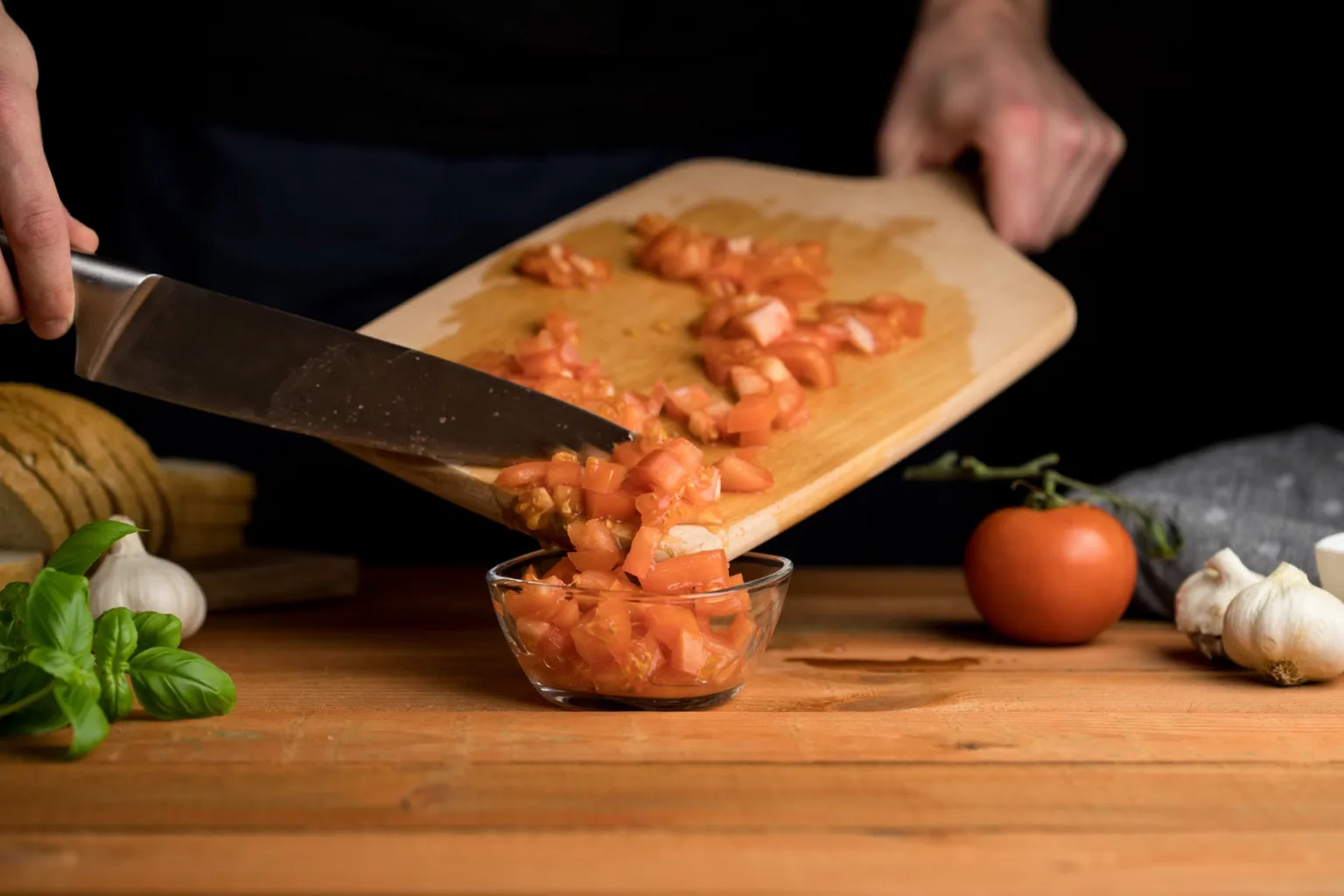
Canned chopped tomatoes are tomatoes prepared in pieces or crushed and packed for cooking. Their texture is not identical across products: some are finer, while others retain small pieces; certain products may be closer to a chunky tomato pulp than a uniform liquid. Check the product name and ingredient list to see exactly what is in the can, as formulations can vary, including whether salt or other ingredients are present. This ready-to-use format saves the step of cutting whole tomatoes and provides a straightforward base for cooked dishes. It is not automatically interchangeable with whole peeled tomatoes, passata or tomato paste: these forms have different textures and may call for adjustments to a recipe.
When to use it
Use canned chopped tomatoes when you want to add tomato directly and fairly evenly to a dish, such as pasta sauce, soup, stew or casserole. Because the tomatoes are already cut or crushed, they are convenient in recipes where whole-tomato shape is not needed. They can be used in shorter or longer cooking, depending on the recipe; if the mixture is too loose, simmering it uncovered can help reduce it. Choose a finer product or blend it for a smooth sauce, and a chunkier one when you want noticeable pieces. Check whether the label lists salt or other ingredients and season accordingly.
How to use it
Open the can and check the product name, ingredient list and any use or storage directions on the label. Pour the tomatoes into the dish or add them to a cooked onion or garlic base. Stir and cook until the mixture reaches the consistency required by the recipe; to thicken a sauce, reduce it uncovered, stirring occasionally. Add salt and other seasonings after checking whether the product already contains salt. Blend the mixture for a smoother texture, or leave the pieces intact for more body. If using whole peeled tomatoes instead, chop or crush them first; if using passata or smooth purée, add it gradually and consider whether the recipe needs another ingredient to provide texture. Always follow the storage directions on the package.
Flavour and texture
The flavor is that of tomatoes prepared for cooking, and it can be more or less pronounced or salty depending on the formulation. Texture varies too: some products are fine, while others retain small pieces. Cooking can help the tomatoes blend into a uniform sauce; reducing the mixture makes it thicker. Read the label and adjust seasoning and consistency to suit the dish.
How to choose it
Read the product name and ingredient list to distinguish chopped tomatoes from chunky pulp, passata or other tomato formats. Check whether salt or other ingredients are included, since formulations vary. Choose a texture that suits the recipe: finer tomatoes for a smooth sauce or visible pieces for a chunkier result. Also check the use and storage information provided on the package.
Storage
Store the product according to the directions on its package, and check the stated duration and date information. After opening, look for label instructions on how and for how long to store it; guidance can differ between products. If you transfer the contents to another container, keep it identified and follow the applicable food-storage directions. Do not estimate storage life from appearance alone.
Substitutions
Whole peeled canned tomatoes can replace chopped tomatoes if you chop or crush them before adding; the result may have larger pieces. Passata or tomato purée gives a smoother texture, so add it gradually and adjust the consistency of the dish. Check whether the substitute contains salt or other ingredients and season accordingly.
Common mistakes
Do not assume every can has the same texture or contains only tomatoes: check the label. Avoid adding salt automatically before checking the ingredients. Passata or smooth purée will not provide the same pieces as chopped tomatoes, so adjust the texture to the result you want.
Safety and allergens
Follow the storage, duration and use directions on the package. Check the ingredient list for components relevant to your dietary needs; do not assume that every brand has the same composition.
Culinary uses
- Base for tomato sauces and pasta dishes
- Moist, chunky component in soups, stews and casseroles
Recommended techniques
- Stir into a sautéed onion or garlic base, then simmer
- Cook uncovered to reduce excess liquid and concentrate the sauce
Pairs well with
- Onion and garlic
- Pasta, beans and vegetables
Frequently asked questions
Are canned chopped tomatoes the same as passata?
Not necessarily. Chopped tomatoes may retain pieces, while passata is usually smoother; check the product description.
Do I need to cook them before using them?
That depends on the recipe. They are ready to add, but are commonly cooked in sauces, soups and stews.
Do all cans contain salt?
Ingredients vary by product. Check the ingredient list and adjust the recipe's seasoning accordingly.
Ingredient allergens
Allergen listThere are no verified associations for these ingredients yet.
Estimated nutrition
- Fat
- 0.25 g
- Saturates
- 0.03 g
- Carbohydrate
- 3.47 g
- Sugars
- 2.55 g
- Fibre
- 1.9 g
- Protein
- 0.79 g
- Salt
- 0.29 g
Sources and review
Automatically researched, cross-checked and validated content. Sources consulted:
- En el etiquetado alimentario hay algunas menciones que son obligatorias eletiquetadocuentamucho.aesan.gob.es/obligatoria.html
- Canning Tomatoes and Tomato Products food.unl.edu/sites/unl.edu.ianr.extension.food/files/articles/documents/spanish/canning-toma…
- Vamos a Conservar Alimentos: Tomates extension.psu.edu/vamos-a-conservar-alimentos-tomates/
- Encurtir los Alimentos - Illinois Extension extension.illinois.edu/media/9836/download?inline=
- 3-Can Chili extension.arizona.edu/sites/extension.arizona.edu/files/attachment/3-%20Can%20Chili%20Eng%26…
- El tomate en conserva: del tomate pelado al concentrado de tomate - Panepanna panepanna.es/el-tomate-en-conserva-del-tomate-pelado-al-concentrado-de-tomate/
- Para la ciudadanía www.aesan.gob.es/para-la-ciudadania
- Puesta en valor de variedades tradicionales de tomate doi.org/10.4995/thesis/10251/48532
- Crushed Tomatoes (with no added liquid) - National Center for Home Food Preservation nchfp.uga.edu/how/can/how-do-i-can-tomatoes/crushed-tomatoes-with-no-added-liquid/
- Preserving tomatillos | Servicio de Extensión de OSU extension.oregonstate.edu/es/food/preservation/preserving-tomatillos
- Caviar vaquero eatingsmartbeingactive.colostate.edu/wp-content/uploads/2022/04/Cowboy-caviar-Spanish.pdf
- Conservas de tomate entero y tomate triturado: ¿en qué se diferencian? - Garpa Alimentación - Almacenamiento y Distribución para las Islas Canarias garpa-alimentacion.com/conservas-de-tomate-entero-y-tomate-triturado-en-que-se-diferencian/