Japanese Oyakodon
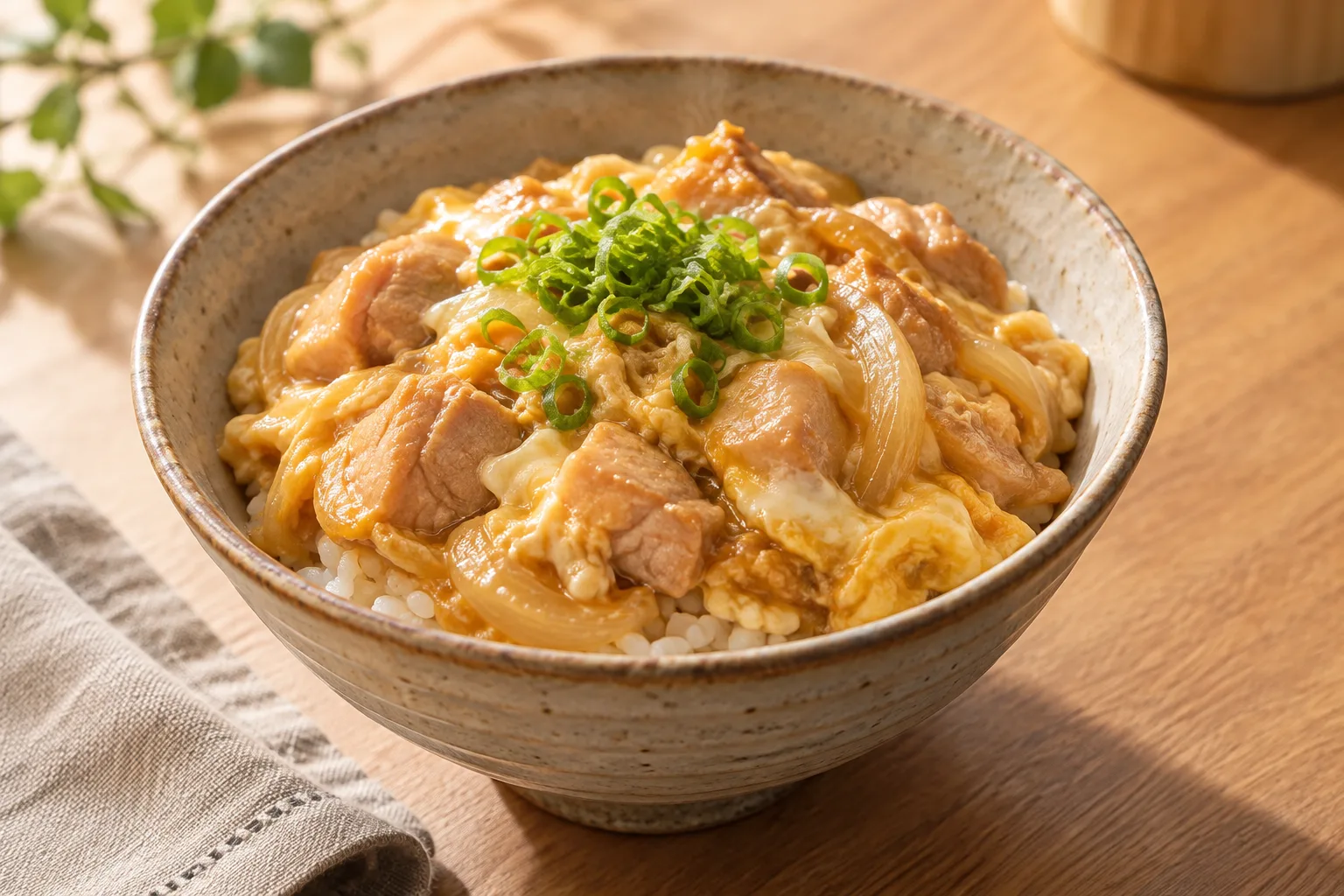
A bowl of rice topped with chicken and onion simmered in dashi, soy, mirin, sake, and sugar, then finished with egg. Serves 4; preparation times are estimates.
Oyakodon combines chicken and egg over hot rice. In this version, the egg is added in two batches so it stays tender and slightly wobbly. Have the Japanese rice cooked before you begin.
Ingredient allergens
Allergen listDocumented presence
-
Soybeans
Soy sauce
Depends on the product
-
Cereals containing gluten
Soy sauce
Ingredients without verified allergen data 8
Ingredients without verified allergen data: Cooked Japanese rice, Chicken, Onion, Eggs, Dashi, Mirin, Sake, Sugar.
Method
- 01
Prepare the ingredients
Cut the chicken into evenly sized pieces and the onion into thin slices. Lightly beat the eggs, leaving them not quite fully blended.
Ready to continue when: The chicken is in even pieces, the onion is thinly sliced, and the eggs are only lightly mixed.
10 min - 02
Make the sauce
In a deep skillet or small saucepan, combine the dashi, soy sauce, mirin, sake, and sugar. Heat over medium until it gently simmers and the sugar dissolves.
Ready to continue when: The sugar has dissolved and the sauce is gently simmering.
2 min - 03
Cook the chicken and onion
Arrange the chicken in the sauce and cook over medium heat, turning it occasionally. When it is nearly cooked, add the onion and cook until soft and translucent.
Ready to continue when: The chicken is cooked and the onion is soft and translucent.
8 min - 04
Add the egg
Lower the heat. Pour half the egg over the chicken and onion, cover, and cook until it begins to set. Drizzle in the rest, cover again, and cook until set at the edges but tender in the center.
Ready to continue when: The egg is set at the edges and still tender in the center.
2 min - 05
Serve
Divide the hot rice among four bowls and top with the chicken, onion, and egg mixture, spooning over the sauce from the pan.
Ready to continue when: Each bowl has hot rice topped with chicken, onion, egg, and sauce.
2 min
Ingredients
Sources and review
Content researched, cross-checked and automatically validated. Sources consulted:
- LA BIOTECNOLOGÍA PARA LA SEGURIDAD ALIMENTARIA, ECONÓMICA Y LA GEOPOLÍTICA doi.org/10.37885/221211159
- Por qué el Sáhara Occidental es una pieza clave para la seguridad alimentaria mundial doi.org/10.64628/aao.swhdr6qsf
- SEGURIDAD ALIMENTARIA INFORME DE AESAN - IDELABINGENIERIA idelabingenieria.com/seguridad-alimentaria-informe-de-aesan-sobre-el-tratamiento-termico-de-…
- Combinaciones tiempo-temperatura para el cocinado seguro de los alimentos - ELIKA www.elika.eus/es/combinaciones-tiempo-temperatura-para-el-cocinado-seguro-de-los-alimentos/
- Tabla de temperaturas de seguridad alimentaria | Alimentia www.alimentiaformacion.com/blog/tabla-temperaturas-seguridad-alimentaria
- Cocinando a baja temperatura: claves para aplicar la técnica sous vide de manera segura - AZTI www.azti.es/blog/claves-para-aplicar-la-tecnica-sous-vide-de-manera-segura/
- Tratamiento térmico de los alimentos y temperaturas de conservación y regeneración | restauracioncolectiva.com www.restauracioncolectiva.com/n/tratamiento-termico-de-los-alimentos-y-temperaturas-de-conse…
- Informe del Comité Científico de la Agencia Española ... - CAIB www.caib.es/sites/seguretatalimentaria/es/documentos_de_interes/archivopub.do?ctrl=MCRST3305…
- ¿Cómo afecta la temperatura a la seguridad de los alimentos? | Comunidad de Madrid www.comunidad.madrid/salud/afecta-temperatura-seguridad-alimentos
- Receta del ‘oyakodon’ | Nippon.com www.nippon.com/es/articles/-/37331
- Oyakodon (receta) - EcuRed ecuadmin.ecured.cu/Oyakodon_(receta)
- Oyakodon del Big Green Egg - pollo a la parrilla y huevo con arroz. www.biggreenegg.eu/es/inspiracion/recetas/oyakodon
- OYAKODON: APRENDA A HACER ESTA RECETA JAPONESA CASERA japanhousesp.com.br/es/jhsponline/oyakodon-aprendea-a-fazer-esta-caseira-receita/
- Oyakodon – iRASSHAi irasshai.co/es/blogs/recettes-japonaises/recette-oyakodon
- Oyakodon - Wikipedia, la enciclopedia libre es.wikipedia.org/wiki/Oyakodon
State: Published after documentary validation; no “Tested” label is shown.