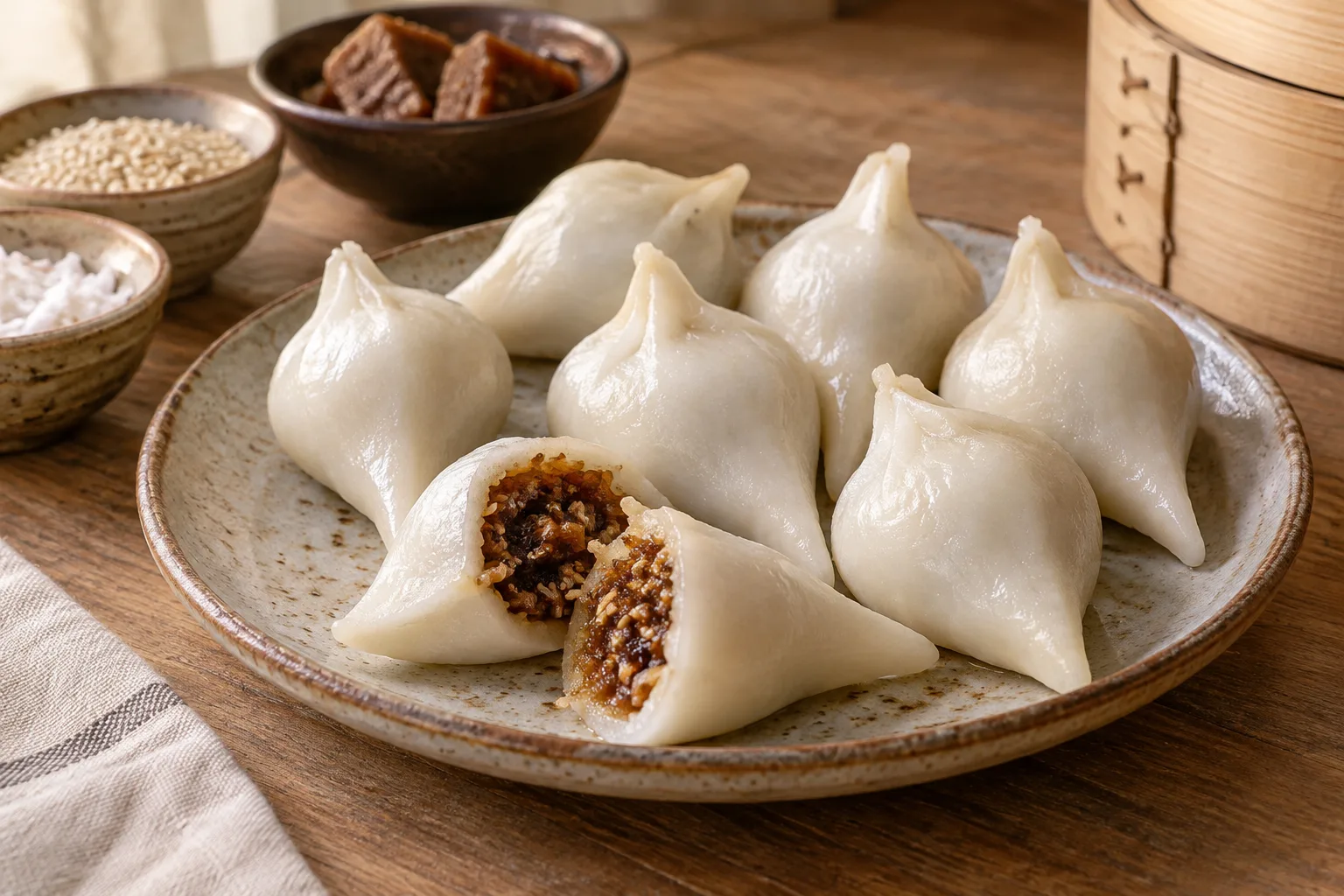
Nepali yomari with chaku and sesame
Newar rice-flour dumplings filled with chaku, sesame and coconut, then steamed. Makes about 12–14 pieces, or roughly 4 servings.
Yomari is a Newar sweet associated with the Kathmandu Valley. This version has a filling of chaku—palm sugar—and sesame. Preparation times are approximate; the dough’s feel and texture are useful guides.
Ingredient allergens
Allergen listDocumented presence
-
Sesame
Sesame seeds
Ingredients without verified allergen data 9
Ingredients without verified allergen data: Fine rice flour, Water, Salt, Ghee for the dough, Chaku (palm sugar), Fresh coconut, Ghee for the filling, Ground green cardamom, Nutmeg.
Method
- 01
Toast the sesame
Toast the sesame seeds in a dry skillet over medium heat for 2–3 minutes, stirring, until lightly golden and fragrant. Transfer them to a plate to cool.
Ready to continue when: The seeds are lightly golden and smell nutty.
3 min - 02
Make and cool the filling
Melt the ghee in a small saucepan over low heat. Add the chaku and stir for 2–3 minutes until melted and thick. Remove from the heat and stir in the toasted sesame, coconut, cardamom and nutmeg. Spread the mixture on a plate and let it cool.
Ready to continue when: The chaku is melted and thick; the cooled filling is sticky and can be portioned.
5 min - 03
Mix and rest the dough
Combine the rice flour and salt in a heatproof bowl. Bring 1 cup of the water and the dough ghee to a boil, then pour over the flour, stirring with a wooden spoon until a shaggy dough forms. Cover and rest for 5 minutes.
Ready to continue when: The flour is hydrated and has formed a shaggy dough beneath the cover.
5 min - 04
Knead the dough
When the dough is cool enough to handle, knead it for 4–5 minutes until smooth and pliable. If it feels dry or cracks, wet your fingers with hot water and knead a little more; reserve the remaining water to adjust the texture. Keep the dough covered.
Ready to continue when: The dough is smooth and pliable and does not crack when pressed.
5 min - 05
Shape the yomari
Divide the dough into small portions. Roll each into a ball and flatten it into an oval. Put a teaspoon of cooled filling in the centre; bring the edges together over the filling and taper one end to make the traditional shape. Seal the joins and cover the dumplings as you finish shaping them.
Ready to continue when: Each dumpling is sealed around its filling and holds its shape when set on the tray.
15 min - 06
Steam
Bring the water in the base of a steamer to a boil. Lightly oil the basket or line it with baking parchment or a banana leaf. Arrange the yomari with space between them, cover and steam for 12–15 minutes.
Ready to continue when: The dough changes from opaque white to glossy and slightly translucent.
15 min - 07
Rest and serve
Switch off the heat and leave the yomari in the covered steamer for 5 minutes. Serve warm.
Ready to continue when: After resting, the dough feels firm and the yomari are served warm.
5 min
Ingredients
Sources and review
Content researched, cross-checked and automatically validated. Sources consulted:
- Por qué el Sáhara Occidental es una pieza clave para la seguridad alimentaria mundial doi.org/10.64628/aao.swhdr6qsf
- SEGURIDAD ALIMENTARIA INFORME DE AESAN - IDELABINGENIERIA idelabingenieria.com/seguridad-alimentaria-informe-de-aesan-sobre-el-tratamiento-termico-de-…
- Combinaciones tiempo-temperatura para el cocinado seguro de los alimentos - ELIKA www.elika.eus/es/combinaciones-tiempo-temperatura-para-el-cocinado-seguro-de-los-alimentos/
- Descubrir la cocina nepalí - Nepal Sonríe nepalsonrie.org/descubrir-la-cocina-nepali/
- HIGIENE Y SEGURIDAD ALIMENTARIA EN araven.com/wp-content/uploads/2022/04/Araven-Gui%CC%81a-Higiene-y-seguridad-alimentaria-en-m…
- Cocina Newari: El Patrimonio Gastronómico de Nepal | Remitly www.remitly.com/blog/es/comida/cocina-newari/
- Evaluación de tiempos y temperaturas en la conservación de pulpa de piña amarilla (Ananas comosus) | Revista Científica INGENIAR: Ingeniería, Tecnología e Investigación. ISSN: 2697-3693. journalingeniar.org/index.php/ingeniar/article/view/478
- Gastronomía de Nepal - Wikipedia, la enciclopedia libre es.wikipedia.org/wiki/Gastronom%C3%ADa_de_Nepal
- Temperatura de conservación de alimentos: tabla completa por producto anukys.com/temperatura-conservacion-alimentos/
- EVALUACIÓN DE TIEMPOS Y TEMPERATURAS EN LA ... journalingeniar.journalgestar.org/index.php/ingeniar/article/download/478/586
- Temperaturas de conservación de alimentos por país | EpiSensor episensor.com/es/base-de-conocimientos/temperaturas-de-conservacion-de-alimentos-por-pais
- - YouTube www.youtube.com/watch?v=nAToJ6FWoqM
- Yomari (Newari Sweet Steamed Rice Dumplings) · Nepali Taste nepalesetaste.com/recipes/yomari/
- Yomari Recipe | Authentic Nepalese Food www.theworldonaplate.co.uk/recipes/nepalese-yomari
- Yomari: origen, ingredientes y alérgenos www.menuella.com/es/food-wiki/yomari
State: Published after documentary validation; no “Tested” label is shown.