Mooncakes with Apricot and Dates
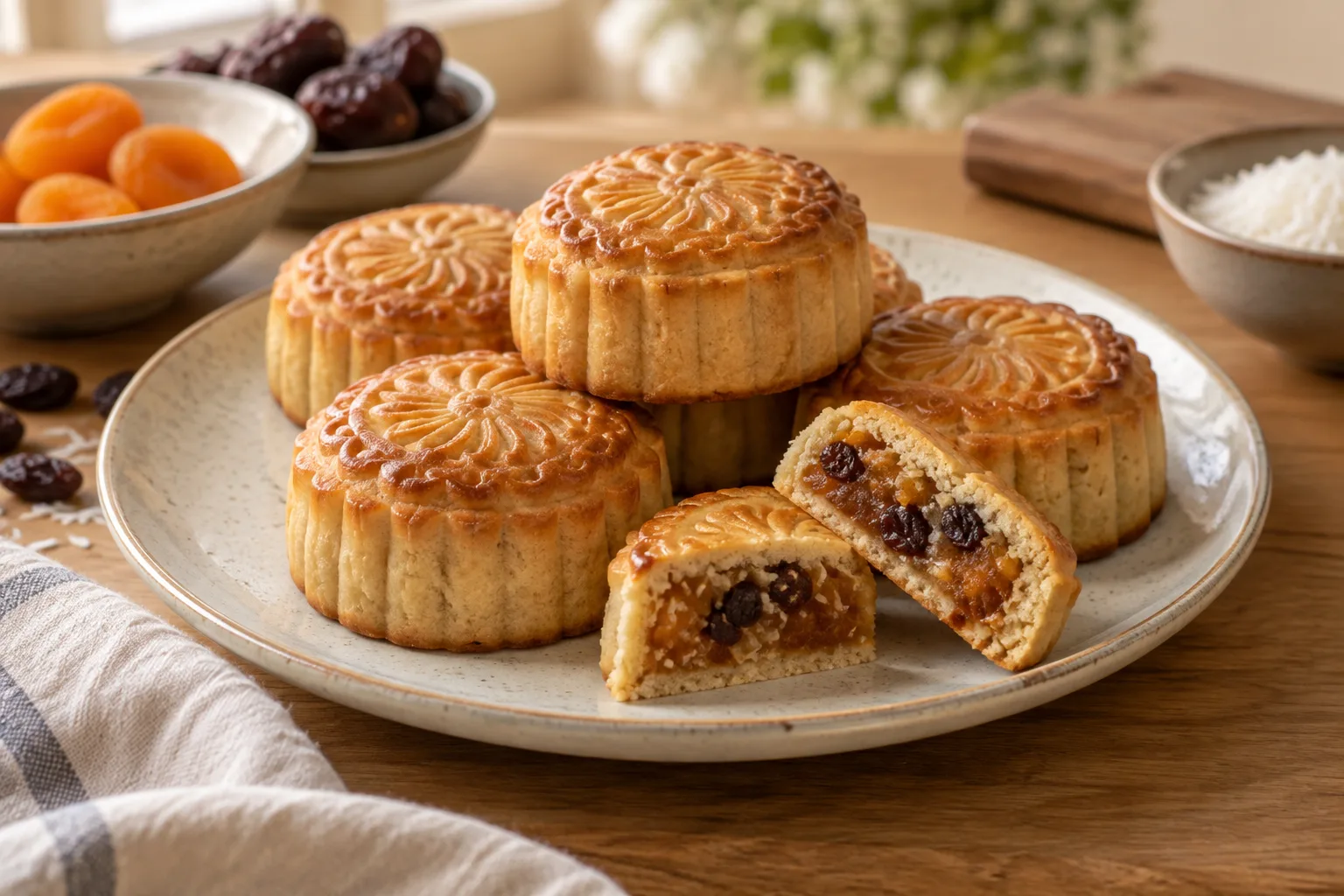
Chinese baked pastries with a tender dough and a sweet filling of apricot jam, dates, coconut, and raisins. The recipe makes approximately 15–20 pieces; serving and preparation-time estimates are approximate.
These mooncakes have a fruit filling wrapped in dough enriched with egg, milk powder, and butter. Shape them with a mooncake mold or press them gently to flatten. Resting the dough overnight is optional and makes it easier to handle.
Ingredient allergens
Allergen listDocumented presence
-
Milk and milk products
Dry milk powder
-
Eggs
Egg for the glaze
Depends on the product
-
Cereals containing gluten
Baking powder
Ingredients without verified allergen data 11
Ingredients without verified allergen data: Flour, Salt, Eggs for the dough, Sugar, Unsalted butter, Vanilla extract, Apricot jam, Dried dates, Sweetened dried shredded coconut, Raisins, Water.
Method
- 01
Mix the dough
In a bowl, combine the flour, milk powder, baking powder, and salt. In another bowl, beat the eggs for the dough with the sugar for about 5 minutes. Mix in the unsalted butter and vanilla extract. Add the dry ingredients to the wet mixture and combine until a uniform dough forms; knead it gently on a floured surface.
Ready to continue when: The dough is even, with no visible dry patches.
15 min - 02
Rest the dough
Shape the dough into a log and refrigerate it, well covered, overnight if convenient; this rest is optional and will make it more pliable. If you do not refrigerate it overnight, continue when the dough can be handled without tearing easily.
Ready to continue when: The dough is cool and can be handled without falling apart.
480 min - 03
Prepare the filling
Mix the apricot jam, dried dates, sweetened dried shredded coconut, and raisins. If the jam has large pieces, mash them with a fork to make the filling more even.
Ready to continue when: The filling is mixed, with its ingredients evenly distributed.
5 min - 04
Shape the pastries
Preheat the oven to 190 °C and line baking trays with baking paper. Divide the dough into 15–20 portions and flatten each into a circle, leaving the center a little thicker than the edges. Place a portion of filling in the center, wrap the dough around it, and seal it well. Shape it into a ball, flatten it slightly, and press it with a floured mooncake mold. Arrange the pieces on the trays.
Temperature: 190 °C / 374 °FReady to continue when: The pastries are sealed, the mold pattern is visible, and the pieces are spaced on the trays.
20 min - 05
Brush and bake
Lightly beat the egg for the glaze with the water. Brush a thin layer over each pastry. Bake at 190 °C for about 30 minutes, until golden.
Temperature: 190 °C / 374 °FReady to continue when: The pastries are golden on the surface and hold their shape.
30 min - 06
Cool
Remove the trays from the oven and let the pastries cool before serving or storing them.
Ready to continue when: The pastries feel cool to the touch and lift from the tray without deforming.
20 min
Ingredients
Sources and review
Content researched, cross-checked and automatically validated. Sources consulted:
- LA BIOTECNOLOGÍA PARA LA SEGURIDAD ALIMENTARIA, ECONÓMICA Y LA GEOPOLÍTICA doi.org/10.37885/221211159
- Costa Rica - Wikipedia, la enciclopedia libre es.wikipedia.org/wiki/Costa_Rica
- Acrilamida www.aesan.gob.es/seguridad-alimentaria/contaminantes-quimicos/acrilamida
- Análisis de las técnicas culinarias ancestrales para su aplicación en elaboraciones de la cocina cuencana | OpenAlex openalex.org/W2343952597
- Estrategia educativa intercultural comunal desde la soberanía alimentaria en la galería Alameda de Cali | OpenAlex openalex.org/W7112747295
- Pastel de luna - EcuRed www.ecured.cu/index.php?oldid=2988903&title=Pastel_de_luna
- ¿Cómo elegir y almacenar pasteles de luna de forma segura? www.vietnam.vn/es/lua-chon-bao-quan-banh-trung-thu-the-nao-cho-an-toan
- Pastel de luna(uno de los alimentos típicos de la temporada del Festival del Medio Otoño)_Baidu Enciclopedia baike.baidu.com/es/item/Pastel%20de%20luna/715645
- Pasteles de luna: tipos, rellenos y tradiciones del Festival del Medio Otoño www.chinaculturepro.com/es/pasteles-de-luna/
- Mooncakes o Pasteles de Luna, ¡bienvenido, Otoño! - Jaleo en la Cocina www.jaleoenlacocina.com/2021/09/mooncakes-o-pasteles-de-luna.html
- ¿Cuánto tiempo puede reposar el pastel? -Suzhou Fulan dulce comida Co., Ltd. www.fulansweet.com/es/How-Long-Can-Cake-Sit-Out-id49980306.html
- ¿Cómo conservar por más tiempo los pasteles en domos de PET? - eco ambiental ecoambientalmx.com/como-conservar-por-mas-tiempo-los-pasteles-en-domos-de-pet/
- Doscientos años de pasteles de luna hechos a mano_CCTV.com Español_央视网(cctv.com) espanol.cctv.com/2016/09/15/VIDEcxhN7XI2LVPjfxTH6xDe160915.shtml
- Pastel de Luna, cómo hacer una versión occidentalizada de la receta tradicional del Mooncake chino. Vídeo | Gastronomía & Cía www.gastronomiaycia.com/pastel-de-luna-como-hacer-una-version-occidentalizada-de-la-receta-t…
- Revista del comité científico de la Aecosan número 28 www.aesan.gob.es/dam/jcr:bf627e5a-e67a-4013-bd5e-23dfa618339b/PROSPECTIVOS_QUIMICOS.pdf
- Diferencia entre revisiones de «Pastel de luna» - EcuRed www.ecured.cu/index.php?diff=next&oldid=2986649&title=Pastel_de_luna
State: Published after documentary validation; no “Tested” label is shown.